Chiffon is the floaty, see-through layer on bridesmaid dresses, the sheer sleeve on a blouse and the scarf that never quite stays put in a breeze. It looks delicate because it is. If you have been wondering what is chiffon fabric beyond “that sheer stuff,” the answer is precise: a lightweight, sheer plain weave made from tightly twisted yarns, originally silk and today usually polyester.
The fiber matters more than most labels let on. Silk chiffon and polyester chiffon can look alike on the bolt, then behave very differently in the wash, under an iron and on your skin. This guide covers how chiffon is built, how the common fibers compare, what it does best, how to sew it without tears, and how to clean it so it keeps its drift.
Chiffon at a glance
- Construction
- Sheer plain weave of high-twist crepe yarns
- Fibers
- Silk (original), polyester, nylon, rayon, sometimes cotton
- Feel
- Very light, slightly rough, fluid drape
- Best for
- Overlays, blouses, scarves, saris and dupattas
- Tricky part
- Slippery to cut and frays easily
- Care
- Silk usually dry clean; polyester gentle wash
On this page
How chiffon gets its float
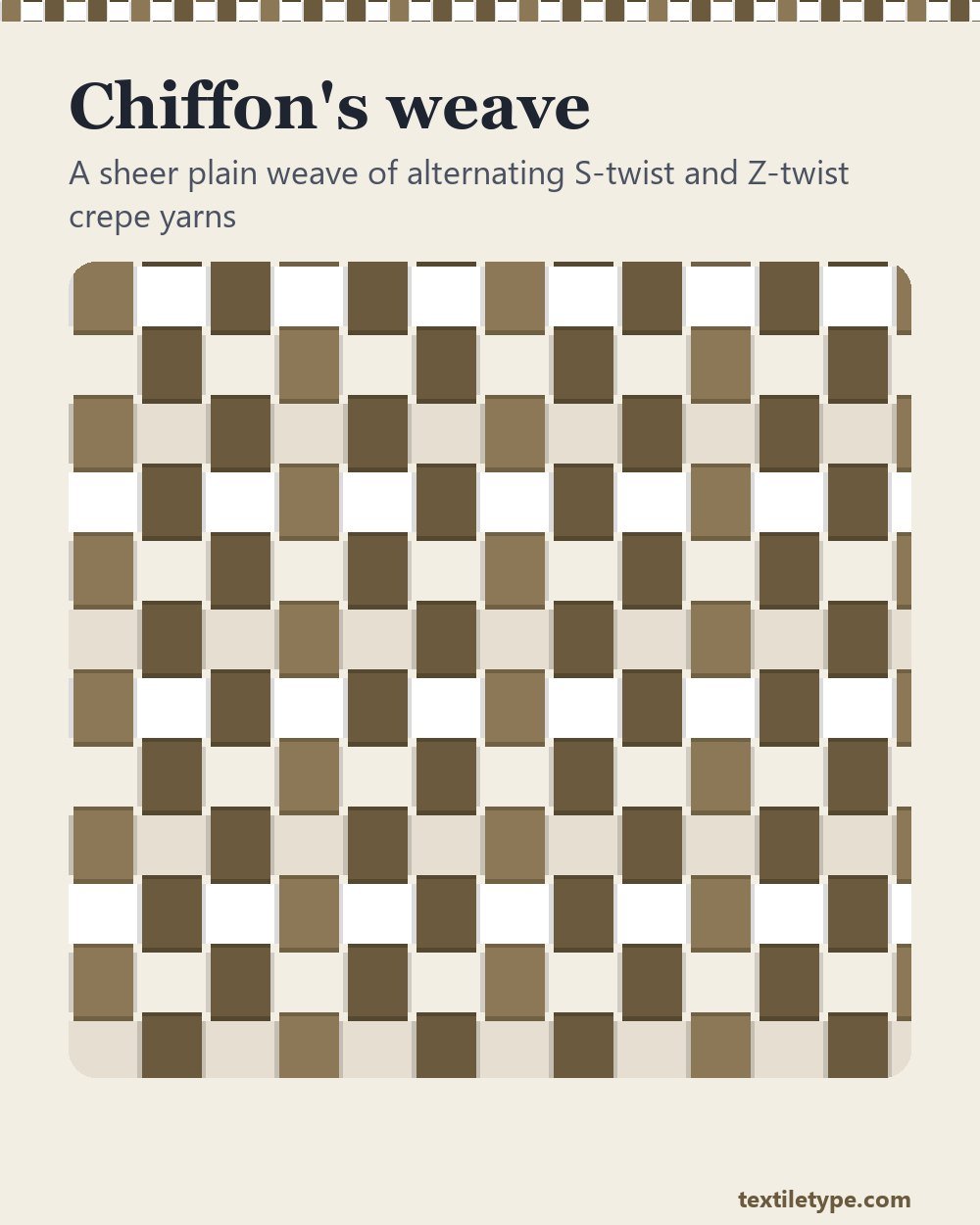
Two things make chiffon what it is: the yarn and the spacing. The weave is the simplest there is, a plain weave where each crosswise yarn passes over one lengthwise yarn and under the next. Britannica describes chiffon as a lightweight, sheer fabric of plain weave, usually of silk or one of the synthetic fibers.
The yarns are where it gets interesting. Chiffon uses crepe yarns, which are twisted much more tightly than ordinary yarns. Weavers alternate yarns twisted in opposite directions (called S-twist and Z-twist, after the slant of the spiral). After weaving, that stored twist makes the cloth pucker very slightly in both directions. The result is a faintly grainy surface, a little give, and a drape that pours rather than folds. Held up to a magnifier, chiffon looks a lot like fine netting.
The name comes from the French “chiffe,” meaning cloth or rag. A humble origin for a fabric that now mostly appears at weddings.
A short explainer on why chiffon feels so light, a good visual companion to the construction notes above.
Silk chiffon vs polyester chiffon (and the rest)
Walk into a fabric store and most of the chiffon on the shelves will be polyester. Silk chiffon still exists and is still the prestige version, at a noticeably higher price. Here is how the usual fibers tend to compare. These are general tendencies; yarn quality and finishing vary a lot between mills.
| Fiber | Look and feel | Strengths | Watch out for | Usual care |
|---|---|---|---|---|
| Silk chiffon | Soft hand, gentle sheen | Takes dye beautifully, luxurious drape | Delicate, water spots, high price | Usually dry clean |
| Polyester chiffon | Slightly crisper, can look shinier | Affordable, resilient, resists wrinkles | Can scorch or melt under a hot iron | Hand wash or gentle cycle |
| Nylon chiffon | Light and smooth | Lower cost than silk | Heat sensitive | Gentle wash, low heat |
| Rayon (viscose) chiffon | Soft, slightly glossy | Silk-like softness at lower cost | Weaker when wet, may shrink | Follow label, often hand wash or dry clean |
| Cotton chiffon | Matte | Breathable | Less common to find | Follow label |
If you are drawn to polyester for price and easy care, our polyester fabric guide explains how the fiber handles heat and sweat. If a label says rayon or viscose, the viscose guide covers why that fiber needs a softer touch when wet.
A short history: from silk luxury to everyday polyester
- The silk era. Early chiffon was pure silk and very expensive, which kept it in wealthy wardrobes.
- 1938. Nylon chiffon was introduced, bringing the price down.
- 1958. Polyester chiffon arrived and became hugely popular for its resilience and low cost.
- Today. Polyester dominates everyday chiffon, while silk chiffon remains the luxury option for couture and bridal work.
Sources disagree on exactly when silk chiffon first appeared in Europe, so we will leave that date to the historians and stick with the ones that are well documented.
What is chiffon fabric used for?
Chiffon is chosen for movement and transparency, so it ends up where you want a garment to float. In Western fashion it is mainly used for evening wear, often as an overlay on a more opaque base so a gown looks airy without being see-through. It also turns up in blouses, scarves, ribbons and lingerie. In India, chiffon is a popular choice for saris and dupattas.
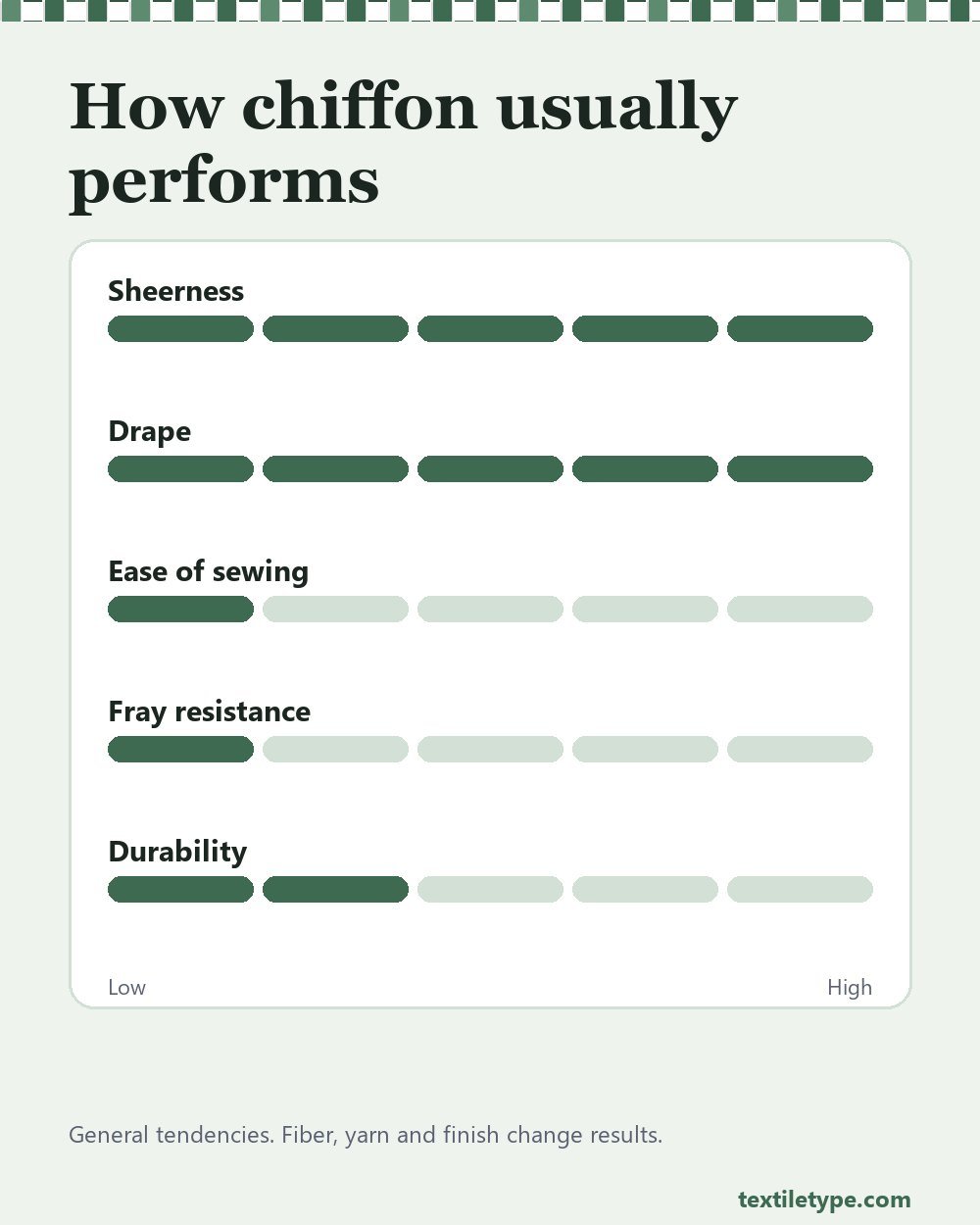
What chiffon is less good at is structure. It will not hold a crisp shape on its own, and it does not stand up to friction well. For a stiff sheer that holds a silhouette, designers usually reach for organza. For a firmer, mesh-like sheer, tulle is the usual pick. Chiffon is the one that sways.
Chiffon vs georgette, briefly
Chiffon’s closest relative is georgette, and shops often shelve them side by side. Both are sheer, both use crepe yarns, and both come in silk and polyester. The short version: chiffon is smoother, a little more lustrous and more transparent, while georgette has a grainier, more crinkled surface and a springier, slightly heavier feel. If you want maximum float and sheen, chiffon is the usual choice. If you want something a touch more opaque with a grainier hand, georgette is worth a look.
Sewing chiffon step by step
Chiffon has a reputation as a beginner’s nightmare. It slides off the table, shifts under scissors and frays the moment you look at it. The fixes are mostly about slowing down and stabilizing the cloth.
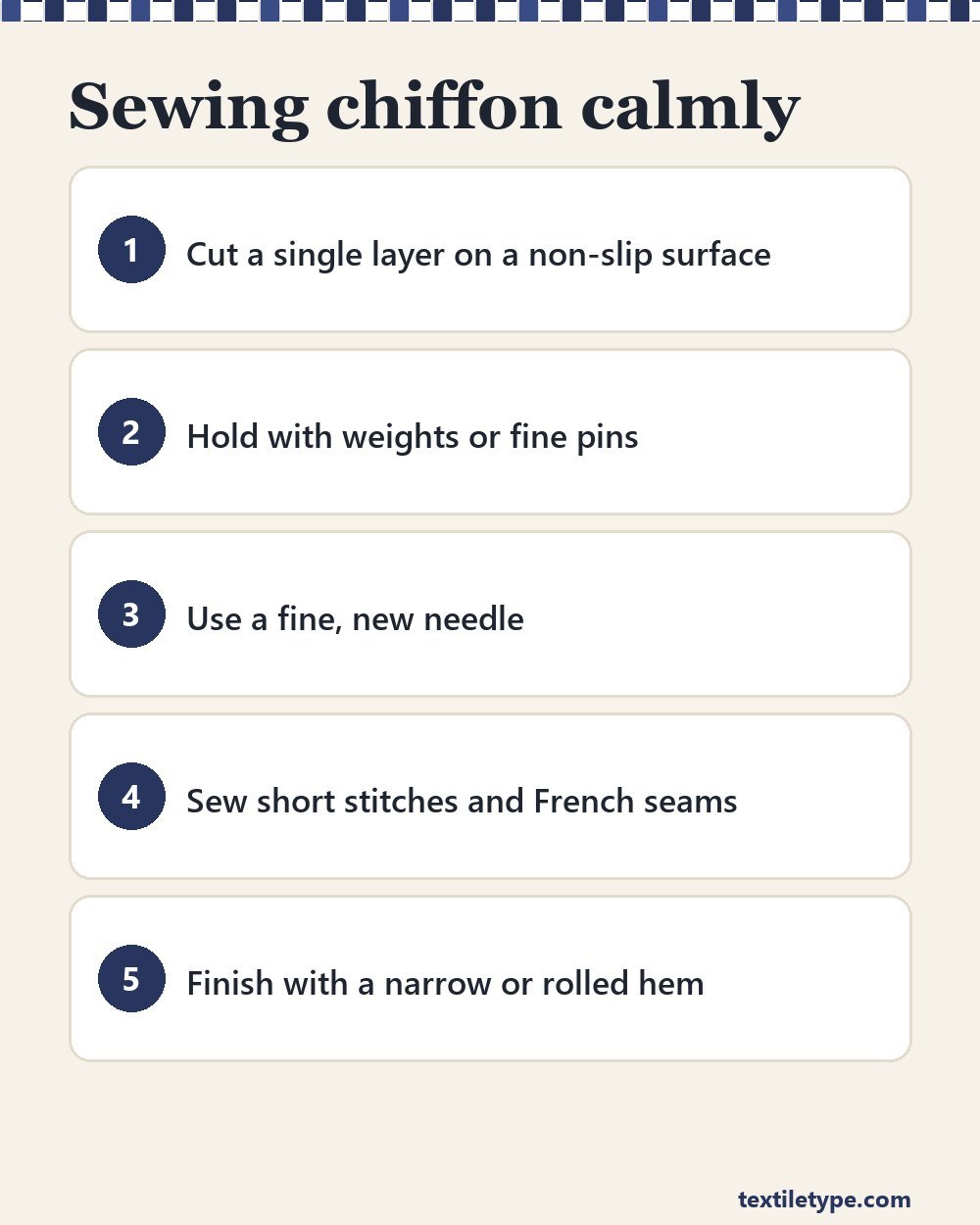
- Cut one layer at a time on a non-slip surface. Many sewists lay tissue paper underneath, or sandwich the fabric between tissue sheets, to stop it sliding.
- Use a rotary cutter or serrated shears. Both grip slippery cloth better than standard blades.
- Hold it with weights or very fine pins, and keep pins inside the seam allowance so holes do not show.
- Fit a fine, new needle. Mood Fabrics suggests a size 9 or 10 or a Microtex needle, with fine thread and a shorter stitch than usual (roughly 10 to 15 stitches per inch).
- Enclose every raw edge. French seams hide fraying edges inside a neat tube, and a rolled or narrow hem keeps the hem light.
- Tie off threads by hand instead of backstitching, which can bunch fine fabric.
A sewing teacher walks through handling chiffon at the machine, ideal before your first project.
If you need interfacing, use the lightest, softest type you can find, or a layer of chiffon or organza, so you do not kill the drape. Pre-treat washable chiffon the way you plan to clean the finished garment before you cut.
Washing, drying and pressing chiffon
Start with the care label and the fiber line. Silk chiffon is usually marked dry clean, and that is the safest route for anything structured, beaded or lined. Polyester and nylon chiffon can usually be hand washed or put through a delicate cycle.
- Wash cool and gentle. Use a mild detergent and swish rather than scrub.
- Do not soak for long. Long soaks can pull dye from sheer fabrics.
- Never wring. Silk is weaker when wet, so roll the piece in a towel to press out water.
- Dry flat or on a padded hanger, out of direct sun.
- Press low and slow. Use a low heat setting and a press cloth; for silk, press from the wrong side at the silk setting with a dry iron.
- Skip chlorine bleach on silk chiffon entirely.
Buying chiffon: a shop checklist
Chiffon prices range from a few dollars a yard to luxury territory, and the label tells you most of what you need. Copy this list to your phone before a fabric run.

- Check the fiber line: silk, polyester, nylon or rayon
- Hold it to the light to judge how sheer it really is
- Scrunch a corner and release to see how fast wrinkles drop
- Look at the cut edge to see how quickly it frays
- Buy extra yardage for French seams and a lining
- Pick a lining color before you leave the store
Chiffon is close to the opposite of a sturdy twill: it trades durability for movement, so a lining usually does the structural work. For more fabric options, browse all Textile Type fabric guides.
Chiffon FAQ
Is chiffon a silk?
Chiffon is a fabric construction, so it can be silk but often is not. The original chiffon was silk, and silk chiffon is still sold, but most chiffon today is polyester. Check the fiber content on the label.
Is chiffon see-through?
Yes, chiffon is sheer by design. That is why it is usually layered over a lining or used as an overlay, scarf or sleeve rather than as a single layer for a whole dress.
Is chiffon stretchy?
It has a little give from its high-twist crepe yarns, but it is a woven fabric, not a stretch fabric. Do not count on it to stretch over the body the way a knit does.
Can you machine wash chiffon?
Polyester and nylon chiffon can often go on a delicate cycle in a mesh bag if the label allows. Silk chiffon is usually best dry cleaned or very gently hand washed if the label permits it.