Twill is the weave behind your jeans, your chinos and quite possibly the trench coat hanging by the door. Those fine diagonal lines you can see on a pair of khakis are the giveaway. The short answer to what is twill fabric: it is any cloth woven so that each crosswise yarn shifts over by one thread on every row, which stacks the crossings into slanted ridges.
That means twill describes how a fabric is built, and the fiber can be cotton, wool, silk, polyester or a blend. Below you will learn how the weave works, how to read numbers like 2/1 and 3/1, which everyday fabrics belong to the twill family, how cotton twill compares with flat plain-woven cotton, and how to spot a twill in a shop in about five seconds.
Twill at a glance
- What it is
- A weave structure, one of the three basic weaves
- Signature look
- Diagonal ridges, called wales
- Common fibers
- Cotton, wool, silk, polyester, blends
- Classic examples
- Denim, chino, gabardine, serge, herringbone
- Known for
- Durability, good drape, hiding small stains
- Care
- Set by the fiber, not the weave
On this page
What is twill fabric made of?
Anything that can be spun into yarn. Britannica lists twill as one of the three basic textile weaves, alongside plain weave and satin, and defines it by its diagonal rib, ridge or wale. Nothing in that definition mentions fiber, which is why you can buy cotton twill, wool twill, silk twill and polyester twill without any of them being a contradiction.
In practice, certain pairings show up again and again. Cotton twill gives you chinos, denim and drill. Wool twill gives you serge and gabardine suiting. Silk twill turns up as surah and foulard, the smooth, slightly ribbed cloth used for ties and scarves. Synthetic and blended twills appear as linings and easy-care trousers, and drapey viscose twill is common in fashion pieces (our viscose fabric guide covers how that fiber behaves).
The word itself is old. Most dictionaries trace “twill” to the Old English “twilic,” meaning two-threaded, a word possibly modeled on the Latin “bilix.” Weavers have clearly been making the diagonal for a very long time, and the name has outlasted the language it was born in.
How the twill weave works
Every woven fabric has two sets of yarns. The warp runs lengthwise and is held under tension on the loom. The weft (also called filling) runs crosswise and is passed over and under the warp. In a plain weave the weft goes over one warp yarn and under the next, a simple checkerboard.
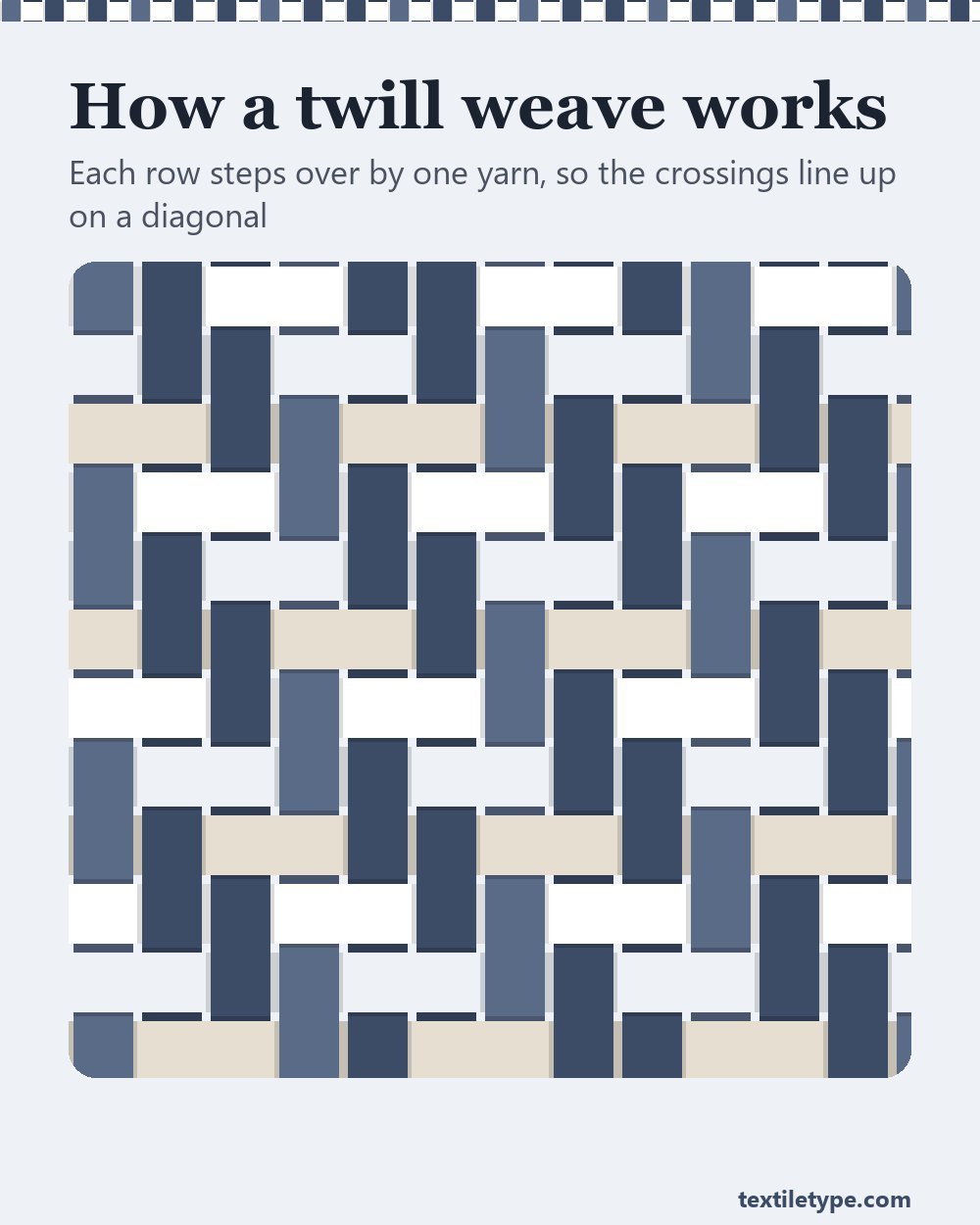
In a twill weave, the weft passes over one or more warp yarns and then under two or more. The key move is the offset: each new row starts one yarn further along than the row before. That small step, repeated row after row, lines the crossing points up into a diagonal. In a regular twill, Britannica notes, the line usually climbs from lower left to upper right at about 45 degrees.
Reading twill numbers like 2/1 and 3/1
Fabric specs often describe a twill as a fraction. The first number is how many warp yarns are lifted over each weft pass, and the second is how many stay down. A 2/1 twill is two up, one down. A 3/1 twill is three up, one down, the structure used for a lot of denim. By the same logic a plain weave is 1/1. Add the two numbers together and you get the minimum number of harnesses (the loom frames that lift the warp) needed to weave it, so a 2/1 twill needs at least three.
Warp-faced and even-sided twills
When the first number is bigger, more warp shows on the face, and the fabric is called warp-faced. Denim, chino, gabardine, drill and cavalry twill all fall in this group. When the numbers match, as in a 2/2 twill, warp and weft show about equally on both sides. Serge, herringbone, houndstooth and surah are typical even-sided twills.
Watch the twill weaving process on a loom to see the row-by-row offset happen in real time.
The twill family: fabrics you already own
Many fabric names you know are simply twills with a particular fiber, weight or finish. This table sorts the common ones. Treat the “usual fiber” column as typical, since mills make most of these in several fibers.
| Fabric | Usual fiber | Twill type | Where you see it |
|---|---|---|---|
| Denim | Cotton | Warp-faced, often 3/1, colored warp and pale weft | Jeans, jackets |
| Chino | Cotton | Warp-faced | Trousers, shorts |
| Drill | Cotton | Warp-faced, sturdy | Work trousers, aprons |
| Gabardine | Wool or cotton | Tight warp-faced twill | Trench coats, suits |
| Cavalry twill | Wool | Warp-faced, pronounced line | Trousers, outerwear |
| Serge | Wool | Even-sided | Suits, skirts |
| Herringbone | Wool, cotton | Broken twill that zigzags | Jackets, coats |
| Houndstooth | Wool | Even-sided, two colors | Jackets, skirts |
| Surah and foulard | Silk | Even-sided, fine | Ties, scarves |
Gabardine has the best backstory. According to the Victoria and Albert Museum, Thomas Burberry invented it in 1879 and patented it in 1888, using a tight twill woven from specially prepared yarn. Linen came first, and the classic version used fine cotton. That weatherproof cloth went on to become the trench coat, which is a lot of history for a fabric most people only notice when it rains.
Right-hand, left-hand and broken twills
The direction of the diagonal has names. In a right-hand twill (also called a Z-twill), the lines rise from lower left to upper right, like the middle stroke of a Z tipped on its side. In a left-hand twill (an S-twill), they rise toward the upper left. Turn any twill over and the direction reverses, because the back is a mirror of the face.
Weavers can also play with the line itself. Britannica points out that twill can be varied by changing the direction of the line, as in herringbone, or its angle. Herringbone reverses direction at regular intervals, so the ribs meet in a zigzag that looks like a fish skeleton. Steeper and flatter angles change the character of the cloth, and cavalry twill is known for a bold, raised line.
For shoppers, direction is mostly a style detail. For sewists it matters more: the diagonal is visible, so cut every piece from the same side of the fabric and keep the lines running the same way across seams.
Twill vs cotton: a weave and a fiber
People search “twill vs cotton” because shop labels mix the two. Cotton is a fiber. Twill is a way of weaving it. A pair of chinos can be 100% cotton and 100% twill at the same time. The comparison that actually helps is cotton twill against cotton in a plain weave, such as poplin or canvas.
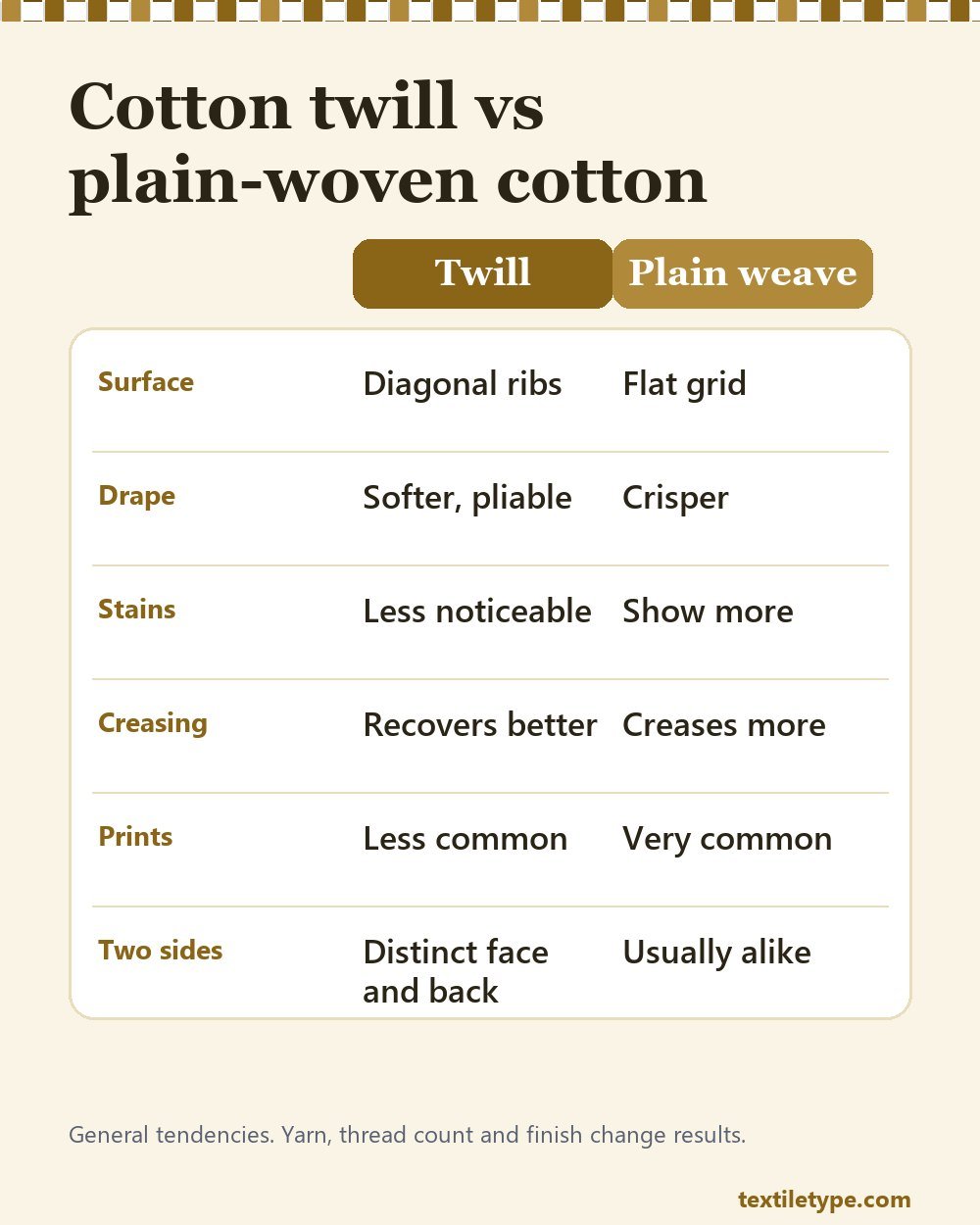
| Feature | Cotton twill (chino, drill) | Plain-woven cotton (poplin, canvas) |
|---|---|---|
| Surface | Diagonal ribs, slightly textured | Flat, even grid |
| Drape | Softer and more pliable | Crisper, holds a sharper shape |
| Stains | Less noticeable on the uneven surface | Show more readily |
| Creasing | Recovers from wrinkles better | Creases more easily |
| Prints | Printed less often | Very common for prints |
| Two sides | Distinct face and back | Usually looks the same on both |
Why the difference? A twill has fewer interlacing points than a plain weave, so the yarns can shift a little, which makes the fabric more pliable. Fewer crossings also let the yarns pack tightly, which is how mills make dense, hard-wearing twills. These are general tendencies, and yarn size, thread count and finishing can push any single fabric in either direction. If you are weighing cotton against other fibers entirely, our guides to linen and polyester cover how those fibers feel in both weaves.
A fabric retailer compares denim and twill side by side, useful if you are choosing yardage for trousers or a jacket.
What twill does well, and where it falls short
Twill earned its place in workwear and tailoring for practical reasons, but it is not the answer to every garment.
Where twill shines
- Durability. Tightly packed twills hold up to hard wear, which is why denim and drill became work fabrics.
- Forgiving surface. The ribbed texture disguises small stains and everyday grime.
- Wrinkle recovery. Twills tend to bounce back from creasing better than plain weaves.
- Drape. They hang more softly than a plain weave of similar weight.
- Weather resistance. Very dense twills, gabardine being the famous case, can resist wind and light rain better than open weaves.
Where it falls short
- Not very sheer. Sheer twills are rare, so look elsewhere for gauzy summer layers.
- Fewer prints. The ribbed surface is printed less often than flat plain weaves.
- A right and wrong side. The face and back differ, which sewists have to track carefully.
- Can feel warm in heavy weights. The same density that blocks wind also slows airflow.
How to tell if a fabric is twill
You do not need a magnifier for most twills, though very fine gabardines and silk twills can be subtle. Try this quick routine in a store or at home.

- Hold the fabric at an angle to a light so the surface texture throws small shadows.
- Look for parallel lines running on a slant. A plain weave shows a tiny grid instead.
- Turn it over. On a twill the diagonal runs the opposite way, and on warp-faced twills the back is often a different shade.
- Check a cut edge or seam allowance. Each crosswise yarn should skip over two or more lengthwise yarns, not just one.
Caring for twill: follow the fiber
Because twill is a structure, the care label is really talking about the fiber underneath. A cotton chino, a wool gabardine and a viscose twill blouse can share the same weave and need three different routines. Read the fiber content first, then the care symbols.
- Cotton twill (chinos, drill, most denim): usually machine washable, though cotton can shrink if the label says to keep things cool and you ignore it.
- Wool twill (serge, gabardine suiting): often dry clean only, so check the label before anything goes near water.
- Silk twill (ties, scarves): treat as delicate silk and follow the label, which is often dry clean.
- Polyester and blends: generally easy care, with a cool iron if needed.
- Viscose twill: gentle handling, since viscose is weaker when wet.
Twill’s knack for hiding marks has a downside: a stain you did not notice can set in the dryer. Give garments a quick look in good light before washing so you can pretreat anything that needs it. For more fiber-by-fiber advice, browse the full set of Textile Type fabric guides.
Twill FAQ
Is twill fabric the same as cotton?
No. Twill is a weave and cotton is a fiber. Plenty of twill is made from cotton, but wool, silk, polyester and blends are woven as twill too, so check the fiber content on the label.
Is denim a twill?
Yes. Denim is a warp-faced twill, very often a 3/1 structure with a colored warp and a pale weft. That is why the outside of jeans is blue and the inside is lighter.
Does twill wrinkle easily?
Twill generally recovers from creasing better than a plain weave of the same fiber. Fiber still matters most: a cotton or viscose twill will wrinkle more than a polyester one.
Which side of twill is the right side?
The face usually shows the more pronounced diagonal and is typically the more durable, better-looking side. On warp-faced twills such as denim, it is also the side where the warp color dominates.