Satin is a way of weaving, and that one fact clears up most of the confusion around it. A satin dress can be silk, polyester or nylon; the shine comes from how the yarns are laid, not what they are made of. So the real answer to what is satin fabric: any cloth woven with long, smooth yarn “floats” on the surface, which catch light in one direction and give that liquid gloss.
That is why a bargain polyester pillowcase and a pricey silk charmeuse slip can share a name while feeling and behaving nothing alike. This guide shows how the satin weave works, how to read a satin label, whether satin is breathable, the main types you will meet in shops, how satin differs from sateen and silk, and how to wash, press and sew it without leaving marks.
Satin at a glance
- What it is
- A weave (one of the three basic weaves), not a fiber
- Common fibers
- Silk, polyester, nylon; cotton versions are called sateen
- Look
- Glossy face, dull back
- Strength
- Drapes beautifully
- Weakness
- Long floats snag and rub
- Breathability
- Depends mostly on the fiber
On this page
What is satin fabric? A weave, not a fiber
Britannica lists satin as one of the three basic textile weaves, next to plain weave and twill, and notes that satin can be made from yarns other than the original silk. Satin was first woven in silk, and some definitions still reserve the word for silk. In everyday US shopping, though, “satin” describes the structure and the fiber is listed separately.
That separation is written into labeling law. Under the FTC’s textile labeling rules, a garment’s label must show the generic fiber names and their percentages by weight, in order of predominance. “Satin” is not a fiber, so it never appears in that line. Here is how to decode what you see on tags and listings.
| You see | What it usually means |
|---|---|
| “100% silk” on a satin blouse | Silk woven in a satin structure, often sold as silk satin or charmeuse |
| “100% polyester” on a satin dress | Polyester satin, sometimes called polysatin |
| “Nylon” on lingerie satin | Nylon filament woven as satin |
| “Satin” with no fiber listed (online) | Ask or check the label photo; it could be any fiber |
| “Cotton sateen” on sheets | Cotton in a satin-type weave; spun cotton yarns earn the name sateen |
How the satin weave makes shine
In a satin weave, one set of yarns passes over four or more yarns of the other set before dipping under a single one. Those long stretches on the surface are called floats. The interlacing points are spread out so they never touch or line up into a visible diagonal, which is the key difference from twill. With so few interruptions, the surface is smooth enough to reflect light in one direction instead of scattering it, and you get gloss.
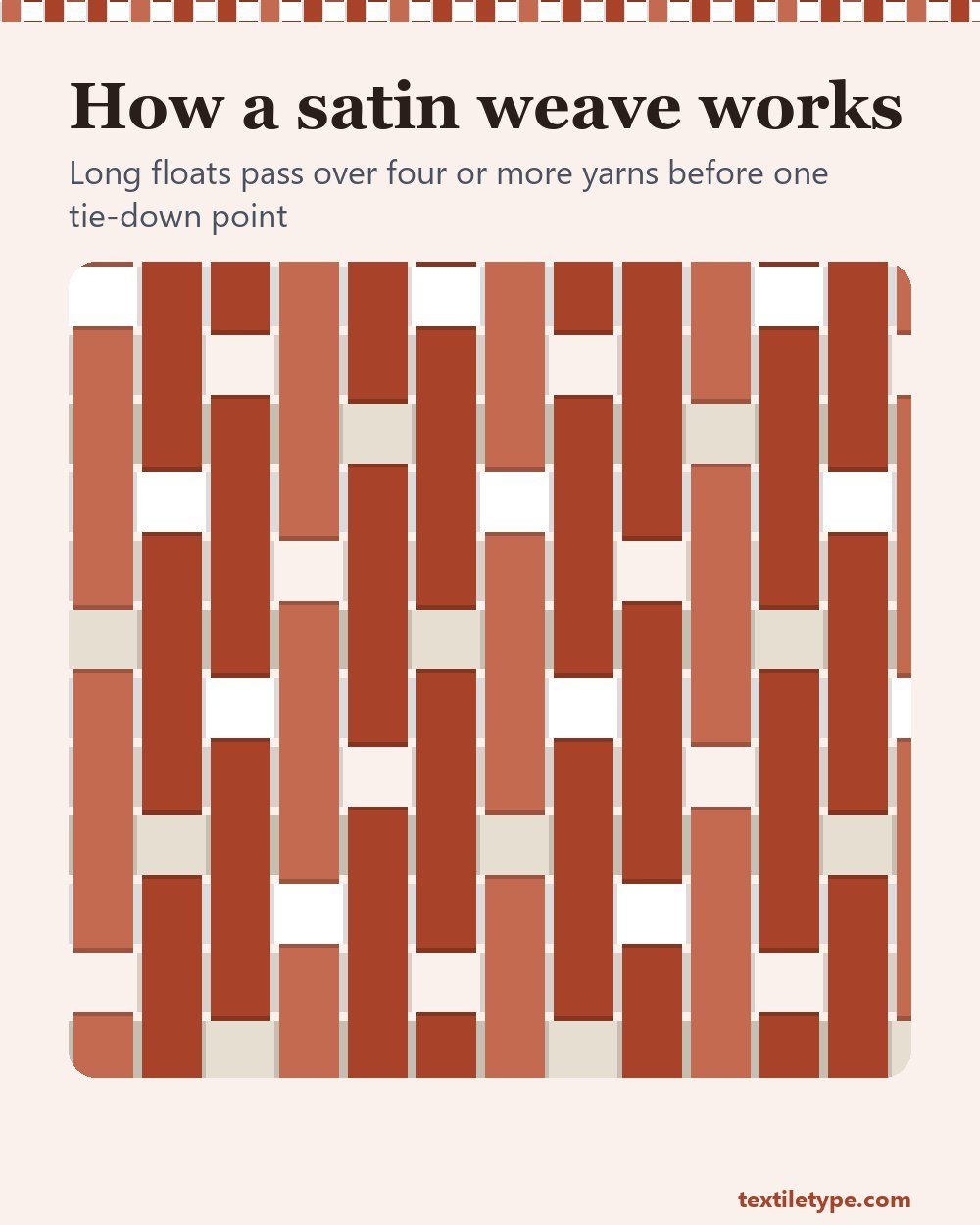
According to Britannica, a true satin needs at least five warp and five weft yarns in each repeat of the pattern, which means a loom with at least five harnesses (the frames that lift groups of lengthwise yarns). Classic satin is warp-faced: most of what you see on the shiny side is the lengthwise warp. Flip it and the back looks matte, because the crossing yarns sit there instead. A longer float, as in an eight-harness satin where a yarn passes over seven and under one, makes an even more pliable fabric.
The same floats that make satin beautiful also make it fragile. Britannica points out that long floats are prone to rubbing and snagging, which is a big reason satins are treated as luxury fabrics rather than workhorses.
Is satin breathable?
It depends mostly on the fiber, with a nudge from the weave. Satin weaves are usually smooth and tightly packed, so they are not airy the way a loose gauze or open plain weave is. Beyond that, the fiber decides how much moisture the fabric can take up.
- Polyester satin absorbs very little moisture. The standard commercial moisture regain figure for polyester in ASTM D1909 is just 0.4%, so sweat tends to sit on the surface rather than soak in. Many people find it warm and clammy for sleeping or hot days.
- Nylon satin takes up a bit more (4.5% in the same table) but still feels close to polyester.
- Silk satin absorbs considerably more moisture than either synthetic, so it generally copes better with light sweat.
So if comfort in warm weather is the priority, silk satin is the better bet and polyester satin the cheaper one. Our polyester guide and nylon guide explain those synthetics in more depth. These are general tendencies; weight, lining and fit all change how warm a garment feels.
7 types of satin you will see in shops
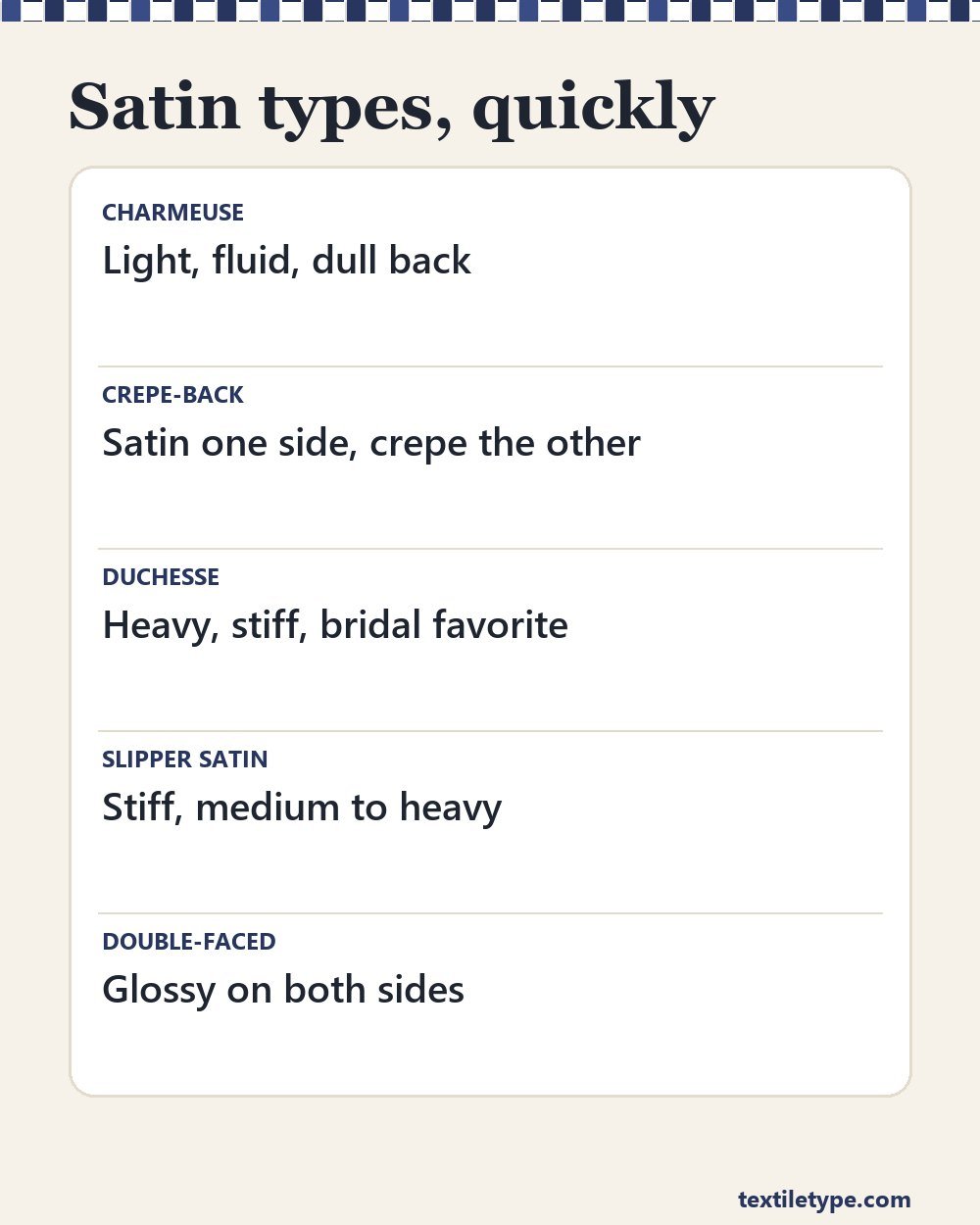
Satin names describe weight, finish and how the back is built. Here are the ones you are most likely to find on a bolt or a label.
| Type | Weight and hand | Typical uses |
|---|---|---|
| Charmeuse | Lightweight, fluid, shiny face with a dull back | Slip dresses, blouses, lingerie |
| Crepe-back satin | Medium weight, satin on one side and crepe texture on the other, usable either way | Dresses, skirts, linings |
| Duchesse satin | Heavy, stiff, holds a shape | Bridal gowns, structured eveningwear |
| Slipper satin | Stiff, medium to heavy | Shoes, structured accessories |
| Double-faced satin | Glossy on both sides | Ribbons, reversible pieces |
| Antique satin | Satin-back shantung with slubby, unevenly spun crosswise yarns | Curtains, upholstery |
| Messaline | Lightweight, loosely woven | Linings, soft dresses |
Weights overlap between mills, so treat the table as a starting point and feel the fabric (or order a swatch) before buying yardage.
Satin vs sateen vs silk
These three words get swapped constantly, and only two of them describe a weave.

- Satin is the weave, usually made with long, smooth filament yarns such as silk, polyester or nylon. Most satin is warp-faced, so the lengthwise yarns form the floats.
- Sateen uses a satin-type weave with short-staple spun yarns, most often cotton. Britannica notes that in sateen the arrangement is reversed and the crosswise filling yarns form the floats. The result is a softer, lower sheen, popular for bed sheets.
- Silk is a fiber from silkworm cocoons. It can be woven as satin, as chiffon, as twill or as plain-woven taffeta. “Silk satin” is simply silk fiber in a satin weave.
A textile specialist explains the silk vs satin mix-up, a handy recap of why one is a fiber and the other a weave.
Where satin works and where it struggles
Satin’s drape and shine make it a favorite for evening and bridal gowns, and it drapes better than plain weaves. You will also find it in lingerie, blouses, neckties, ballet pointe shoes, bedding, cushion covers, ribbons and evening bags.
Its weak spots follow from those floats. Satin catches on rough nails, jewelry, velcro and zippers. It shows pin holes and needle marks, so mistakes in sewing are visible. Its sheen shifts with the angle of light, which means pieces cut in different directions can look like slightly different colors. And in polyester, it can feel warm against the skin in summer. Satin is a fabric for occasions and gentle use, not for hauling firewood.
Washing and pressing satin
The weave sets the handling (gentle, no friction), while the fiber sets the cleaning method. Always read the fiber line and the care symbols together.

Silk satin
Ohio State University Extension advice for washable silk applies here: use mild soap in cool or warm water, avoid strong alkaline detergents, never wring (silk is weaker when wet), and air dry away from sunlight on a padded or plastic hanger. Skip presoaks and chlorine bleach, which damage silk. If a silk satin is labeled dry clean, or is lined, beaded or structured, let a professional handle it.
Polyester and nylon satin
These are usually hand washable or fine on a delicate cycle if the label allows. Put the piece in a mesh laundry bag and keep zippers and hooks on other garments closed, so nothing can snag the floats. Air dry or use the lowest heat, since synthetics dislike high temperatures.
Pressing
Keep the iron low, press from the back, and use a press cloth. A hot iron directly on the face can leave shiny marks, and on polyester it can scorch or melt.
Sewing satin: a short checklist
Satin is slippery and unforgiving, but it rewards a few habits. Simplicity’s guidance for satin covers most of them.
- Use a “with nap” layout. Cut every piece facing the same direction so the sheen matches across seams.
- Pin only in the seam allowances, or use pattern weights, because pin holes show.
- Pick the right needle. Simplicity suggests a universal needle in 70/10 to 80/12; many sewists prefer a fresh Microtex (sharp) needle for thin satin that snags easily.
- Shorten the stitch to about 10 to 15 stitches per inch, with fine cotton-covered polyester thread.
- Choose clean seams. A French seam or double-stitched seam controls fraying.
- Cut with a rotary cutter or serrated shears on a large flat surface.
- Interface lightly with a soft, light interfacing and keep the iron low.
Nine practical tips for sewing satin and other slippery fabrics, from cutting to stitching.
For more fabrics explained the same way, see the full list of Textile Type fabric guides.
Satin FAQ
Is satin the same as silk?
No. Silk is a fiber and satin is a weave. Satin can be made from silk, but most affordable satin is polyester, so check the fiber content on the label.
Is satin natural or synthetic?
Either, because satin describes the weave. Silk satin is natural, while polyester and nylon satin are synthetic. The label’s fiber line tells you which one you have.
Why does satin snag so easily?
Its surface is made of long yarn floats that pass over several crossing yarns before being tied down. A rough fingernail or jewelry edge can hook a float and pull it out of line.
Can you iron satin?
Yes, on a low setting, from the wrong side, with a press cloth. High heat or a hot iron on the face can leave shiny marks and can melt polyester satin.