Spandex is the reason your jeans let you sit down after lunch and your leggings still fit on day three. It is rarely the star of a fabric label (often just 2 or 5 percent), yet it decides how a garment moves, hugs and snaps back into shape.
So, what is spandex fabric? Strictly speaking, spandex is a fiber, not a fabric: a synthetic stretch fiber made from segmented polyurethane that is blended with cotton, nylon, polyester and other fibers to give them stretch and recovery. “Spandex fabric” usually means any cloth with a meaningful share of it. This guide untangles the spandex, elastane and Lycra naming, explains how the stretch actually works, and shows you how to wash and sew stretch fabrics without wrecking them.
Spandex at a glance
- Fiber type
- Synthetic; at least 85% segmented polyurethane (US definition)
- Other names
- Elastane (Europe and most of the world), Lycra (a brand)
- Superpower
- Stretches several times its length and recovers close to its original size
- Usually found
- Blended in small amounts into knits, denim, swimwear and activewear
- Weak spots
- High heat and chlorine bleach
- Care in one line
- Cool or lukewarm wash, no chlorine bleach, air dry or low heat
On this page
What is spandex fabric made of?
The Federal Trade Commission defines spandex as a manufactured fiber whose fiber-forming substance is a long-chain synthetic polymer made of at least 85 percent segmented polyurethane. That word “segmented” is the whole trick, and we will come back to it in a moment.
Spandex filaments are fine, smooth and very elastic. According to the American Fiber Manufacturers Association (AFMA), the fiber is produced in a range from 10 denier, finer than a hair, up to 2,500 denier, and it comes in clear and opaque versions. You almost never meet it alone. Instead, a thin spandex core is wrapped or blended with other fibers, so the outside of the yarn looks and feels like cotton, nylon or wool while the inside does the stretching.
That is why a pair of stretch chinos feels like ordinary cotton twill. The cotton handles looks, breathability and comfort; the hidden spandex handles fit.
Elastane vs spandex vs Lycra: one fiber, three names
This is the question that sends most people to search engines, so here is the plain answer: spandex and elastane are the same fiber. Spandex is the generic name used in the United States and Canada. Elastane is the name used in Europe and most of the rest of the world, and US labeling rules also accept it because they recognize the international ISO fiber names. The National Inventors Hall of Fame notes that Lycra “is known as elastane in Europe and throughout most of the world.”
Lycra is different. It is a brand name, owned today by The LYCRA Company, for its own spandex fibers. Calling every stretch fabric “Lycra” is like calling every tissue a Kleenex: common, understandable, and technically wrong unless the fiber really came from that company.
| Word on the tag | What it is | Where you see it |
|---|---|---|
| Spandex | Generic fiber name | US and Canadian labels |
| Elastane | Generic fiber name (same fiber) | European, UK, Australian and many Asian labels |
| Lycra or LYCRA® | Brand of spandex from The LYCRA Company | Hangtags and labels worldwide, often next to “elastane” or “spandex” |
| LYCRA® XTRA LIFE™ | A branded spandex marketed as more resistant to chlorine, heat and sunscreen | Swimwear and activewear |
| Elastic, stretch | Marketing words, not fiber names | Product descriptions; check the fiber content line |
How the stretch works: soft segments, hard segments
A spandex molecule is a long chain built from two kinds of blocks. The soft segments are long, floppy and coiled up like a phone cord. The hard segments are short and stiff, and they cling to the hard segments of neighboring chains, acting as anchor points.
When you pull on the fiber, the soft coils straighten out. The hard anchors stop the chains from sliding past each other, so nothing gets permanently rearranged. Let go, and the soft segments spring back into their tangled, relaxed state, pulling the fiber back toward its original length. AFMA describes the hard segments as “virtual cross-links” that tie the chains into a network.
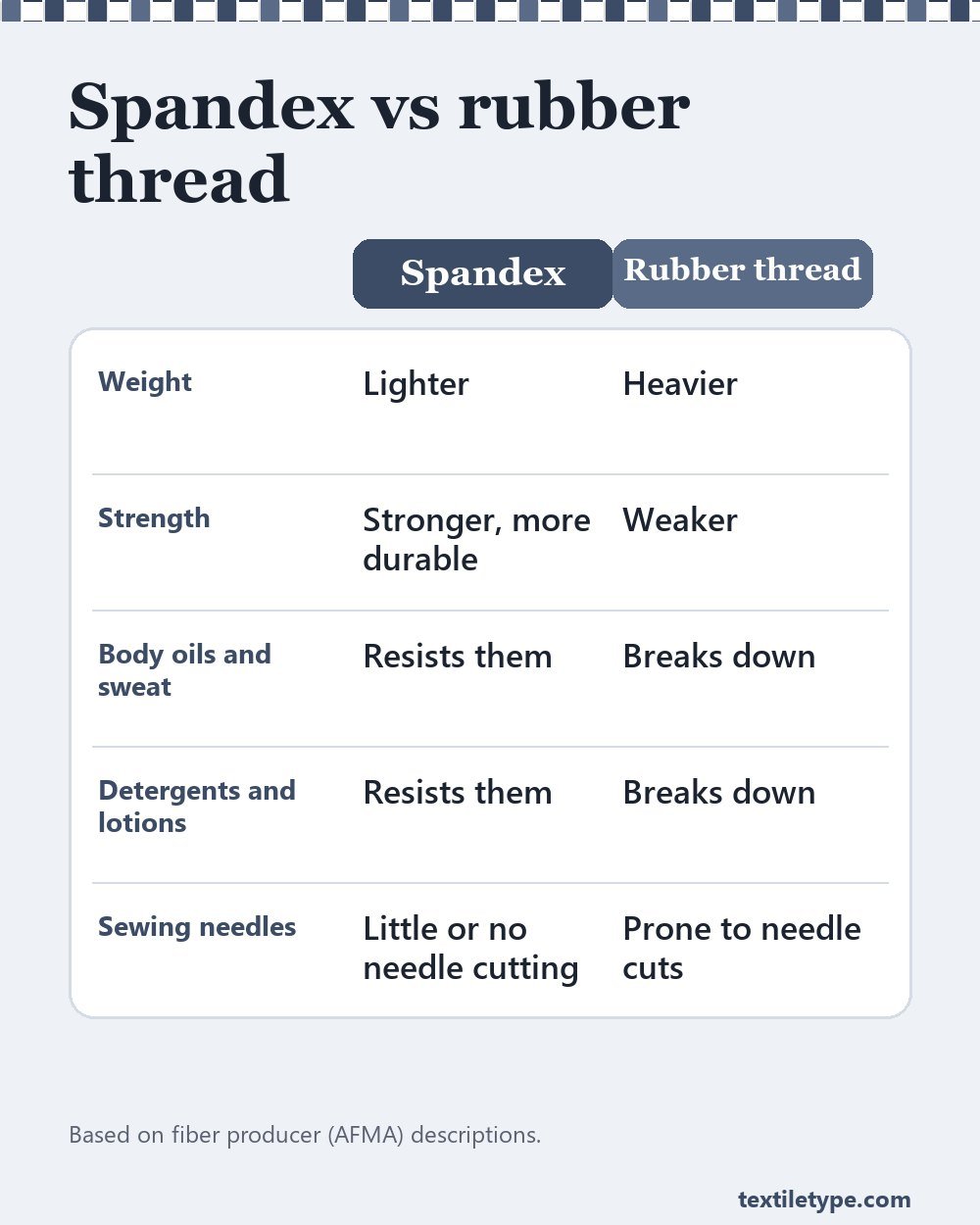
The result, according to AFMA, is a fiber that can generally stretch more than 500 percent without breaking and recover to very near its original length, again and again. It is also lighter, stronger and more durable than the rubber thread it replaced, and it resists body oils, perspiration, lotions and detergents.
Stretch vs recovery
Stretch is how far a fabric extends. Recovery is how well it comes back. Plenty of knits stretch without spandex (jersey and rib knits get give from their looped structure), but they can bag out at knees and elbows. A little spandex mainly improves recovery: the fabric returns to shape instead of keeping the memory of your knees. If you want the knit side of the story, the guides to jersey fabric and rib knit fabric cover how loops create stretch on their own.
From rubber girdles to leggings: a short history
Before spandex, stretch clothing relied on rubber thread, which was heavy and broke down with sweat and laundry. DuPont wanted a synthetic replacement, especially for foundation garments such as girdles.
| When | What happened |
|---|---|
| 1946 | Chemist Joseph Shivers joins DuPont, where he works on Orlon and Dacron polyester before turning to elastic fibers. |
| 1950 | DuPont shelves its first attempt at a rubber replacement; Shivers keeps working on elastomers. |
| Early 1950s | Shivers modifies a Dacron polyester intermediate and gets a polymer that bounces and handles heat. |
| 1958 | The fiber is patented, according to the American Association of Textile Chemists and Colorists, as reported by Smithsonian. |
| 1959 | DuPont begins the first US commercial spandex production, per AFMA. |
| 1962 | Spandex reaches the public under the Lycra brand and takes off in girdles, bras and hosiery. |
| 2004 | DuPont sells its Invista fibers business, including Lycra, to Koch Industries. |
| 2018 | Shivers is inducted into the National Inventors Hall of Fame. |
From underwear, spandex spread into swimsuits, ski pants, cycling shorts and, eventually, the leggings that half the world now wears to the grocery store.
Chemist Joe Schwarcz talks through bathing suits and the history of spandex, a quick watch if you like the science behind the stretch.
How much spandex is in your clothes (and what it does)
Spandex percentages vary by garment, mill and brand, so treat the ranges below as typical rather than rules. A small number on the label still makes a big difference to how a garment fits and moves.
| Garment | Spandex you often see | What you will notice |
|---|---|---|
| Stretch jeans and chinos | About 1 to 5% | Easier sitting and bending; higher numbers feel more like jeggings |
| Stretch cotton tees and shirting | About 2 to 5% | Neckbands, cuffs and hems keep their shape longer |
| Swimwear | Often 10 to 20% or a bit more | Snug fit that holds when wet |
| Leggings, shapewear, compression wear | Often 20 to 30% | Firm hold and the strongest snap-back |
Higher is not automatically better. Fabric construction, yarn quality and the fiber spandex is paired with (usually nylon or polyester in activewear) matter at least as much as the percentage.
What wears spandex out, and how to wash it
Spandex shrugs off sweat and detergent, but it has two real enemies: high heat and chlorine. Repeated hot dryer cycles weaken the fibers, and chlorine bleach attacks them. Over time you see the result as a saggy waistband, a swimsuit that goes thin and shiny in the seat, or tiny white threads poking through the surface of a stretch fabric.
- Wash spandex blends in cool or lukewarm water, inside out, on a gentle cycle.
- Never use chlorine bleach on anything with spandex; use an oxygen-type bleach if you need one.
- Skip fabric softener and dryer sheets on activewear; they can leave residue on the fabric.
- Rinse swimsuits in clean water soon after the pool.
- Air dry, or tumble on the lowest heat and remove promptly.
- If ironing is needed, use a low setting and keep the iron moving.

Garments with only a little spandex (a pair of 2 percent stretch jeans, say) usually follow the care rules of their main fiber. The higher the spandex content, the more these heat and chlorine rules matter.
Sewing with spandex blends
Stretch fabrics have a reputation for being fussy, but most problems come from using woven-fabric habits on a fabric that moves. These are the standard fixes sewing teachers recommend.
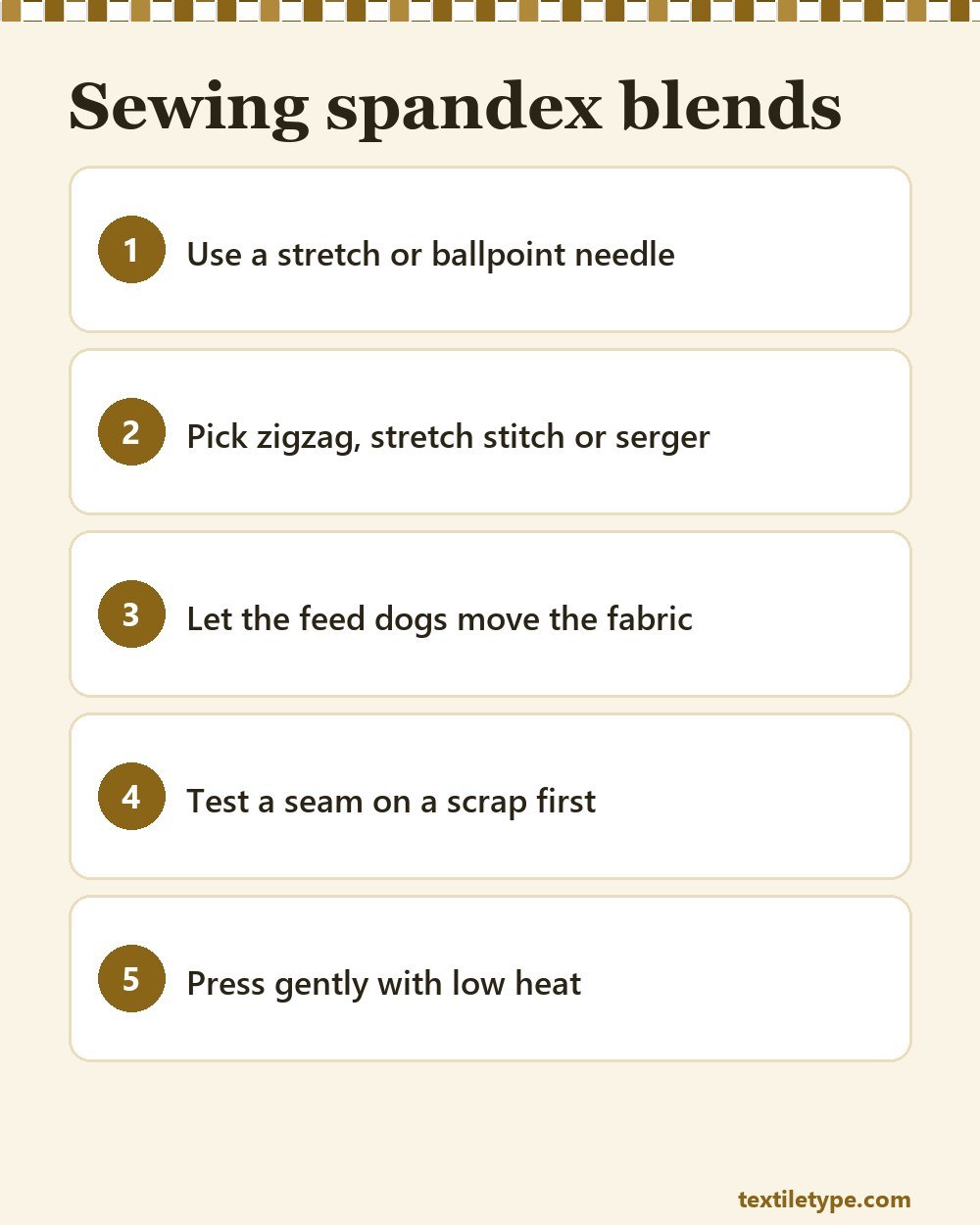
- Use a stretch or ballpoint needle. The rounded tip slips between fibers instead of piercing them, which helps prevent skipped stitches and holes.
- Choose a stitch that stretches. A narrow zigzag, a dedicated stretch stitch or a serger lets seams extend with the fabric. A plain straight stitch can pop.
- Stop stretching as you sew. Let the feed dogs move the fabric; pulling it through makes wavy seams. A walking foot helps on slippery knits.
- Test on a scrap. Sew a sample seam, stretch it hard, and adjust stitch length or tension before you touch the real pieces.
- Mind the direction of greatest stretch. Cut pattern pieces so the stretch goes around the body unless the pattern says otherwise.
- Press gently. Use low heat and a press cloth; high heat can make spandex lose its spring.
AFMA notes one hidden bonus: a sewing needle does little or no damage to spandex compared with older elastic materials, which used to get “needle cut.”
A practical tutorial on sewing stretch fabric with a regular home sewing machine, no serger required.
Spandex is one small ingredient in a lot of fabrics, so you will meet it again across the fabric guides.
Spandex FAQ
Is spandex the same as elastane?
Yes. Spandex and elastane are two generic names for the same segmented polyurethane fiber. US and Canadian labels usually say spandex, while European and many other labels say elastane.
Is Lycra the same as spandex?
Lycra is a brand of spandex made by The LYCRA Company. All Lycra is spandex, but not all spandex is Lycra.
Is spandex breathable?
Spandex itself is a synthetic that absorbs little moisture, but it usually makes up a small share of a fabric. Breathability depends mostly on the main fiber and the knit or weave, so a cotton and spandex tee breathes much like cotton.
Does spandex shrink?
Spandex blends can tighten up or lose elasticity in high heat, especially in a hot dryer. Cool washing and air drying keep both the size and the stretch more stable.
Sources and further reading