Rib knit fabric is the grooved, extra-stretchy knit that grips your wrists on a sweatshirt and hugs your neck on a crew-neck tee. If you are wondering what is rib knit fabric and why it behaves so differently from plain T-shirt jersey, the answer is in its columns: raised lines and sunken lines that alternate across the width and act like a built-in spring.
That spring is why rib knit finishes so many edges, and also why it turns up as whole garments, from fitted tanks to body-skimming dresses.
This guide covers how the ribs form, what 1×1 rib and 2×2 rib actually mean, how rib compares with jersey and interlock, what to check before you buy, and a step-by-step method for sewing a neckband that lies flat.
Rib knit at a glance
- Structure
- Columns of knit stitches alternating with columns of purl stitches
- Common versions
- 1×1 rib, 2×2 rib, wider ribs such as 3×3
- Stretch
- High across the width, with strong pull-back
- Edges
- Balanced ribs lie flat instead of curling
- Two sides
- Balanced ribs look the same front and back
- Typical uses
- Cuffs, neckbands, waistbands, fitted tanks and dresses
On this page
What is rib knit fabric? The structure in brief
All weft knits are made of loops pulled through loops. Our jersey guide explains the basics, including wales (vertical columns of loops) and courses (horizontal rows). In jersey, every loop is pulled toward the same side. Rib breaks that rule on purpose.
In rib knit, some columns of loops are pulled to the front and the neighboring columns are pulled to the back. The front-facing columns are knit stitches; the back-facing ones are purl stitches, which are simply knit stitches seen from the other side. On a knitting machine this takes two sets of needles, one for each side, so textile courses group rib with the double knits. A machine with only one needle bed cannot make it.
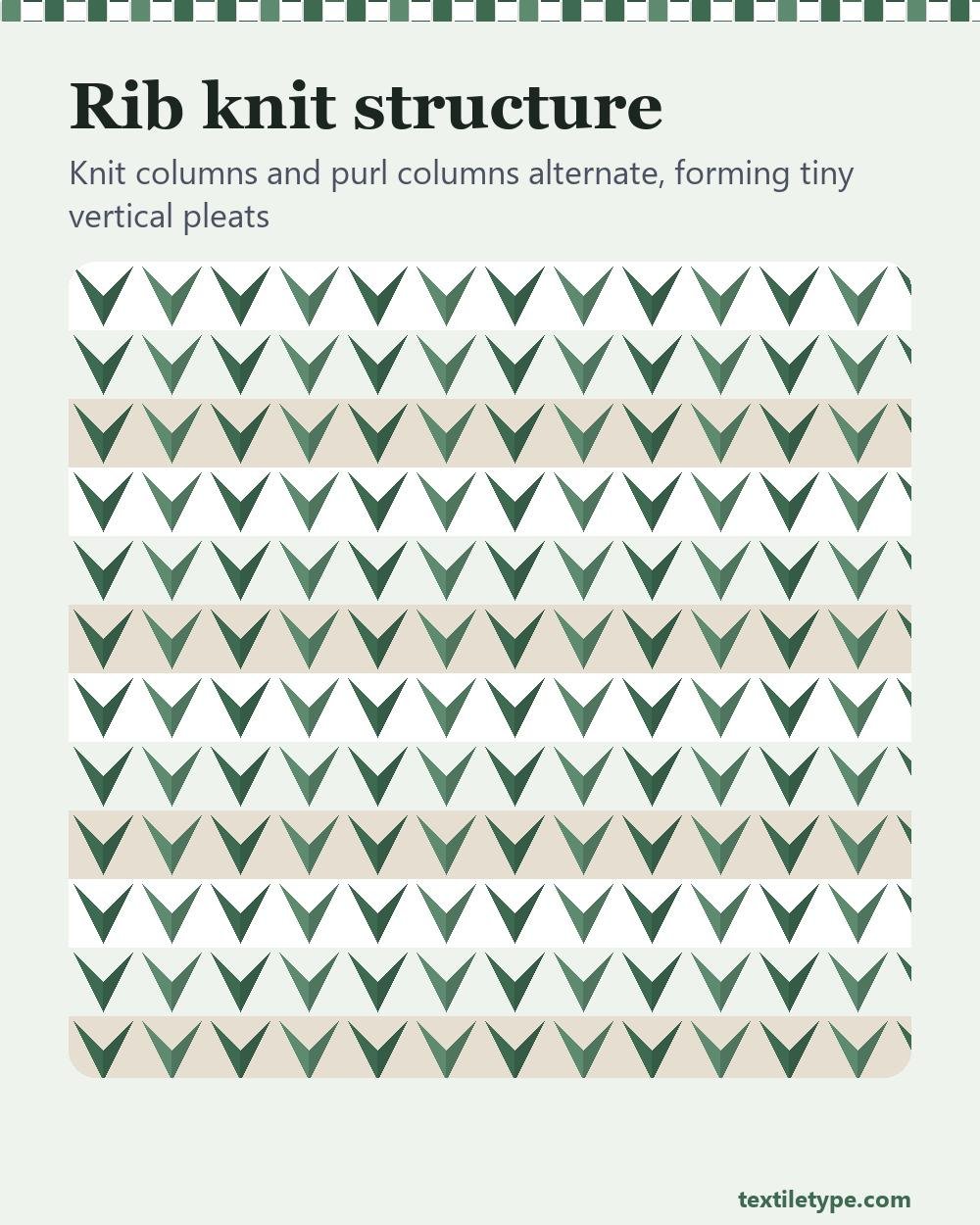
When the fabric relaxes, the purl columns sink back and the knit columns push forward, forming tiny vertical pleats. Pull it sideways and those pleats open up. Let go, and they fold closed again. That is the whole trick.
A side-by-side look at jersey, rib, piqué, terry and fleece, helpful for seeing rib next to the knits it is often confused with.
1×1 rib, 2×2 rib and other counts
Rib names follow a simple pattern: the first number is how many knit columns sit side by side, and the second is how many purl columns follow them. The pattern then repeats across the fabric.
| Name | Pattern | What it looks like | Often chosen for |
|---|---|---|---|
| 1×1 rib | 1 knit column, 1 purl column | Very fine ribs, close to a smooth knit from a distance | Neckbands, close-fitting cuffs, fitted tees and tanks |
| 2×2 rib | 2 knit columns, 2 purl columns | Clearly visible ribs with more texture | Sweatshirt cuffs and hems, waistbands, sweaters |
| Wider ribs (3×3 and up) | 3 or more of each | Bold vertical stripes of texture | Statement tops, dresses, knitwear trims |
| Uneven ribs (such as 2×1) | Different counts of knit and purl | One side shows wider raised ribs than the other | Fashion fabrics and trims |

Which one stretches more? This is where sources split. Knitting references generally say elasticity depends on how many knit-to-purl transitions there are, which makes 1×1 rib more elastic than 2×2 rib. Some fabric suppliers say the opposite for their own goods. Fiber, yarn thickness, knitting tension and any spandex all change the answer, so the honest advice is to stretch a sample of the actual fabric before you commit.
Why rib grips and snaps back
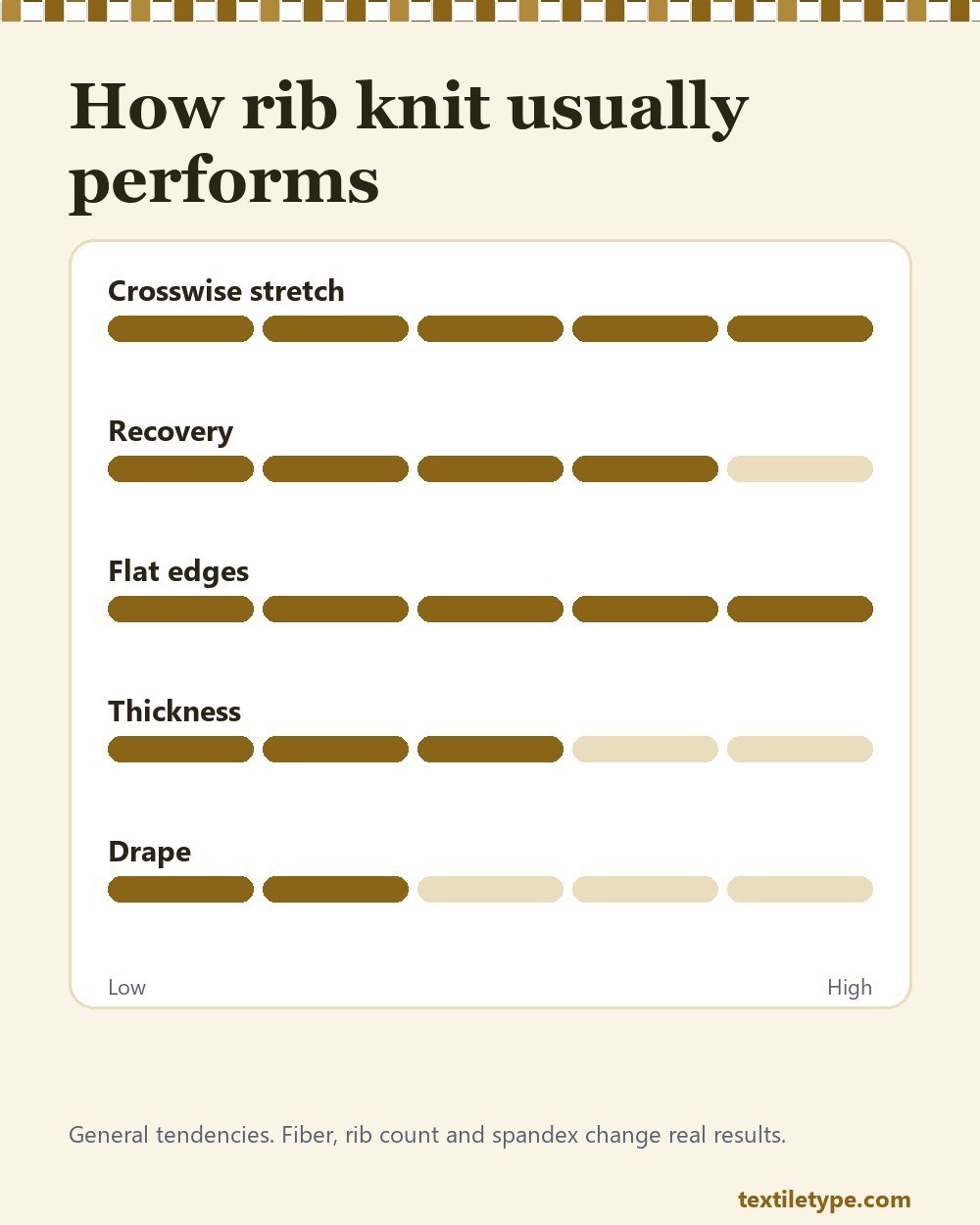
Rib’s party trick is recovery, meaning how well it returns to its original width after being stretched. Those little folded pleats want to close, so a rib cuff pulls itself snug around a wrist without any elastic inside. Britannica describes rib knits as heavier and more elastic than plain knits, and that matches what your sweatshirt cuffs do every day.
Three other traits come from the same balanced structure:
- Flat edges. With equal numbers of knit and purl columns, the pulls cancel out, so rib does not roll up at cut edges the way single jersey does.
- No wrong side, usually. Balanced ribs (1×1, 2×2) look identical on both faces, which is handy for folded bands where both sides show.
- Narrower than it looks. Rib pulls in sideways when relaxed, so the width on the bolt can change a lot depending on how the fabric was laid out or stretched for measuring.
Rib vs jersey vs interlock
These three knits get mixed up in fabric shops all the time, partly because a fine 1×1 rib can look a lot like jersey from arm’s length. Here is how they differ. The behaviors are general tendencies, not guarantees.
| Rib knit | Single jersey | Interlock | |
|---|---|---|---|
| Needle beds | Two | One | Two |
| Face and back | Same on both (balanced ribs) | Distinct face and back | Same on both |
| Curl at cut edges | Little or none | Yes | Little |
| Crosswise stretch | Highest of the three | Moderate | Lower than rib |
| Thickness | Thicker than jersey | Thinnest | Thick and dense |
| Classic job | Cuffs, bands, fitted tops | T-shirts, drapey tops | Smooth, stable knit garments |
Textile teaching material from India’s NPTEL program sums up the key differences: double knits like rib are thicker and stretch more crosswise than single jersey, and interlock, which locks two rib structures together, stretches less than rib.
Where rib knit fabric gets used
Most of the time, rib knit is the supporting actor. Look at a hoodie and you will usually find it at the cuffs and the bottom band. Gildan’s popular Heavy Blend hoodie, for example, lists rib knit cuffs and waistband with spandex. Crew-neck tees use a narrow rib band to keep the neckline from gaping, and many sweatpants and joggers finish their ankles the same way.
It also plays the lead. Rib fabric made into the whole garment gives you the classic ribbed tank, fitted long-sleeve tops, ribbed midi dresses and lounge sets. Because the fabric hugs, it shows the body’s shape clearly, which is exactly the point for some styles and exactly the problem for others.
Rib comes in many fibers: cotton, cotton with spandex, modal blends for a softer drape, and polyester blends for activewear and quick drying. A little spandex is common in trims because it helps the rib keep snapping back after years of being pulled over hands and heads.
Buying rib knit: a checklist
Rib for trims has a harder job than rib for a whole top, so check these points before you add it to your cart. Save the list to your phone for the next fabric store visit.
- Stretch test: fold 10 cm (4 in) crosswise and stretch it; for neckbands look for at least 50 percent stretch.
- Recovery test: stretch hard, release, and check it springs back without staying wavy.
- Spandex: a few percent helps trims keep their grip over time.
- Fiber match: choose rib that washes like your main fabric, so one does not shrink more than the other.
- Weight: check the GSM so the band is neither flimsy nor bulky next to the body fabric.
- Rib count: 1×1 for fine finishes, 2×2 for bolder cuffs and hems.
- Color: buy trim and body fabric at the same time if you need a close match.
If you are unsure what the weight figure on a listing means, our explainer on fabric GSM walks through it.
Sewing a rib neckband step by step
A good rib neckband should lie flat, hug the neck lightly and never ripple. The secret is cutting the band shorter than the neckline it goes into, then stretching it evenly to fit. Seamwork’s neckband tutorial puts the principle simply: the band should always be shorter than the opening, and you stretch as you pin, not as you sew.
How much shorter? Pattern company In the Folds suggests starting rib bands at roughly 70 to 75 percent of the neckline measurement for a regular crew neck, compared with about 80 percent for a band cut from self-fabric jersey. Very stretchy ribbing can go below 70 percent, while overstretching gathers the neckline. Treat these as starting points and test.
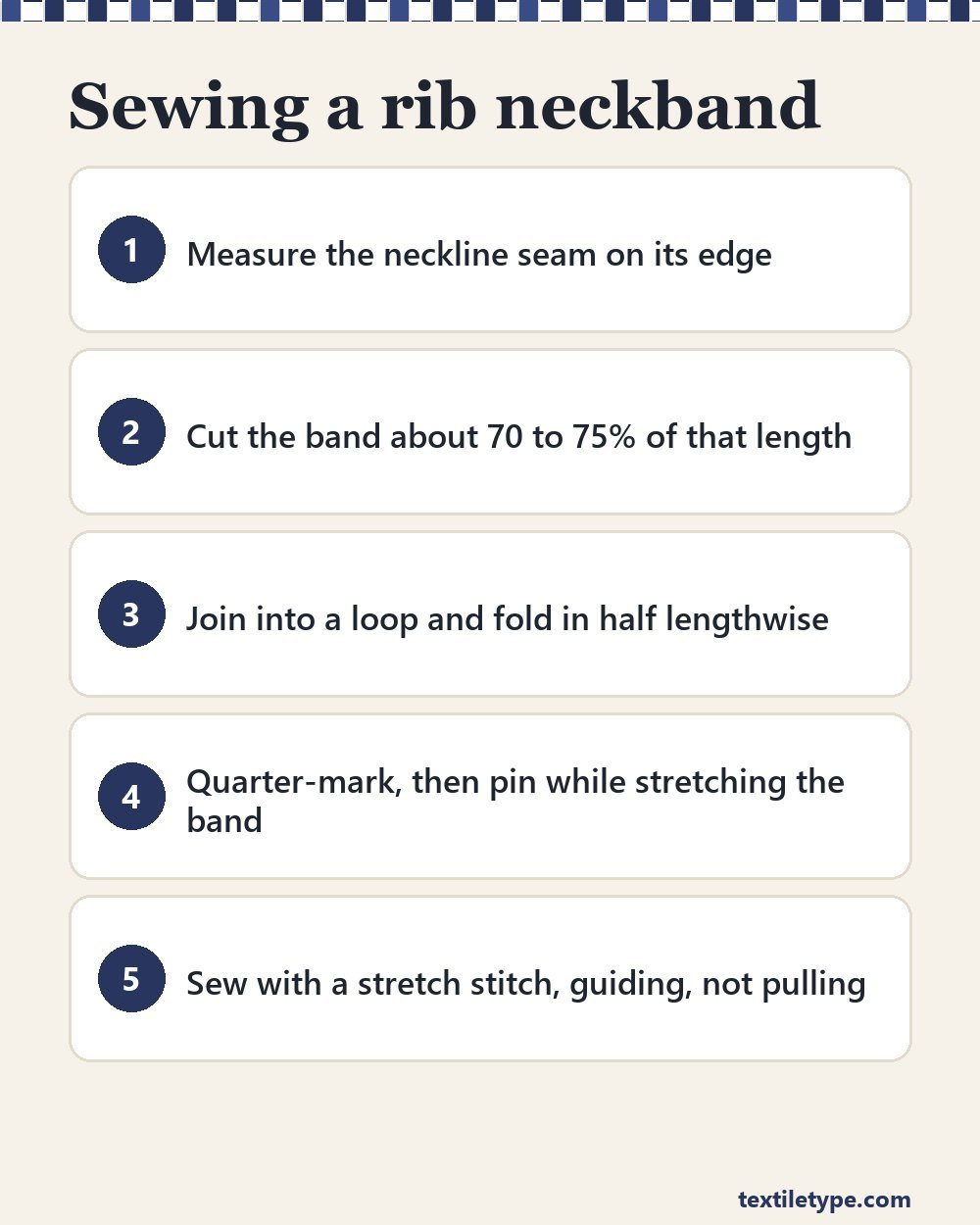
- Measure the neckline seam with a flexible tape on its edge, not flat across, after the shoulder seams are sewn.
- Cut the band at about 70 to 75 percent of that length (plus seam allowances), with the ribs running across the band’s short direction so the stretch goes around the neck.
- Join the short ends into a loop, press the seam open, then fold the loop in half lengthwise, wrong sides together.
- Quarter-mark the band and the neckline with pins or clips, matching the band seam to the center back.
- Pin while stretching the band to fit each quarter; the neckline itself should stay relaxed.
- Sew with a stretch stitch or serger, guiding the fabric rather than pulling it, then press the seam toward the body.
A sewing-focused guide to working with rib knit, a good companion to the neckband steps above.
Keeping rib knit springy in the wash
Rib follows the care rules of its fiber, so start with the label. The structure adds one extra goal: protect the recovery. Heat and constant stretching are what wear it out.
- Keep dryer heat low. Many rib trims rely on a little spandex for their grip, so check the label’s drying advice and lean toward low heat or air drying.
- Dry rib garments flat. A wet ribbed dress on a hanger grows longer and narrower; flat drying lets the ribs settle back.
- Do not use cuffs as handles. Shoving sleeves up over the elbow every day stretches rib cuffs faster than washing does.
- Fold ribbed tops for storage. Hanging lets gravity pull the ribs open over time.
Rib knit FAQ
Is rib knit stretchy in both directions?
Most of rib’s stretch runs crosswise, across the ribs, because that is the direction the folded columns can open. It does give a little lengthwise, and spandex blends add some stretch both ways.
Does rib knit fabric shrink?
It depends on the fiber. Cotton rib can shrink like other cotton knits, especially in a hot dryer, while polyester-rich rib barely changes. Prewashing before sewing is the safest move.
What is the difference between 1×1 and 2×2 rib?
1×1 rib alternates single columns of knit and purl stitches, giving fine ribs. 2×2 rib alternates pairs, giving bolder ribs and more texture; knitting references usually rate 1×1 as more elastic, though real fabrics vary.
Can you make a whole garment from rib knit?
Yes. Ribbed tanks, fitted tops and dresses are made entirely from rib. Expect a close, body-hugging fit, and size patterns with the fabric’s stretch in mind.
More fabrics, fibers and knits are in our fabric guides.