Linen vs cotton comes down to a trade: linen gives you strength, quick drying and an airy, textured feel at the price of wrinkles and a bigger bill, while cotton gives you softness, smoothness and easy care for less money. Neither is the better fabric overall. Each is better at particular jobs.
Here you will find quick verdicts for sheets, shirts, summer clothes and kitchen textiles, a side-by-side table, the reasons behind each difference, care routines for both, and why linen costs what it does. If you want the full backstory on flax first, our guide to what linen fabric is covers the fiber from field to loom.
One ground rule before the verdicts: weave, yarn weight and finishing can make a cotton feel linen-like and a linen feel almost silky, so the label and your hands both get a vote.
Linen vs cotton at a glance
- Linen comes from
- Fibers in the stem of the flax plant (a bast fiber)
- Cotton comes from
- Fibers attached to the seeds of the cotton plant
- Stronger and quicker to dry
- Linen
- Softer out of the package
- Cotton
- Wrinkles more
- Linen, by a lot
- Costs less
- Cotton, usually
- Best known for
- Linen: summer clothes and airy bedding. Cotton: everything else.
On this page
Linen or cotton: quick verdicts
Start with the use you have in mind. These verdicts describe how each fiber usually performs in typical weaves.
- Bedding for hot sleepers: linen, for its quick drying and loose, airy feel. A cotton percale is the cheaper runner-up.
- Bedding that feels smooth and soft on night one: cotton, especially sateen.
- Summer shirts, trousers and dresses: linen, if you can live with creases. A lightweight cotton is the lower-wrinkle alternative.
- Office shirts that must look sharp all day: cotton.
- Kitchen and glass-drying towels: linen, which dries quickly between uses. Cotton terry wins for bath towels.
- Kids’ clothes, everyday tees and budget buys: cotton.
- Tablecloths and napkins for special meals: linen, which wears for years and launders crisp.
Linen vs cotton side by side
Read the table as general tendencies. A heavy linen canvas and a gauzy cotton will scramble several rows.
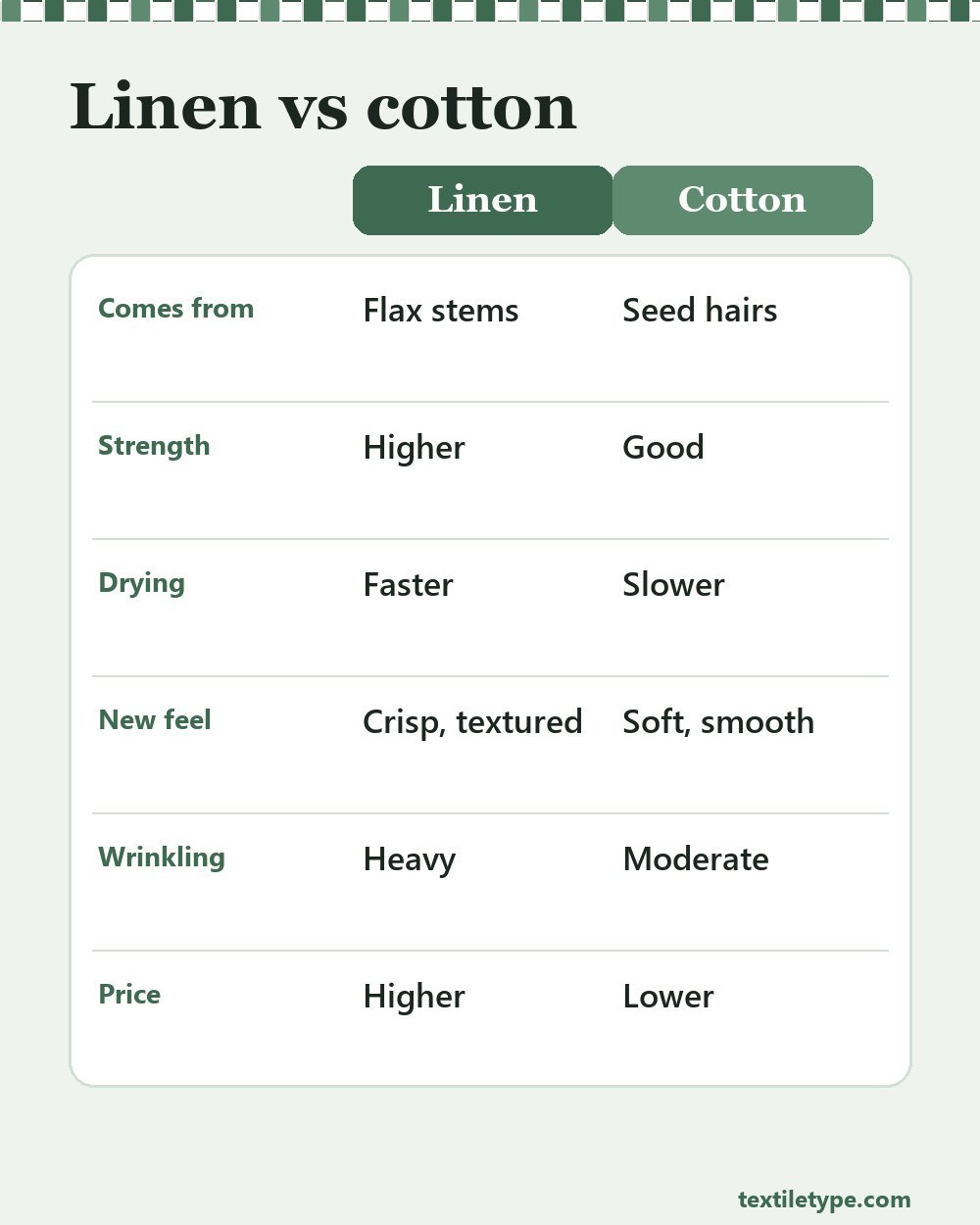
| Trait | Linen | Cotton |
|---|---|---|
| Plant part | Stem (bast fiber from flax) | Seed hairs |
| Strength | Higher | Good |
| Moisture regain (water taken up from air) | About 12% for flax | About 7 to 11% |
| Drying speed | Faster | Slower |
| Hand feel when new | Crisp, textured, slightly stiff | Soft and smooth |
| After many washes | Softer and more supple | Softer, can wear thin over time |
| Wrinkling | Heavy, because of low elasticity | Moderate |
| Sunlight | Affected more slowly | Affected faster |
| Price | Higher | Lower |
| Usual bedding measure | Fabric weight (GSM) | Thread count |
Two plants, two kinds of fiber
Both fibers are mostly cellulose, the same plant material found in wood and paper, which is why they share traits like absorbency and tolerance for heat. The difference is where the fiber grows.
Cotton fibers are the fluffy hairs attached to the seeds inside a cotton boll. They are short and fine, which suits a soft, even yarn.
Linen fibers sit in bundles inside the stalk of the flax plant. Freeing them takes extra steps (soaking or dew-rotting the stalks, then crushing and combing out the fiber), and the result is longer, stiffer and slightly irregular. Those slubs, the small thick spots you see in linen yarn, are part of its charm. Hemp is a close cousin with similar habits; see our guide to hemp fabric if you are weighing that option too.
Feel and wrinkles: crisp vs soft
New cotton feels soft and familiar. New linen feels cool, dry and a little stiff, closer to paper than to a T-shirt. Give linen time: the European flax industry body notes that linen becomes softer and more flexible with washing.
Wrinkles are the famous catch. Britannica explains that linen’s low elasticity gives it its hard, smooth texture and also makes it prone to wrinkling. A linen shirt creases the moment you sit down. Cotton creases too, just less dramatically and with more forgiveness to an iron.
Heat, sweat and drying speed
Both fibers soak up moisture, which is why both feel better in summer than most synthetics. Reference tables put flax’s moisture regain (how much water a dry fiber pulls from ordinary air) at about 12 percent and cotton’s at roughly 7 to 11 percent, so linen holds a bit more before it feels damp.
The bigger advantage is speed. Britannica notes that linen dries more quickly than cotton. In practice that means a linen shirt that goes damp on a hot walk recovers faster, and a linen sheet feels less clammy on a sticky night. Linen garments are also often woven more loosely, which lets air move through.
So which is cooler? For most people in heat and humidity, linen. In a dry, mild climate the difference shrinks, and a lightweight cotton percale or voile can feel just as comfortable.
Linen or cotton sheets
Sheets are where most shoppers face this choice, and the labels speak different languages.
Cotton sheets: weave and thread count
Cotton bedding is sold by weave and thread count. Percale is a plain, one-over-one-under weave that feels crisp and matte. Sateen floats yarns over several others, so it feels smoother and has a soft sheen. Consumer Reports’ advice is simple: choose sateen for softness and percale for crispness. The Sleep Foundation suggests about 200 to 400 for good cotton sheets, and higher counts are not automatically better.
Linen sheets: look at weight instead
Linen yarns are thicker, so fewer fit into an inch and the thread count looks low. The Sleep Foundation puts typical linen counts around 80 to 140 and notes that sellers rarely list them. Instead, many linen bedding brands quote fabric weight in grams per square meter; our guide to GSM in fabric explains how to read that number.

The sheet verdict
Pick linen sheets if you sleep hot, like a relaxed, rumpled bed and plan to keep them for years. Pick cotton sheets if you want a smooth hand from the first night, a neat-looking bed and a lower price. Choosing a cotton weave you love matters more than chasing a big thread count.
Care differences that matter
Both fibers are tough, machine-washable plant fibers, so neither is fussy. The differences come down to shrinking, creasing and how you finish them.
| Step | Linen | Cotton |
|---|---|---|
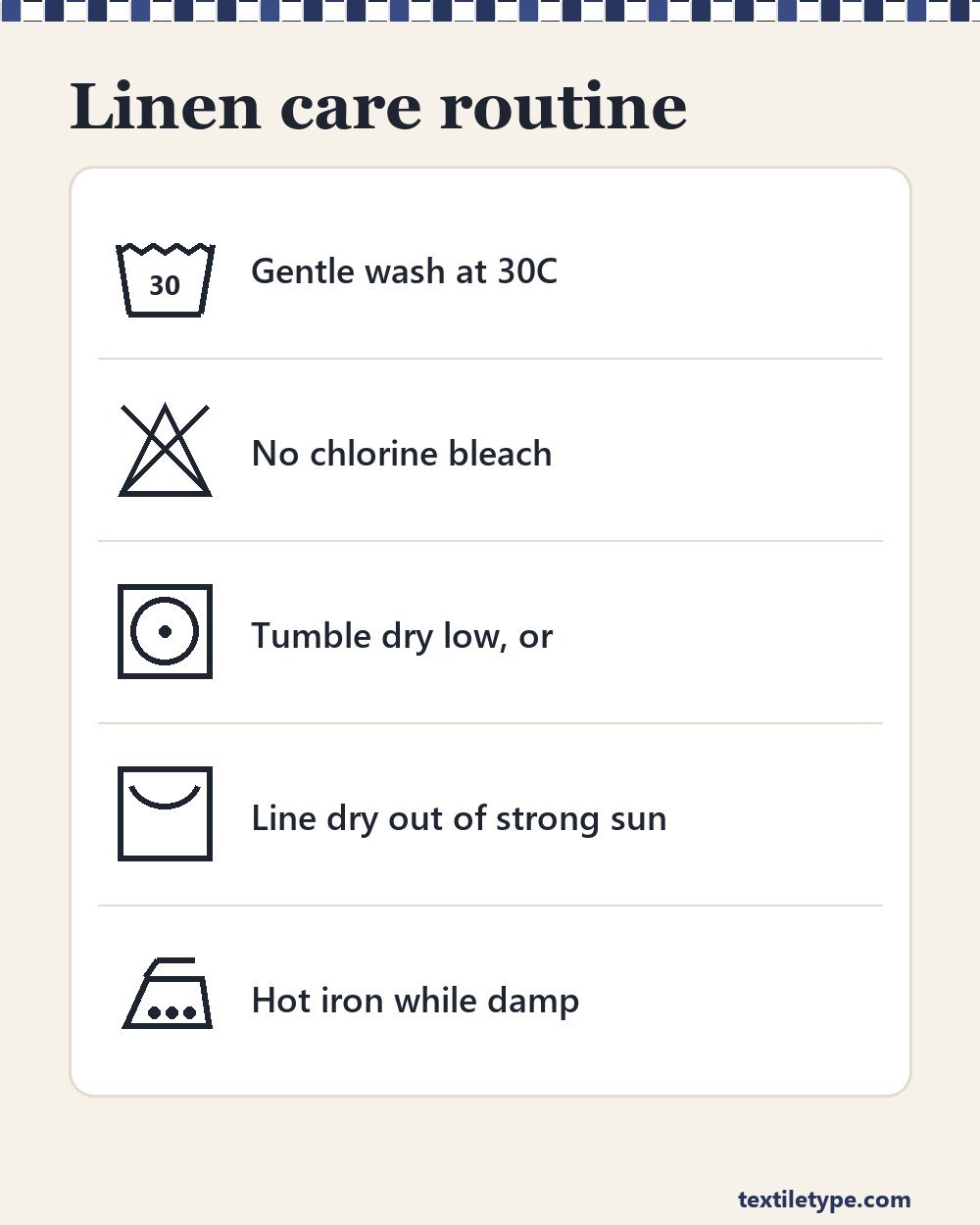
| Washing | Gentle cycle around 30°C, mild detergent without bleaching agents, low spin | Cold to hot depending on the label; sturdy whites can take hot water |
| Drying | Air dry, or tumble on low and remove while slightly damp | Tumble dry per label; low heat limits shrinking |
| Ironing | Hot iron while still damp, on the reverse side | Hot iron is fine for most plain cotton |
| Shrinking risk | Untreated linen can shrink with heat and water | Non-preshrunk cotton can shrink, mostly in a hot dryer |
| Storage | Breathable bag or shelf, away from damp | Same |
Both fibers tolerate the hottest iron setting, which the international care symbol marks with three dots, about 200°C. Linen presses best when damp; trying to iron bone-dry linen is the textile version of arguing with a cat.
Why linen costs more
Linen’s price tag reflects scarcity and labor. Textile Exchange puts cotton at 19 percent of all fiber produced in 2024, while the European flax and hemp industry body puts flax-linen at under half a percent of the world’s textile fibers. That is a tiny crop by comparison.
Processing adds cost too. Flax has to be pulled, retted, broken, scutched and combed before it can be spun, and much of the world’s fiber flax grows in a narrow coastal belt of Western Europe, which the same industry body credits with about three-quarters of the world’s scutched flax fiber.
The upside is lifespan. Linen’s strength and slow response to sunlight mean good linen sheets and tablecloths often outlast comparable cotton, which narrows the price gap over the years.
A sleep-focused comparison of linen and cotton for anyone choosing bedding.
Pick linen if, pick cotton if
Pick linen if:
- You run hot at night or live somewhere humid.
- You like texture and a relaxed, lived-in look.
- You want bedding or table linens that will last a decade.
- You are happy to pay more up front.
Pick cotton if:
- You want softness and smoothness from day one.
- Wrinkles make you twitch.
- You are buying for kids, for heavy everyday use or on a budget.
- You want the widest choice of weaves, weights and colors.
Weighing cotton against a synthetic instead? Our polyester vs cotton comparison covers that matchup, and the fabric guides hub lists every fiber we cover.
A menswear shop compares cotton-linen blends with pure linen, handy if a blend is on your shortlist.
Linen vs cotton FAQ
Is linen cooler than cotton?
Usually, yes. Linen dries faster and is often woven more loosely, so it tends to feel cooler in heat and humidity. A lightweight cotton percale can come close.
Is linen more durable than cotton?
Linen fiber is stronger than cotton and stands up to sunlight better, so well-made linen often lasts longer. Fabric construction still matters, and a flimsy linen will not outlive a sturdy cotton twill.
Why are linen sheets so expensive?
Flax is a small crop compared with cotton and takes more steps to turn into yarn. Much of the best fiber comes from a few regions of Western Europe, which adds cost.
Do linen sheets get softer?
Yes. Linen softens and becomes more supple with repeated washing, so new linen sheets that feel crisp usually relax over the first months of use.