GSM stands for grams per square meter, and it is the most useful number on a fabric listing that nobody explains. If you have asked yourself what is GSM in fabric while comparing two T-shirts or two towels online, here is the plain answer: it is how much one square meter of that fabric weighs.
A higher number means more fabric packed into the same area. That usually translates to a thicker, more opaque, more substantial cloth, although the fiber and the knit or weave still decide how it actually feels.
This page shows you what fabric weight can and cannot tell you, gives a GSM chart for common products with honest ranges, walks through measuring it at home with a cutter or a ruler, and settles the ounces conversion and the thread count confusion once and for all.
GSM at a glance
- Stands for
- Grams per square meter (g/m²)
- Measures
- The mass of one square meter of fabric
- US equivalent
- Ounces per square yard (oz/yd²)
- Conversion
- 1 oz/yd² is about 33.9 gsm
- Home test
- Weigh a 100 cm² swatch in grams, multiply by 100
- Does not tell you
- Fiber quality, softness or thread count
On this page
What is GSM in fabric, exactly
GSM is a measure of mass per unit area. Take a piece of fabric exactly one meter by one meter, put it on a scale, and the number of grams you read is its GSM. Nobody actually cuts a full square meter, of course. Labs and mills weigh a smaller piece of known size and scale the result up.
Standards bodies treat this as a routine test. ISO 3801 covers mass per unit length and mass per unit area for woven fabrics, and ASTM D3776 sets out test methods for the mass per unit area (weight) of fabric that apply to most fabrics. In US trade the same idea is usually stated in ounces per square yard.
One detail matters more than people expect: fabric absorbs moisture from the air, and water has weight. That is why textile testing uses a standard atmosphere. ASTM D1776 lists 21°C (70°F) and 65 percent relative humidity for general textiles, and samples sit in those conditions until they stop changing before anyone weighs them. A swatch fresh out of a steamy bathroom will read heavier than the same swatch after a day on a dry shelf.
What fabric weight tells you and what it does not
GSM is a great shortcut when you cannot touch the fabric. It is also easy to over-read. Use it for what it is.
Fabric weight is a good clue to:
- Thickness and body. Within the same fiber and construction, a higher GSM usually feels thicker and hangs more heavily.
- Opacity. Light tees and shirting are more likely to show what is underneath.
- Warmth, roughly. More fabric usually traps more air, so heavier fleece tends to feel warmer than light fleece.
- Comparing similar items. Two cotton tees at 142 and 180 gsm will feel noticeably different.
It is a poor guide to:
- Quality. A heavy fabric can be made of short, coarse fibers; a light one can be beautifully made.
- Softness. Yarn, fiber and finishing decide hand feel far more than weight does.
- Comparing different fibers. Two fabrics at the same GSM can differ in thickness because fibers have different densities and yarns trap different amounts of air.
- Comparing different constructions. A loopy knit and a dense woven at the same weight look and behave like different worlds.
GSM chart: typical weights by product
There is no official GSM chart for clothing or home textiles. Brands and retailers draw their own lines between “light,” “mid” and “heavy,” and those lines disagree. The ranges below come from published guides and specification sheets, and the right-hand column gives a real product listing so you have a fixed reference point.
| Product | Typical range (varies by source) | Real listing for reference |
|---|---|---|
| Silk chiffon | Often sold as 6 to 8 momme, roughly 26 to 35 gsm | A 6 momme silk chiffon works out to about 26 gsm |
| Lightweight T-shirt | About 120 to 150 gsm | Bella+Canvas 3001: 4.2 oz/yd², 142 gsm |
| Midweight T-shirt | About 150 to 180 gsm | Varies widely between blank makers |
| Heavyweight T-shirt | About 180 to 254 gsm | Gildan Heavy Cotton 5000: 180 gsm (white 170) |
| Quilting cotton | Many solids sit near 145 to 150 gsm | Robert Kaufman Kona solids: listed around 4.3 to 4.35 oz/yd², about 146 to 148 gsm |
| Hoodie or sweatshirt fleece | Light up to 280, mid 280 to 350, heavy 350+ gsm | Gildan Heavy Blend 18500 hoodie: 8.0 oz/yd², about 271 gsm |
| Denim | Light under 12 oz/yd² (about 407 gsm), mid 12 to 16 oz (about 407 to 542), heavy above 16 oz | Denim is almost always quoted in ounces |
| Bath towels | Light 300 to 400, medium 400 to 600, heavy 600 to 900 gsm | Retailers draw these bands differently |
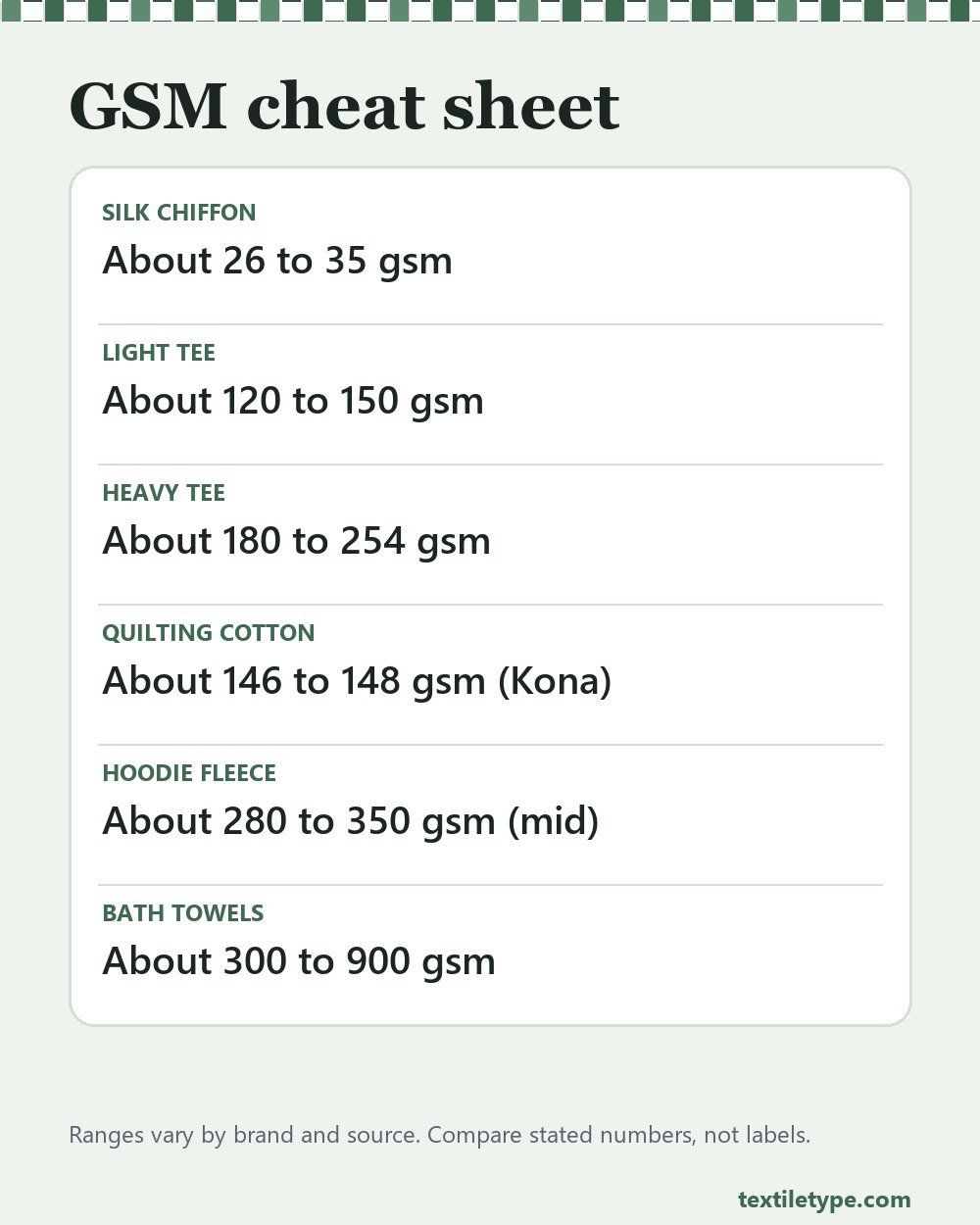
Silk is the odd one out because it is usually sold in momme, a traditional Japanese unit; one momme is about 4.34 gsm. If you are shopping for sheers, our guide to chiffon covers how silk and polyester versions differ. For T-shirt fabric specifically, the jersey guide explains why two cotton tees at the same weight can still behave differently after washing.
How to measure fabric GSM at home
You do not need a lab to get a good estimate. You need an accurate area and an accurate scale, and the scale is where most home measurements go wrong.
Method 1: a GSM circle cutter
A GSM cutter is a round, spring-loaded blade that punches out a disc of exactly 100 square centimeters (about 112.8 mm across). Because 100 cm² is one hundredth of a square meter, the math is as easy as it gets.
- Lay the fabric flat on the cutting pad, smooth but not stretched, away from the selvage.
- Press and rotate the cutter to cut one clean disc.
- Weigh the disc on a scale that reads to 0.01 g.
- Multiply the grams by 100. A disc weighing 1.42 g means 142 gsm.
- Cut two or three more discs from different spots and average them.

A short demonstration of a GSM cutter in use, which makes the steps above easy to picture.
Method 2: a ruler, a rotary cutter and some arithmetic
No cutter? Cut a square or rectangle and divide. The formula is grams divided by area in square meters.
- A 10 cm by 10 cm square is 100 cm², so multiply its weight in grams by 100, exactly like the disc.
- A 20 cm by 25 cm rectangle is 500 cm², which is 0.05 m². If it weighs 7.1 g, the fabric is 7.1 divided by 0.05, or 142 gsm.
The bigger rectangle is the smarter choice if your scale only reads to whole grams. A 100 cm² swatch of 142 gsm fabric weighs 1.42 g, which a kitchen scale rounds to 1 g. That would tell you 100 gsm, an error of almost a third. The same fabric at 500 cm² weighs about 7 g, so a one-gram rounding error shrinks a lot.
Shows how to work out GSM from a measured swatch when you have no cutter, the same idea as Method 2.
Converting GSM and ounces, plus the linear yard trap
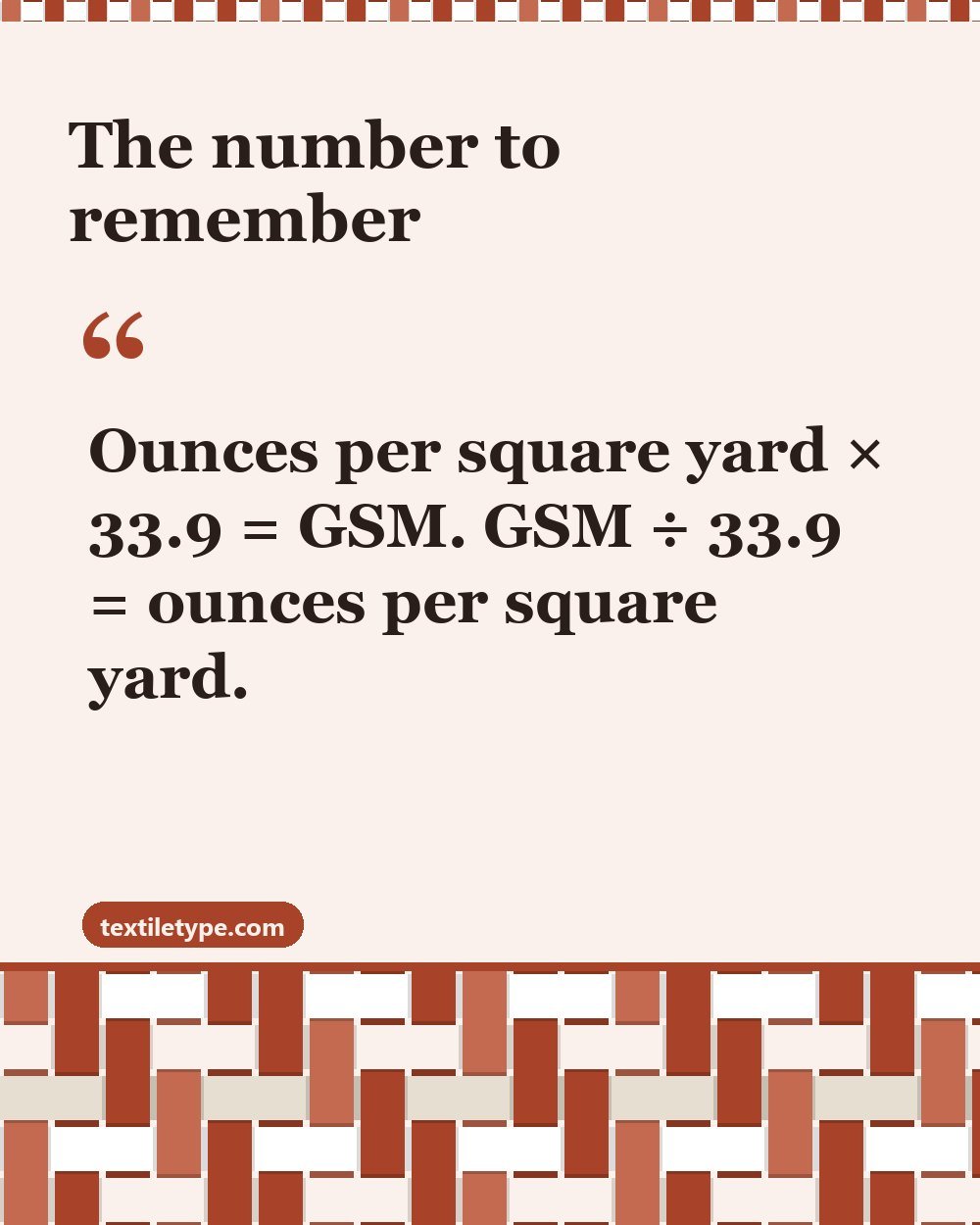
The conversion comes straight from the unit definitions. One ounce is 28.3495 grams, and one square yard is 0.83613 square meters. Divide the first by the second and you get the factor you need:
- Ounces per square yard to GSM: multiply by 33.906.
- GSM to ounces per square yard: divide by 33.906 (or multiply by about 0.0295).
| oz/yd² | GSM (rounded) | Where you might see it |
|---|---|---|
| 3 | 102 | Light shirting, light knits |
| 4 | 136 | Light tees, quilting cotton range |
| 5 | 170 | Mid to heavy tees |
| 6 | 203 | Heavy tees, light canvas |
| 8 | 271 | Sweatshirt fleece |
| 10 | 339 | Light to mid denim |
| 12 | 407 | Midweight denim |
| 14 | 475 | Sturdy denim |
| 16 | 542 | Heavy denim |
The linear yard trap
Some US sellers, especially for canvas and some denim, quote ounces per linear yard instead. That is the weight of one yard cut off the bolt at full width, so it depends on how wide the fabric is. To turn it into ounces per square yard, multiply by 36 and divide by the width in inches. A 60-inch fabric listed at 10 oz per linear yard is 10 × 36 ÷ 60 = 6 oz/yd², or about 203 gsm. If a listing just says “10 oz,” ask which one it means before you order.
GSM vs thread count
These two numbers get mixed up constantly, especially on bedding, but they measure different things. GSM weighs the fabric. Thread count counts yarns.
The textile testing lab IDFL summarizes the ASTM definition: thread count is the sum of warp yarns (ends) and filling yarns (picks) per unit distance, and each yarn counts as one unit whether it is single or plied. In US sheet marketing that is quoted per square inch. Plies matter because counting each strand of a twisted, plied yarn separately would inflate the figure, and back in 2002 a textile trade group asked FTC staff about exactly that practice.
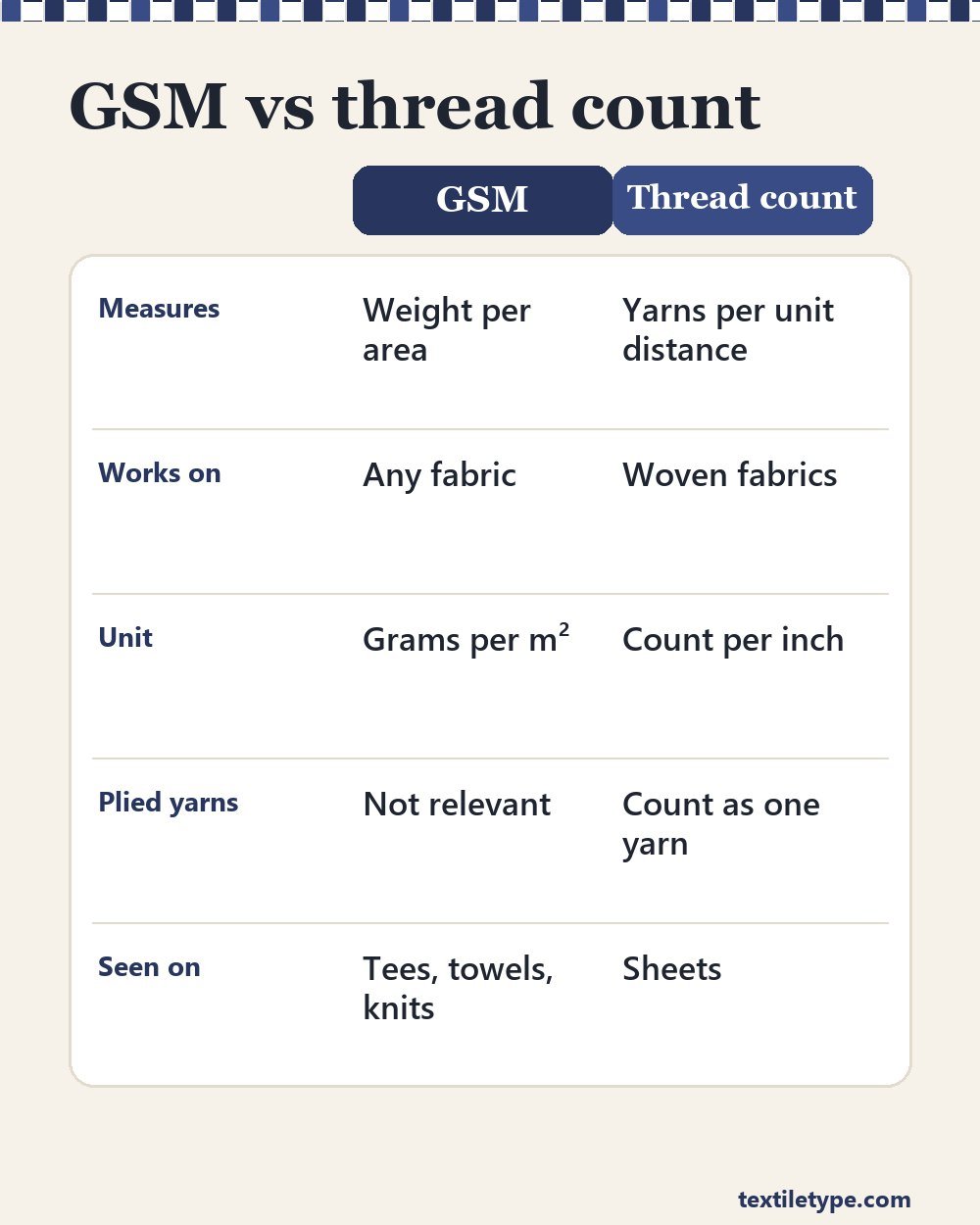
- Thread count only makes sense for woven fabrics, where you can count lengthwise and crosswise yarns. You will see it on percale and sateen sheets.
- GSM works for anything: knits, wovens, terry, fleece, felt. Jersey sheets and towels are sold by GSM because there are no warp and weft to count.
- They are not substitutes. Fine yarns packed densely can give a high thread count at a modest weight, while thick yarns give a heavy fabric at a lower count.
Choosing a fabric weight for your project
Weight is one input, alongside fiber and construction. Use these as starting points rather than rules, and when two options tie, buy a swatch.
- Pick something light (under about 150 gsm) if you want drape, summer comfort or layering pieces. Expect more sheerness in pale colors.
- Pick a middle weight (about 150 to 200 gsm) for everyday tees, shirts and dresses that should cover well without feeling stiff.
- Pick heavier fabric (about 250 gsm and up) for sweatshirts, structured jackets, bags and cold-weather layers.
- Match the fiber to the job first. A light twill and a heavy plain weave can suit the same pants pattern; the fiber decides breathability and care, which our polyester vs cotton comparison covers in detail.
- For towels, lighter weights dry faster and pack smaller, while heavier ones feel plusher but take longer to dry.
Fabric GSM FAQ
Is higher GSM better?
Not automatically. Higher GSM means more fabric per square meter, which often feels thicker and more opaque. Quality depends on fiber, yarn and construction, so a light fabric can easily outlast a heavy one.
What is a good GSM for a T-shirt?
Most tees fall somewhere around 120 to 250 gsm. Lighter shirts drape and breathe; shirts near 180 gsm and above feel sturdier and show less through the fabric.
How do I convert GSM to ounces?
Divide GSM by 33.906 to get ounces per square yard. To go the other way, multiply ounces per square yard by 33.906, so 5 oz/yd² is about 170 gsm.
Is GSM the same as fabric thickness?
No. GSM is mass per area, while thickness is a separate measurement. They usually rise together within one fabric type, but a fluffy fleece can be thicker than a dense canvas of the same weight.
Find more plain-English explainers in our fabric guides.