Thread count is the number of lengthwise and crosswise yarns woven into one square inch of fabric, added together. So what is thread count good for? It tells you roughly how densely a sheet is woven, and that is about all. It says nothing reliable about fiber quality, softness or how long the sheet will last, and the number on the package can be inflated with a perfectly legal-looking trick.
This page explains exactly what gets counted, how to count it yourself with a ruler and a magnifier, how ply yarns turn 300 into “1,000,” what the FTC has said about that, and which ranges make sense for cotton percale, sateen and linen. You will finish with a label checklist you can carry into the store.
Thread count at a glance
- Measures
- Warp yarns plus weft yarns in one square inch of woven fabric
- Industry test
- ASTM D3775 (end and pick count of woven fabrics)
- Plied yarns
- Count once each, however many strands are twisted together
- Typical good cotton sheets
- About 200 to 400
- Linen sheets
- Often 80 to 140, and rarely listed
- Matters more
- Fiber, yarn quality, weave and finish
On this page
What is thread count, exactly
Every woven fabric has two sets of yarns. Warp yarns (also called ends) run the length of the cloth and are held taut on the loom. Weft yarns (also called picks or filling) travel across, over and under the warp. Thread count adds the two together for a one-inch square.
So a sheet with 200 warp yarns and 200 weft yarns per inch is sold as 200 thread count. A sheet with 250 warp and 150 weft is also 200 thread count, which already tells you the single number hides detail.
The textile industry’s reference method is ASTM D3775, the standard test method for end (warp) and pick (filling) count of woven fabrics. It counts the fabric while it lies relaxed, free of folds and wrinkles, and averages several readings taken across the cloth. Thread count applies only to woven fabric; a jersey sheet or a fleece blanket has no warp and weft to count, which is why knits are described by weight instead (see our guide to GSM in fabric).
How to count threads yourself
You can check a label claim on a sheet you already own, or on a store swatch, with cheap tools. Fine sheeting is hard on the eyes, so expect a few tries.
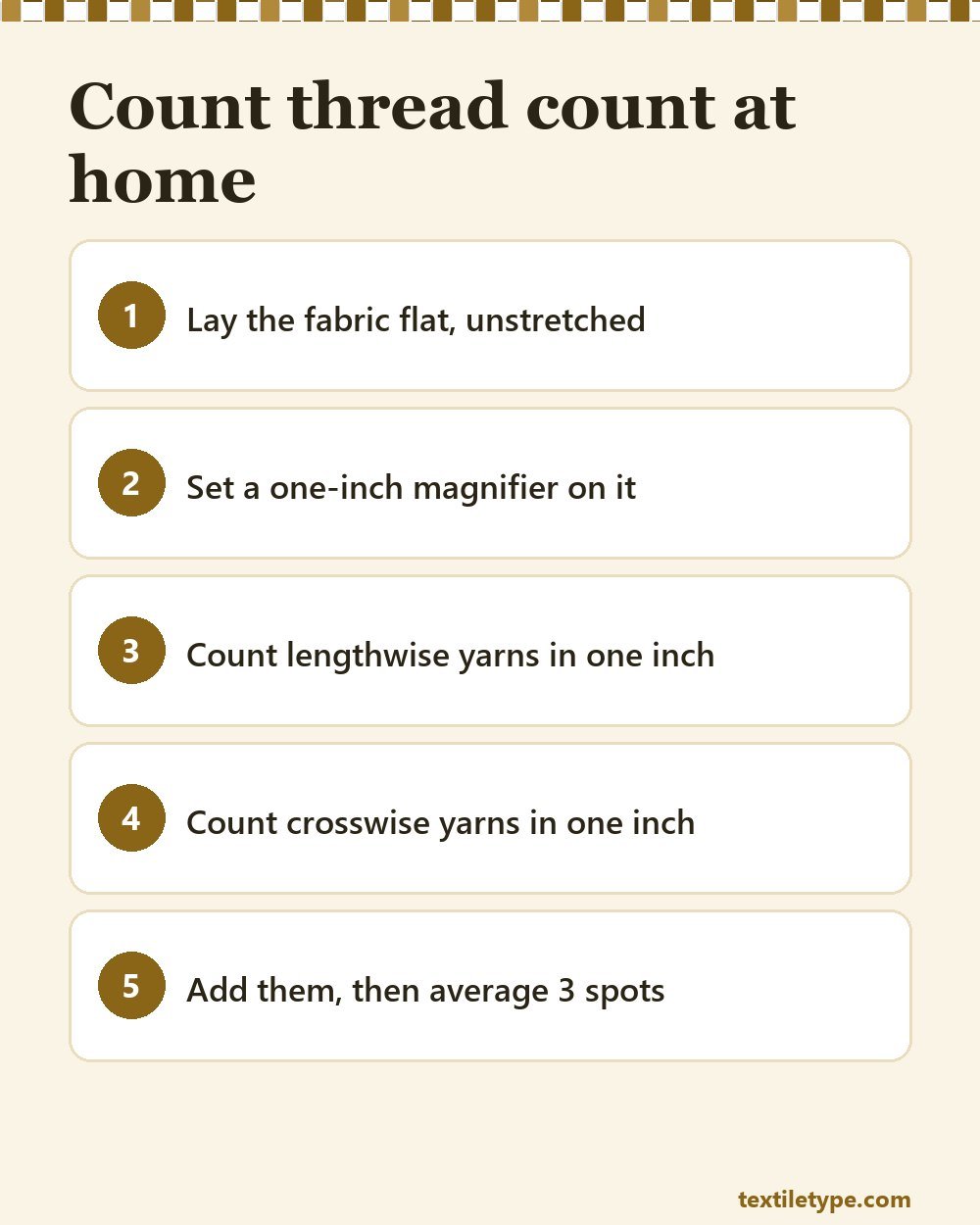
- Lay the fabric flat and smooth, without stretching it.
- Place a ruler or a linen tester (a small folding magnifier with a one-inch window) on the cloth.
- Count the lengthwise yarns across one inch, marking your place with a pin every ten yarns.
- Turn the tester 90 degrees and count the crosswise yarns in one inch.
- Add the two numbers. Repeat in two other spots and average the results.
- If the label claims far more than you can count, look for ply wording on the package.
The ply problem: how 300 becomes 1,000
A ply yarn is two or more thin strands twisted together into one yarn. Two-ply yarns are not a defect; they can make a strong fabric. The trouble starts when a seller counts each strand inside the twist as a separate thread. A sheet woven with 300 two-ply yarns per square inch suddenly gets marketed as 600, and three-ply yarns can push a modest weave toward four figures.
The industry definition does not allow that arithmetic. Under the ASTM approach, each yarn counts once, whether it is a single strand or a plied one. The testing lab IDFL, summarizing that guidance, gives “300 thread count, 2 ply yarn” as an honest way to describe such a sheet and warns that calling it 600 would likely mislead buyers.
The FTC weighed in back in 2002. Responding to a textile manufacturers’ association that complained about counting yarns within a ply individually, FTC enforcement staff wrote that thread count claims need a reasonable basis and that the agency gives great weight to consensus test methods such as those from ASTM. The same letter pointed to an earlier case in which a company, after FTC staff questioned its packaging, changed a down comforter’s package wording from “760 White Goose Down” to “finely woven 380 2-ply fabric.”
Why a higher thread count is not always better
More yarns in an inch means finer yarns, and finer yarns only make a better sheet when the fiber is good enough to spin them well. Pack thick, cheap yarns tighter and you get a heavy, stiff fabric. Pack multi-ply yarns tighter and you mostly get a bigger number on the box.
Consumer Reports has said this for years. In 2013 its textile expert noted that multiplying the count “doesn’t give you a better sheet,” and the top-scoring percale sheet in its tests had a thread count of only 280. Its more recent buying advice reports no significant link between test performance and thread-count claims.
There is also a comfort cost. The Sleep Foundation points out that crowding in too many threads can restrict airflow, so very dense sheets can sleep heavier and warmer, and it suggests counts between 600 and 800 rarely change much beyond the price.
What matters more than the number
Four things decide how a sheet feels and lasts, and thread count only hints at one of them.
Fiber and staple length
Long cotton fibers spin into smooth, strong, fine yarns with fewer loose ends to pill. Cotton counts as extra-long staple (ELS) when its fibers reach at least 1 3/8 inches; American Pima, sold under the Supima trademark when certified, and Egyptian cotton are the names you will see. Consumer Reports suggests looking for combed cotton, Egyptian cotton or Pima cotton on the label. Combing removes short fibers before spinning.
Single-ply yarn
A single-ply yarn made from long-staple cotton is a sign the mill had fiber good enough to spin fine yarn without twisting strands together. A label that says “single ply” next to a modest count is usually more encouraging than a giant count with no ply information.
Weave
Percale and sateen at the same count feel completely different, which the next sections cover.
Finish
Many sheets are treated with softeners at the mill. Consumer Reports judges softness only after five washes for that reason, so the dreamy feel in the store is not always the feel you keep.
Best thread count by sheet type
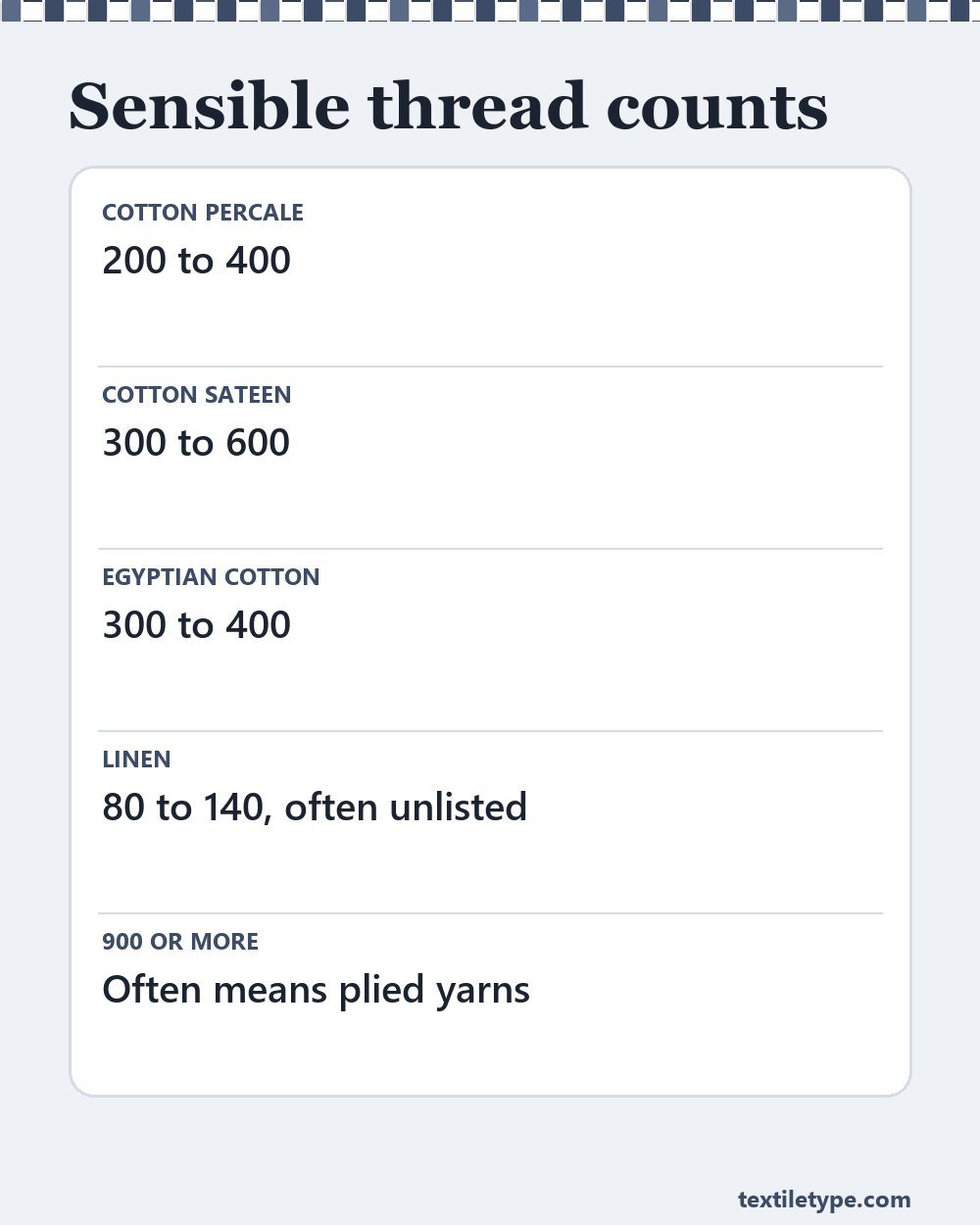
These are the ranges the Sleep Foundation recommends. Use them as a sanity check rather than a target, and choose by fiber and weave first.
| Sheet type | Sensible range | What to know |
|---|---|---|
| Cotton percale | 200 to 400 | Around 180 to 200 is average quality; crisp, matte, airy |
| Cotton sateen | 300 to 600 | Around 250 to 300 is average; smooth with a soft sheen |
| Egyptian cotton | 300 to 400 | Fiber quality does most of the work |
| Bamboo-derived rayon | 300 to 500 | Silky and drapey; check the label says rayon or viscose |
| Linen | 80 to 140 | Thick yarns, so the count looks low; often not listed at all |
If you are deciding between fibers rather than counts, our linen vs cotton comparison covers how the two sleep, and the polyester vs cotton guide covers microfiber’s cousin fiber.
Percale vs sateen at the same count
Percale is a plain weave: each yarn goes over one and under one. That tight crisscross makes a crisp, cool, matte fabric. Sateen uses a satin-type weave in which yarns float over several others before dipping under one. Those floats give a smooth, slightly shiny surface and a heavier drape, and sateen sheets are typically sold at higher counts than percale. For more on that family of weaves, see our guide to satin fabric.

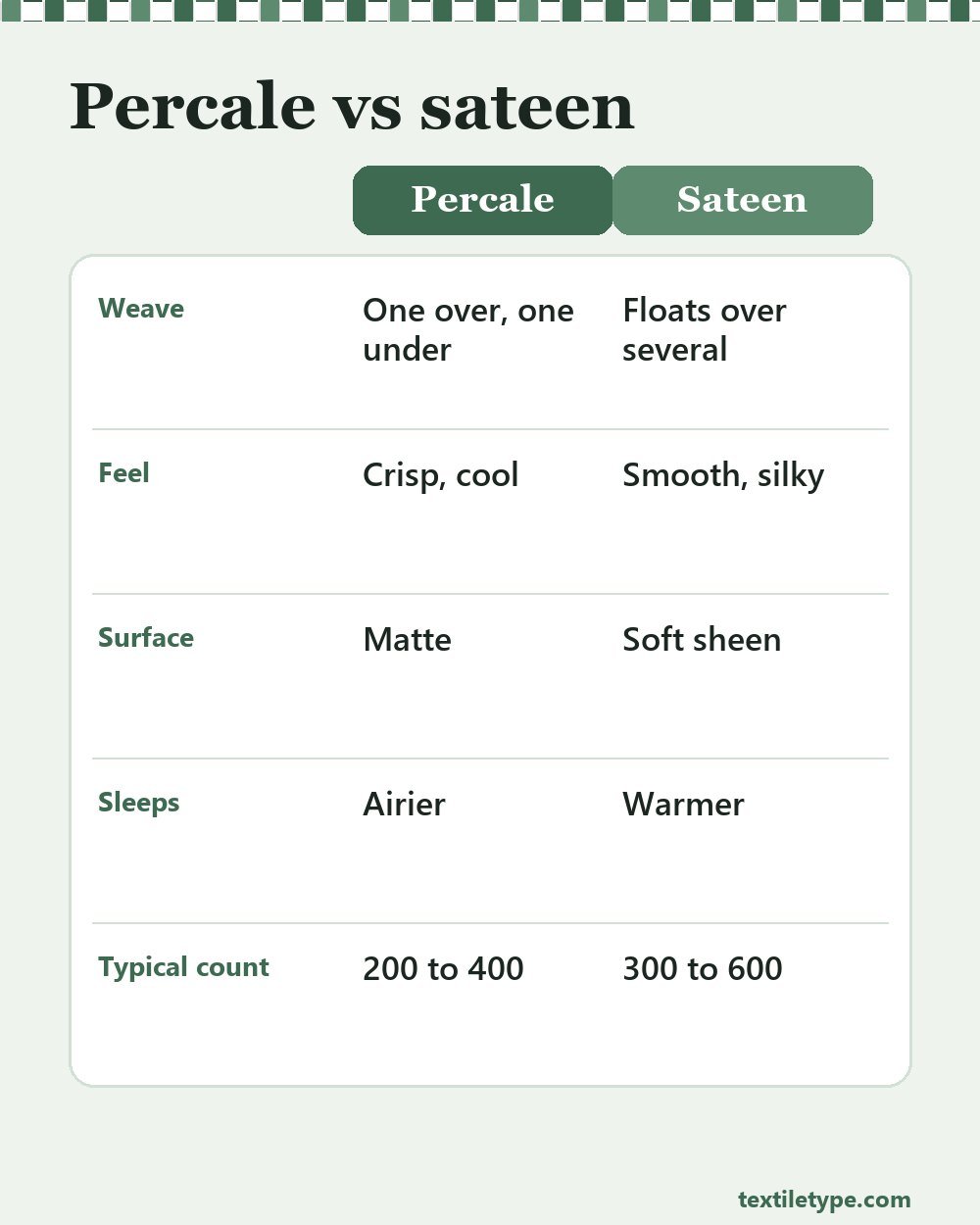
Consumer Reports puts the choice simply: sateen for softness, percale for crispness. Hot sleepers usually lean toward percale’s airier grid, while people who want a silky hand lean toward sateen.
A side-by-side look at how percale and sateen sheets differ in weave and feel.
Thread count sheets: a label checklist
Run through these before you pay for a big number. Copy them into your phone if you shop for bedding often.
- Fiber named clearly: 100% cotton, long-staple, combed, Pima or Egyptian
- Ply stated: single ply, or the count given with the ply (300 thread count, 2-ply yarn)
- Weave stated: percale for crisp and cool, sateen for smooth and warm
- Thread count between about 200 and 600 for cotton
- Skeptical of 900+ without ply details
- Return policy that lets you wash and try the sheets
A bedding maker talks through what thread count does and does not tell you.
For more on how fabrics are built and labeled, browse the fabric guides hub.
Thread count FAQ
What is a good thread count for sheets?
For cotton, about 200 to 400 for percale and 300 to 600 for sateen covers most good sheets. Past that range, fiber and yarn quality matter far more than extra threads.
Is 1,000 thread count better than 400?
Usually not. Counts that high often rely on counting the strands in plied yarns, and Consumer Reports has found no reliable link between thread count claims and how sheets perform.
Does thread count apply to linen sheets?
Linen yarns are thick, so linen sheets often land around 80 to 140 and many brands skip the number. Fabric weight is a more useful guide for linen.
Is higher thread count warmer?
Often, yes. A very dense weave lets less air through, so very high-count sheets tend to feel warmer than an airy percale.
Sources and further reading
- FTC: 2002 staff letter on thread count to the American Textile Manufacturers Institute
- IDFL: Thread count ASTM definitions
- ASTM: D3775 Standard Test Method for End and Pick Count of Woven Fabrics
- Sleep Foundation: Best thread count for sheets
- Consumer Reports: Higher thread count doesn’t guarantee better sheets