Lyocell is the wood-based fiber that fashion brands love to mention twice: once on the hangtag and again in the sustainability blurb. If you’ve wondered what is lyocell fabric, why it is so often printed as TENCEL, and why one lyocell shirt is machine washable while another says dry clean only, this guide sorts it out.
You’ll get the label definition, how the fiber is spun, the brand-versus-fiber question, how well it breathes, and the one quirk that decides how you should wash it: fibrillation.
Lyocell at a glance
- Fiber type
- Regenerated cellulose, legally a subcategory of rayon
- Raw material
- Dissolving wood pulp (eucalyptus, beech, spruce and others)
- Best-known brand
- TENCEL Lyocell, made by Lenzing
- Feel
- Smooth and cool, or sueded “peach skin”, depending on finish
- Strength
- Stronger than cotton when wet
- Care
- Depends on finish; always follow the label
On this page
What is lyocell fabric, by definition?
Under the FTC’s fiber-naming rule, lyocell sits inside the rayon category. Rayon covers fibers made of regenerated cellulose, and the rule says the name “lyocell” may be used when the cellulose is precipitated from an organic solution in which no substitution of the hydroxyl groups takes place and no chemical intermediates are formed.
In plainer words: wood pulp is dissolved as-is in a solvent and then reformed into fiber, without first being turned into a different chemical compound. That’s the key difference from viscose, where the cellulose is chemically converted along the way. Ohio State University’s clothing fact sheet notes that when the FTC approved the lyocell name in 1996, it was the first new generic fiber group in about 30 years.
The result is a fiber that is chemically the same stuff as cotton and linen, cellulose, in a manufactured form. It behaves like a sturdier relative of viscose.
How lyocell is made: the solvent-spun route
The process is shorter than the viscose route, and it is the reason lyocell gets its “closed loop” reputation.
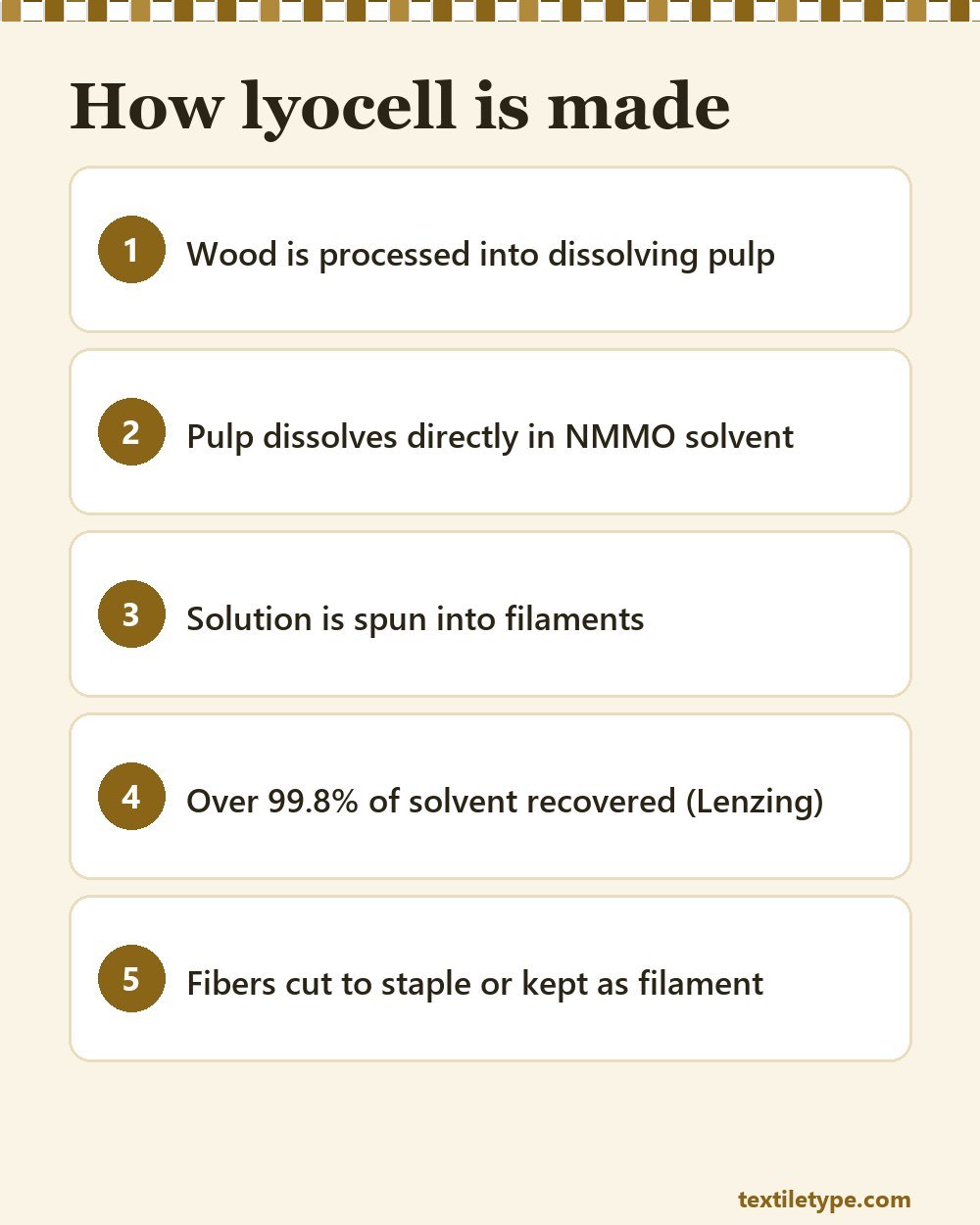
- Pulp. Trees are processed into dissolving pulp, a very pure cellulose. Lenzing lists eucalyptus, spruce, beech, maple, southern pine, birch and acacia among its wood species.
- Dissolve. The pulp is dissolved directly in a solvent, N-methylmorpholine N-oxide (usually shortened to NMMO).
- Spin. The thick solution is extruded through a spinneret, and the cellulose sets back into solid filaments as the solvent is washed out.
- Recover. The solvent is cleaned and fed back into the process. Lenzing says it recovers more than 99.8 percent of the solvent for TENCEL Lyocell.
- Finish. Fibers are cut into staple for spinning into yarn, or kept as filament for silkier fabrics.
Unlike viscose production, the lyocell process does not use carbon disulfide, a chemical that is toxic to workers. The trade-offs are that the process is energy intensive and NMMO itself is made from petrochemicals.
Lenzing’s own video on how its wood-based cellulosic fibers are made.
TENCEL vs lyocell: brand vs fiber
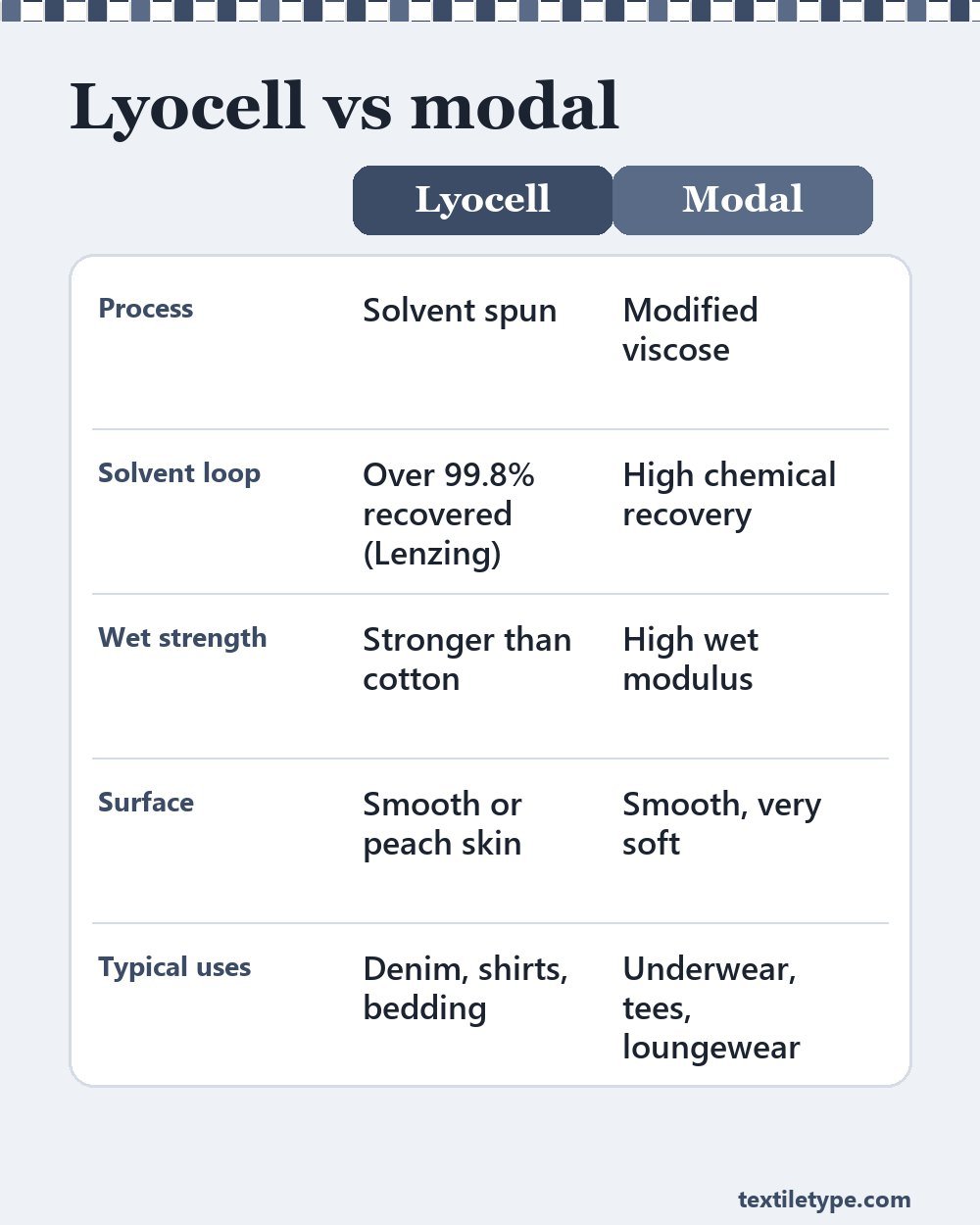
This trips up a lot of shoppers. Lyocell is the generic fiber name; TENCEL is a trademark owned by the Austrian company Lenzing. TENCEL Lyocell is lyocell made by Lenzing, and lyocell from other producers is still lyocell, just without that brand.
The brand umbrella also covers a second fiber, TENCEL Modal, so “TENCEL” alone on a hangtag doesn’t tell you which one you’re holding. The fiber content line on the sewn-in label does.
| Label wording | What it means |
|---|---|
| 100% lyocell | Lyocell from any producer. |
| TENCEL Lyocell | Lyocell made by Lenzing, sold under its brand. |
| TENCEL Modal | A different fiber: Lenzing’s modal, made by a modified viscose process. |
| Lyocell with Micro technology | Finer fibers for lighter, softer fabrics. |
| Rayon | Also legally correct, since lyocell is a rayon subcategory under FTC rules, though most labels use the more specific name. |
If you’re weighing lyocell against its brand sibling, our modal guide covers the other fiber.
Fashion Value Chain walks through the difference between Tencel and lyocell.
Is lyocell breathable?
Yes, in the way that matters most for comfort: it takes up moisture. Lenzing describes the fiber as having high moisture uptake, and the Ohio State fact sheet gives a handy ranking of absorbency. From most to least absorbent, lyocell lands here:
- Rayon, linen and wool (more absorbent)
- Lyocell
- Cotton and silk (less absorbent)
- Synthetics such as polyester and nylon (far less)
So a lyocell shirt pulls sweat away from your skin better than a cotton one of the same build, though not quite as well as linen. As always, the fabric matters: a dense lyocell twill traps more warmth than a light lyocell voile or a loose jersey.
Fibrillation: why finish decides everything
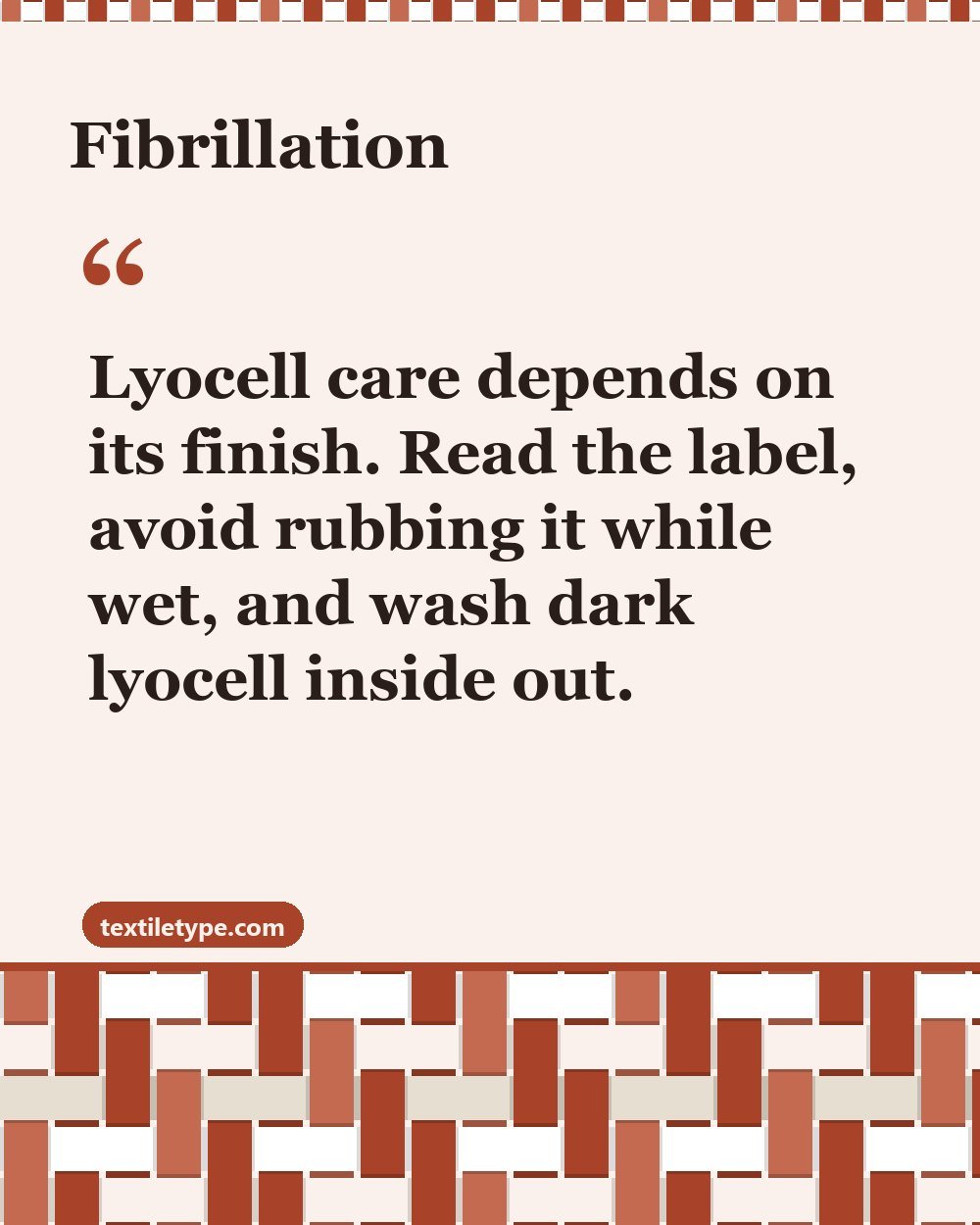
Here is lyocell’s signature quirk. When the fiber is wet and rubbed, tiny fibrils split off its surface like the frayed end of a rope. Controlled, this gives the soft “peach skin” or sueded hand that makes lyocell feel expensive. Uncontrolled, the fibrils mat into a frosty, faded-looking haze, most visible on dark colors.
Mills manage it with finishes, and the finish is what decides how the fabric should be washed. The Ohio State fact sheet groups lyocell fabrics into three types:
| Finish type | What it looks and feels like | Usual care |
|---|---|---|
| Untreated, fibrillating | Smooth at first, can frost and pill if rubbed wet | Usually labeled dry clean only |
| Enzyme treated | Surface hairs removed, then a controlled sueded or sandwashed texture | Usually machine wash, line dry |
| Chemically finished (non-fibrillating) | Smooth and stable surface | Generally machine wash and tumble dry |
Lenzing sells both low-fibrillation types (labeled LF) and a non-fibrillating type (A100) to garment makers, so two lyocell shirts can have opposite care labels for good reason.
A short history of lyocell
Lyocell is a late-20th-century fiber. The process was developed in 1972 by a team at American Enka in Enka, North Carolina, though that company’s attempts to commercialize it did not succeed. The British firm Courtaulds took the idea further, marketing the fiber as Tencel and starting commercial production at Mobile, Alabama around 1990. In 1996 the FTC approved “lyocell” as a fiber name, Lenzing started its own commercial production in Austria in 1997, and the Tencel business later passed to Lenzing, which still owns the brand.
Where you’ll find lyocell
Lyocell started in high-end designer clothing and has since spread to mid-priced lines. You’ll commonly meet it as:
- Denim and chambray. Often blended with cotton for a softer, drapier jean.
- Shirts, dresses and blouses in twill, poplin and voile.
- Jersey knits for tees and innerwear.
- Bedding and bath: sheets, pillowcases, towels.
- Workwear and activewear, especially the non-fibrillating types.
- Behind the scenes: conveyor belts, specialty papers and medical dressings.
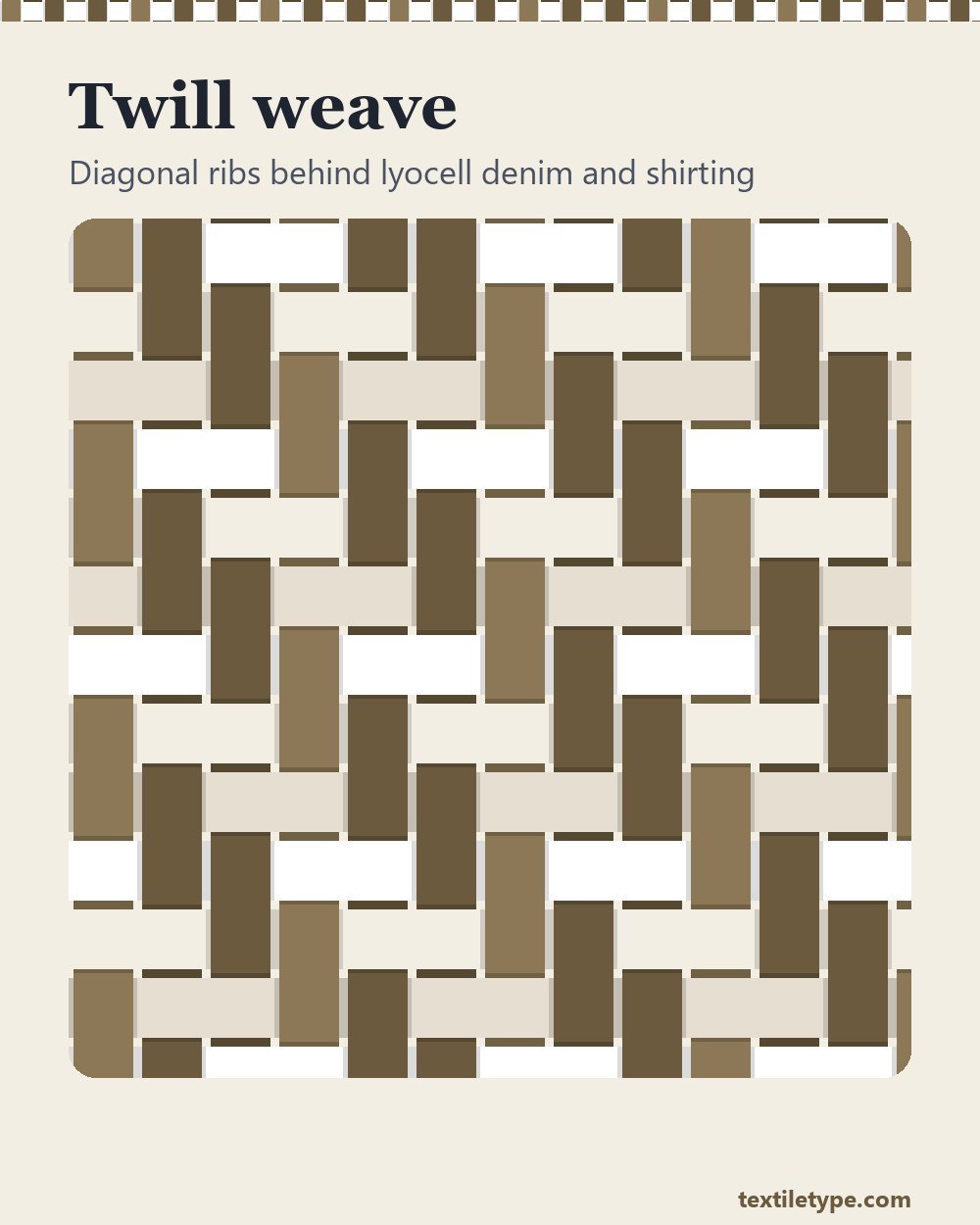
Lyocell is often woven as a twill for denim and shirting. If you’d like to know how that diagonal weave works, see our guide to twill fabric.
How to care for lyocell, finish by finish
Start with the label, because it reflects the finish. Then use these habits to protect the surface:
- Dry clean only? Believe it. That label usually signals an untreated, fibrillating fabric.
- Washable lyocell: a gentle or permanent-press cycle at a cool to medium temperature, turned inside out, works for most pieces.
- Don’t scrub wet fabric. When treating a stain, blot rather than rub, since abrasion while wet is exactly what raises fibrils.
- Drying: line dry enzyme-washed pieces. If a dried garment feels stiff, Ohio State suggests a short tumble with a damp towel to bring back the softness.
- Bleach: the fiber generally tolerates it, but dyes and finishes may not, so test first or skip it.
- Ironing: lyocell takes medium to high heat and scorches rather than melts. Fine yarns and microfibers scorch more easily, so start lower.
Expect slight shrinkage, especially in the first wash, and buy with that in mind if a fit is tight.
Is lyocell eco-friendly? What can fairly be said
Lyocell has a stronger environmental story than many fibers, but the details matter.
- Solvent recovery: Lenzing reports more than 99.8 percent solvent recovery for TENCEL Lyocell. That’s a producer figure.
- Wood sourcing: Lenzing says its lyocell wood comes from FSC- or PEFC-certified or controlled sources, and TENCEL Lyocell carries the EU Ecolabel for textile products.
- Fewer harsh chemicals than viscose: the process skips carbon disulfide.
- Still industrial: it needs considerable energy, and the solvent is petrochemical.
- Generic lyocell varies: claims made for one brand’s process don’t automatically transfer to every lyocell on the market.
In short, lyocell avoids the harshest chemistry of the viscose route and its leading producer documents its sourcing. Fabric dyeing, finishing and how long you keep the garment still matter at least as much as the fiber. Browse the rest of our fabric guides to compare other options.
Lyocell fabric FAQ
Is lyocell better than cotton?
Lyocell is more absorbent, smoother, and stronger when wet than cotton, and it may wrinkle a little less. Cotton is cheaper, easier to care for, and tolerates hot washes better.
Does lyocell shrink?
Slightly, usually in the first wash. Washing cool, skipping high dryer heat, and reshaping while damp keep the change small.
Is lyocell the same as rayon?
Legally it’s a subcategory of rayon, since both are regenerated cellulose. In practice lyocell is made by a different, solvent-based process and is much stronger when wet than ordinary viscose rayon.
Why does my lyocell shirt look faded and fuzzy?
That’s fibrillation: tiny surface fibrils raised by rubbing while wet. Gentler cycles, washing inside out, and avoiding rough loads help prevent it.