Pure polyester barely shrinks in a normal home wash, because the fiber is heat-set at the mill and ordinary laundry water never gets hot enough to undo that. So does polyester shrink at all? It can, a little, under high heat, and a polyester blend can shrink quite a bit more because of whatever fiber is mixed in.
This page gives you the actual temperatures involved (wash water, dryer settings, iron dots), explains why a “polyester” shirt sometimes comes out smaller anyway, and lays out step-by-step routines both for preventing polyester shrinkage and for shrinking a garment on purpose. Spoiler for the second one: manage your expectations.
Polyester shrinkage at a glance
- 100% polyester in a normal wash
- Little to no shrinking
- Main shrink trigger
- High heat, mostly from dryers, irons and hot surfaces
- Where softening starts
- About 67 to 81°C (roughly 153 to 178°F)
- Most common culprit
- The cotton or rayon in a blend, or a knit relaxing
- Safe everyday routine
- Cold or warm wash, low or medium dryer
- Can you shrink it on purpose?
- Slightly, and blends respond more than pure polyester
On this page
Does polyester shrink? The short answer
Polyester is a thermoplastic, a material that softens with heat and firms up again as it cools. Fiber makers use that property on purpose. During production, polyester yarn and fabric are heat-set: held at a controlled size while heated, then cooled so the shape locks in. Heat setting is what gives synthetic fabrics their dimensional stability, which is textile-speak for “stays the same size.”
The practical rule follows from that. Below the temperature where polyester starts to soften, the fabric has no strong reason to change size. Above it, the locked-in structure can relax, and stretched molecules pull back. Standard references put the glass transition of PET (the usual polyester) at roughly 67 to 81°C, and the melting point above 250°C. Your washing machine never gets close to the first number. Some dryers and every iron can.
That is also why Britannica lists polyester among fibers that resist shrinking. Resist is not the same as immune, which is the whole reason this page exists.
The temperature ladder: wash, dryer, iron
Here are the numbers, from cold tap water to a melting fiber. Wash temperatures come from the FTC’s care-label definitions, dryer temperatures from Samsung’s published settings (other brands run in a similar range, but check your manual), and iron temperatures from the international care-symbol system.
| Setting | Approximate temperature | What it means for polyester |
|---|---|---|
| Cold wash | Up to 86°F (30°C) | No shrink risk |
| Warm wash | 87 to 111°F (31 to 44°C) | No meaningful risk |
| Hot wash | 112 to 145°F (45 to 63°C) | Little risk for pure polyester; cotton or rayon in a blend may shrink |
| Dryer, low | About 120 to 122°F (49 to 50°C) | Safe |
| Dryer, medium | About 130 to 133°F (54 to 56°C) | Safe for most polyester and blends |
| Dryer, high | About 140 to 145°F (60 to 63°C) | Approaching the softening range; knits and blends may tighten |
| Polyester softening (glass transition) | About 153 to 178°F (67 to 81°C) | The zone where shape changes become possible |
| Iron, one dot | 230°F (110°C) | Low setting; use a press cloth on polyester |
| Iron, two dots | 302°F (150°C) | Risk of shine, puckering or shrink marks |
| Iron, three dots | 392°F (200°C) | Can glaze or scorch polyester |
| Melting | Above 482°F (250°C) | Fiber melts |
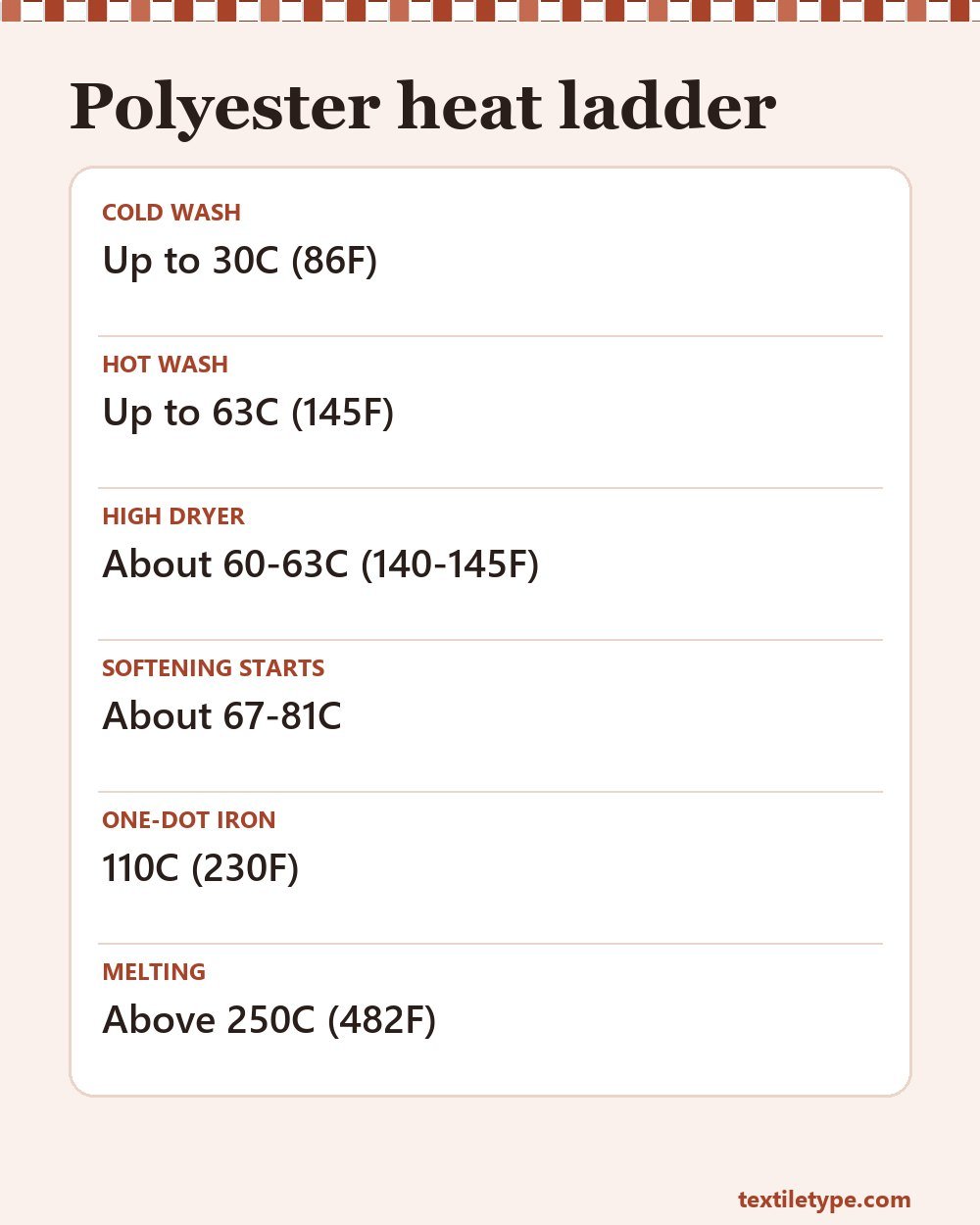
Read the table from the top and you can see why hot water alone rarely shrinks pure polyester: the hottest wash the FTC defines tops out below polyester’s softening range. The dryer gets close on high. The iron blows straight past it.
Why your polyester still got smaller
If a polyester garment came out of the laundry a size down, one of these is usually responsible.
It was a blend
Check the fiber content tag, not the product name. A “polyester” tee might be 50 percent cotton, and a dress could be part rayon. Those fibers absorb water, swell and can shrink in ways polyester does not. If you want the background on how those two main fibers behave differently, see our polyester vs cotton comparison.
The knit relaxed
Knits are stretched and pulled during knitting and finishing. The first few washes can release that built-in tension, and the fabric settles into a slightly shorter or narrower shape. Textile people call this relaxation shrinkage. It usually shows up in the first washes and then settles down. Polyester jersey and fleece can show a little of it.
It met a hot spot
An iron on the wrong setting, a radiator, a hot car seat or a dryer run long on high can soften polyester locally. That kind of damage often looks like puckering, rippling or a shiny patch rather than even, all-over shrinking.
The trims or lining shrank
A polyester shell with a cotton lining, a rayon facing or an elastic waistband can pull out of shape when only one part shrinks. The result looks like shrinking even though the polyester itself held steady.
Polyester shrinkage by blend
The fibers mixed with polyester set the real shrink risk. These are general tendencies; finishing and preshrinking at the mill can change the picture.
| Fabric | Shrink tendency | Best care move |
|---|---|---|
| 100% polyester woven | Very low | Warm wash, medium dryer is fine |
| 100% polyester knit or fleece | Low, some early relaxation | Cold or warm wash, low dryer |
| Polyester-cotton blend | Moderate, rising with cotton share | Cold or warm wash, low dryer or hang dry |
| Polyester-rayon blend | Moderate to high, since rayon soaks up water and weakens when wet | Cold wash, gentle cycle, air dry |
| Sheer polyester (chiffon, georgette) | Low shrinking, high risk of heat marks | Hand wash cool, hang dry, lowest iron with a press cloth |
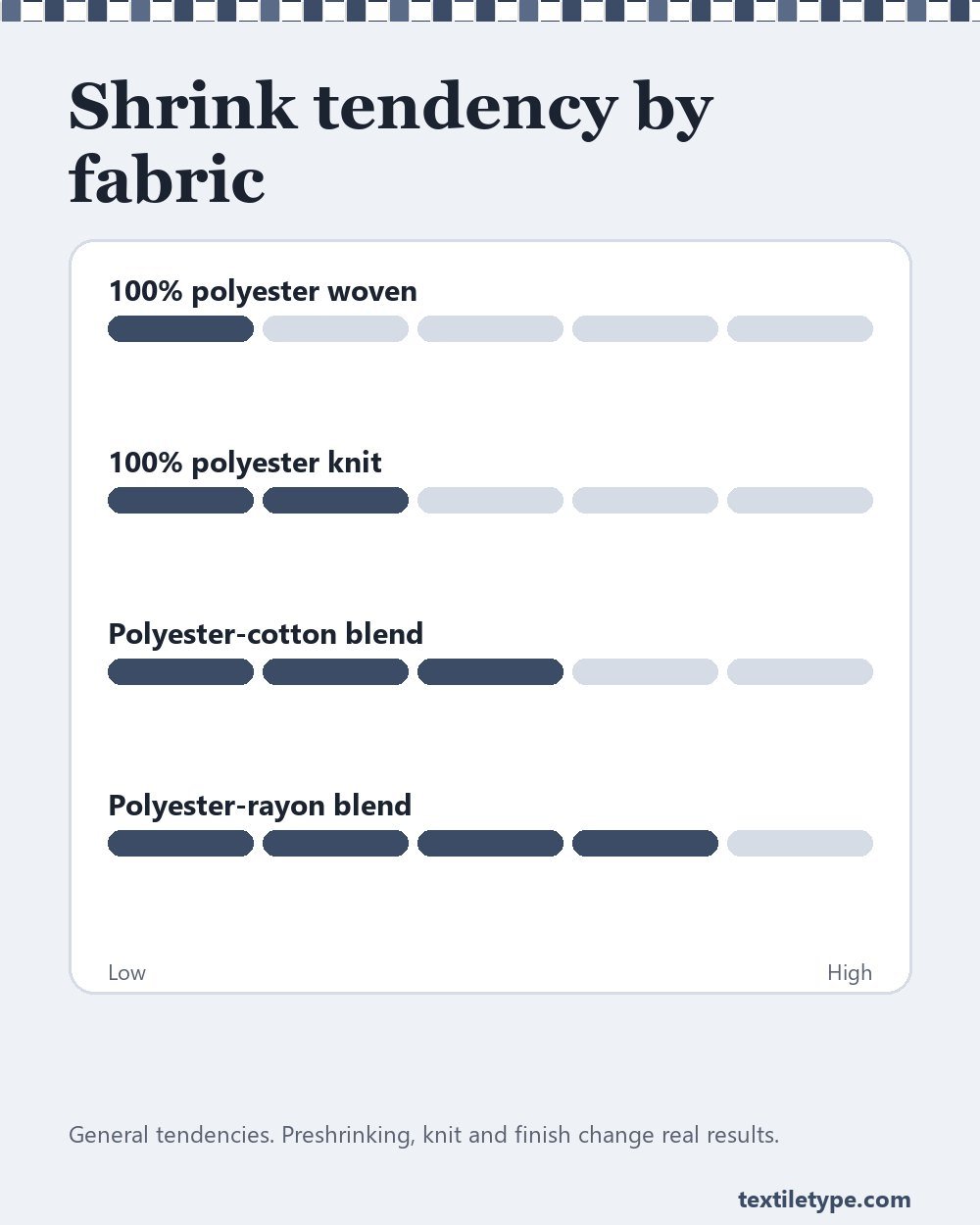
For more on why rayon behaves that way, our guide to viscose fabric covers how the fiber handles water.
How to keep polyester from shrinking
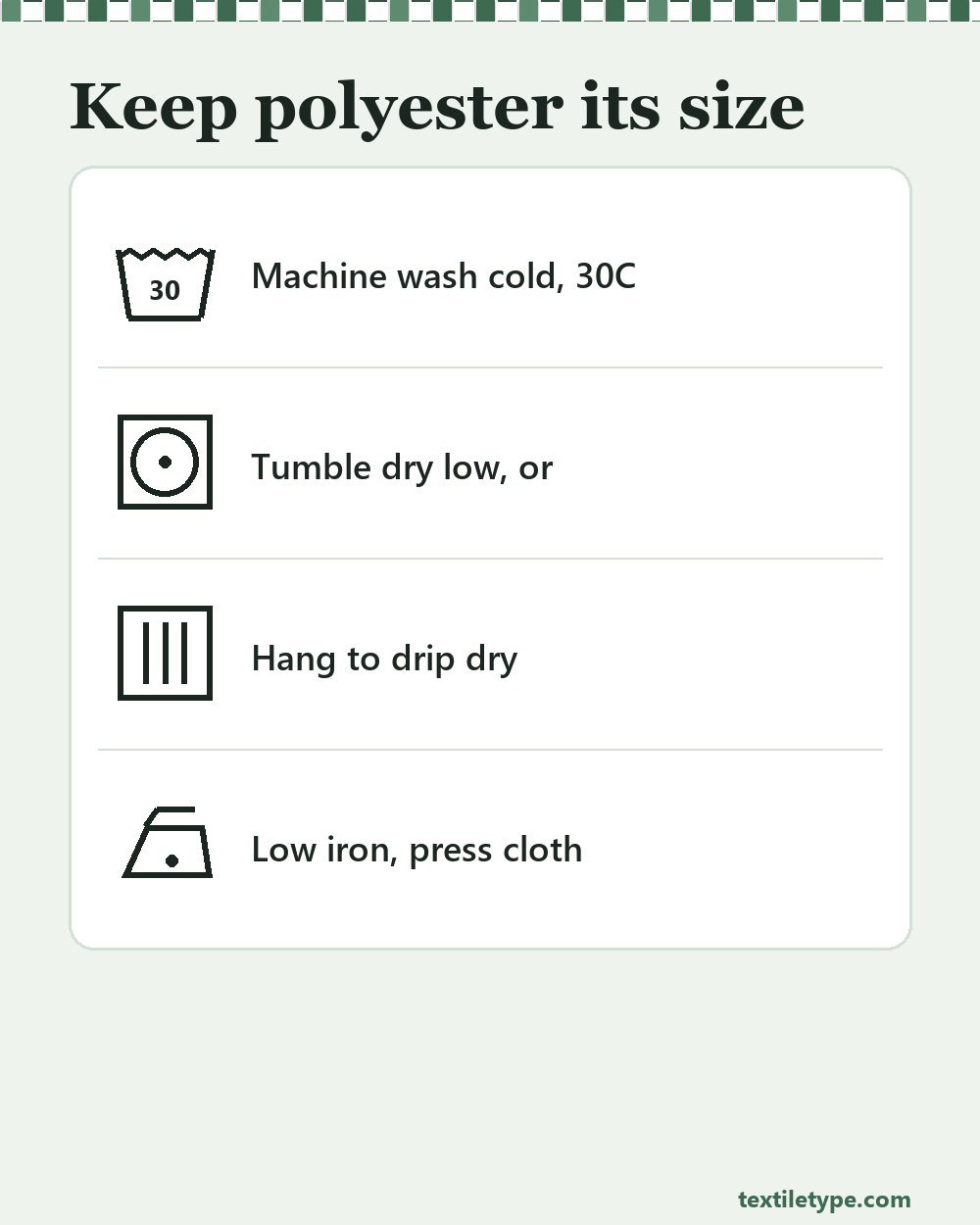
A gentle routine costs nothing and keeps polyester and its blends at their original size. It also reduces pilling and static.
- Read the fiber content first. Treat any blend as if it were the more delicate fiber.
- Wash in cold or warm water. Cold is plenty for everyday polyester.
- Turn knits and printed tees inside out to cut abrasion.
- Dry on low or medium, or use a permanent press cycle, which ends with a cool-down period.
- Pull items out promptly; heat plus a heap of hot laundry sets wrinkles.
- Hang or lay flat anything you care about. Polyester dries fast anyway.
- Iron on the low setting with a press cloth, and only if you need to.
How to shrink polyester on purpose
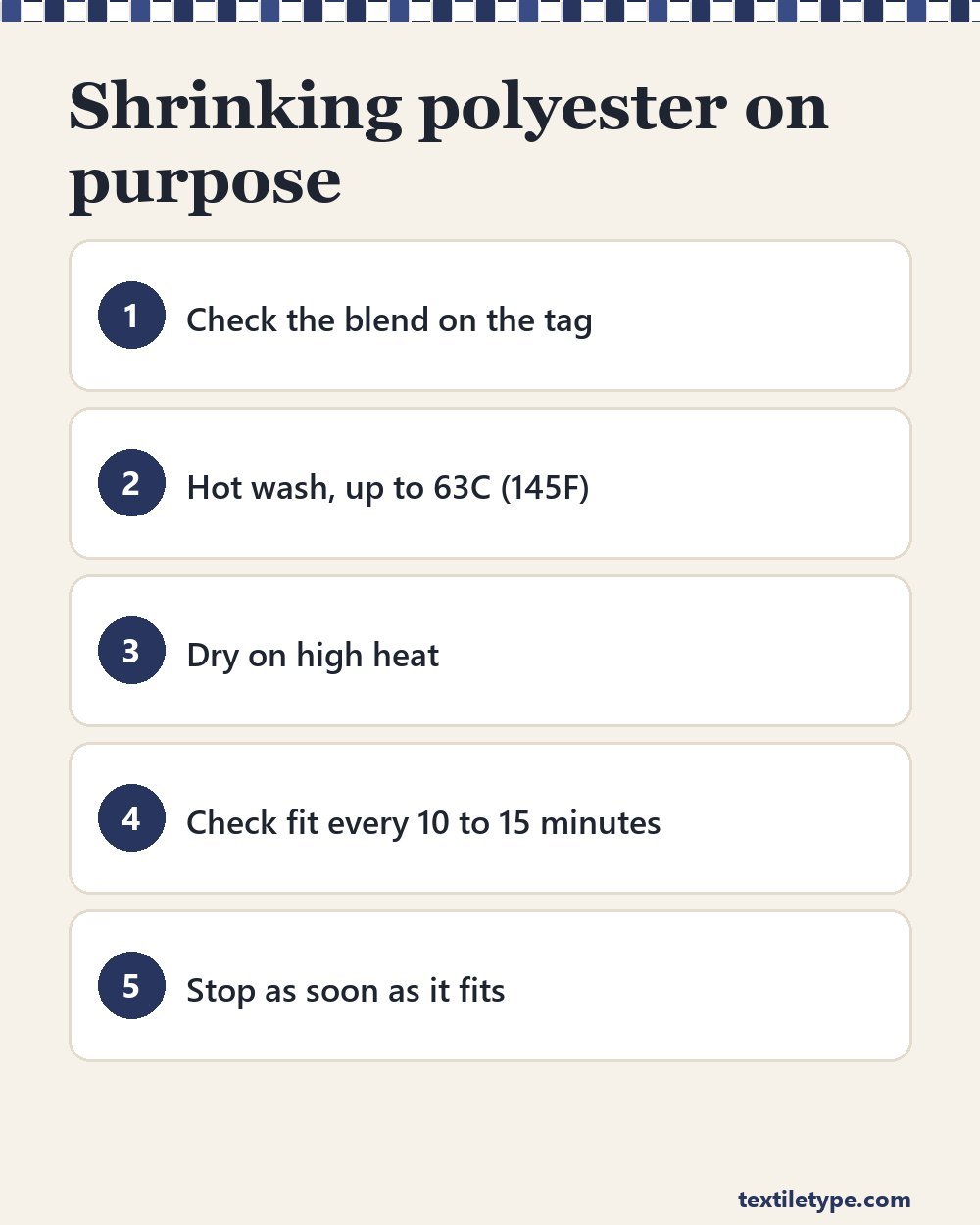
Maybe the athletic shirt is too baggy or the thrifted blazer runs long. You can try shrinking it, but know the odds first: pure polyester usually moves only a little, while blends with cotton or rayon respond more. Changes can also be uneven, since seams, linings and trims each react differently.
- Check the tag. A high cotton or rayon share means a better chance of visible shrinking.
- Wash on the hottest setting the machine offers, which on a care label means water up to about 145°F (63°C).
- Move it straight to the dryer on high.
- Check fit every 10 to 15 minutes, while the garment is still warm.
- Stop as soon as it fits; repeat the cycle once if it still needs a little more.
- From then on, wash cool and dry low so it stays at the new size.
For anything with structure (a suit jacket, lined trousers, a formal dress), a tailor will get a better result than heat. Alterations change length or width exactly where you want them; a hot dryer changes everything a little and sometimes unevenly.
What the care label is really telling you
US care labels follow the FTC’s Care Labeling Rule, and its definitions hide a useful detail: silence has meaning. Under the Rule, a label that says “machine wash” without a temperature means hot water (up to 145°F) can be used regularly. A label that says “tumble dry” with no setting means a high dryer setting is acceptable.
So when a polyester top says “machine wash cold, tumble dry low,” take it literally; the maker is warning you away from hotter settings. When it just says “machine wash, tumble dry,” the maker claims the garment can handle hot water and high heat.
- Machine wash cold, tumble dry low, cool iron if needed
- Polyester blend: wash cold, hang dry, do not iron prints
Save those two lines to your notes as a fallback routine for polyester with a missing or faded label.
A short walkthrough of methods for shrinking a polyester garment, useful to watch before you commit to a hot cycle.
Can you undo polyester shrinkage?
Sometimes, partly. If a knit tightened up in the dryer, soak it in lukewarm water, press out the water in a towel, ease it gently back toward its original shape, and let it dry flat. That can recover some length or width in knits and blends.
Heat damage is harder. Puckering, shine and melted spots in polyester are physical changes to the fiber surface, and no wash will reverse them. Prevention, in this case, really is the whole cure. For the basics of the fiber itself, read our guide to what polyester fabric is, and browse more laundry help in the fabric guides hub.
An apparel maker’s care guide for polyester clothing, covering everyday washing and drying.
Polyester shrinkage FAQ
Does polyester shrink in the dryer?
Pure polyester rarely shrinks much in a home dryer, because even high settings run close to, but mostly below, the temperature where polyester softens. Blends and knits can tighten on high heat, so low or medium is the safer habit.
Does 100% polyester shrink in hot water?
Not in any meaningful way. The FTC’s definition of a hot wash tops out at 145°F (63°C), which sits below polyester’s softening range.
How much does a polyester-cotton blend shrink?
It varies with the cotton share and whether the fabric was preshrunk. More cotton generally means more shrinking, so treat a cotton-rich blend like cotton and keep the dryer low.
Can you shrink polyester with an iron?
Not safely. An iron is hot enough to soften or glaze polyester, so it tends to leave shiny or puckered spots instead of an even size change.