Organza is the sheer fabric that refuses to flop. Hold a length of it up and it stands away from your hand like a sheet of very fine paper, crisp, see-through and faintly glossy. So what is organza fabric, exactly? It is a thin, sheer plain weave, traditionally made from silk, known for a crisp hand, a lot of stiffness for its weight and a slippery surface. Today a great deal of it is woven from polyester or nylon filament instead.
That stiffness is the whole point. Chiffon floats and georgette ripples, but organza holds a shape: a puffed sleeve, a standing ruffle, a skirt that keeps its volume. It also works behind the scenes, inside couture garments and on the ironing board, in ways most shoppers never see.
This guide explains where organza’s crispness comes from, how silk and synthetic versions differ, which finishes you will meet in shops, how it compares with its sheer cousins, and how to sew and clean it without crushing the effect.
Organza at a glance
- Construction
- Sheer plain weave of fine, tightly twisted filament yarns
- Fibers
- Silk (traditional), polyester, nylon
- Hand
- Crisp, stiff for its weight, slippery
- Drape
- Stands away from the body; holds volume
- Best for
- Overlays, bridal and evening wear, sleeves, interfacing
- Care
- Silk: usually dry clean. Synthetic: gentle cool wash, low iron
On this page
What is organza fabric, in plain terms
Organza is a sheer fabric made in a plain weave, the simplest over-one, under-one grid. Its character comes from the yarn: fine continuous filaments (long unbroken strands rather than short spun fibers) twisted tightly before weaving. The finished cloth is transparent, light and springy, with a firm hand that rustles a little when it moves.
The name is usually traced to the French word “organsin,” a term for twisted silk thread, and possibly further back to Urgench, a city on the old Silk Road in Central Asia. Sources hedge on that second step, so treat it as a likely story rather than settled fact.
Silk organza is still woven in China, in India and in smaller luxury quantities in France and Italy. Most organza sold by the yard in ordinary fabric stores, though, is synthetic. Check the bolt end before you assume.
Where the crispness comes from
Plenty of fabrics use a plain weave, and most of them are soft. Organza is crisp for two reasons working together.
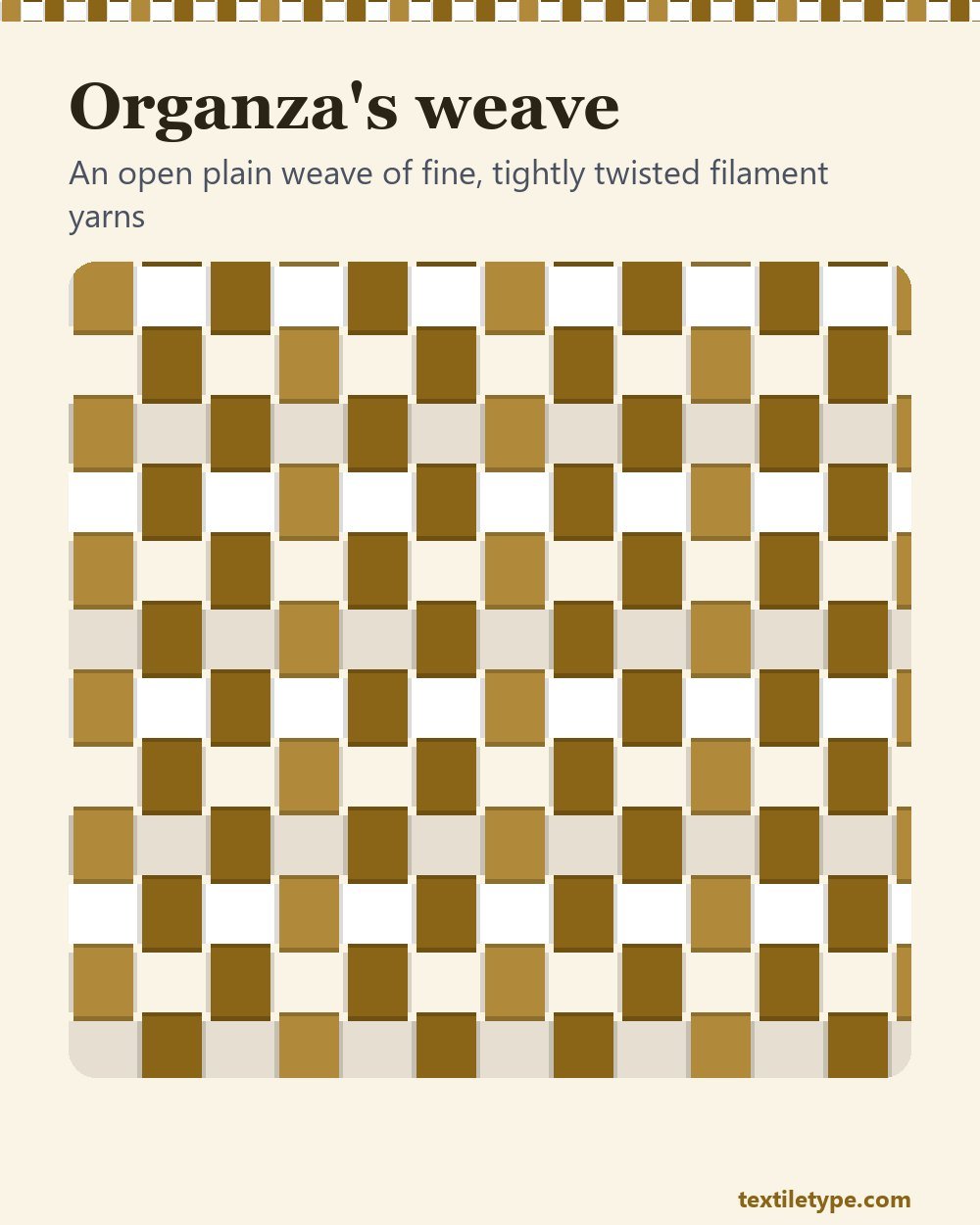
Tight twist
Twisting a yarn hard makes it firmer and more wiry. Woven in an open grid, those wiry yarns resist bending, so the cloth pushes back instead of collapsing. Fiber references describe classic silk organza as woven from fine, tightly twisted raw silk threads, and that twist is a big part of why it is stiffer than chiffon.
Gum left on the silk
Raw silk is coated in a natural protein gum called sericin. Most silk fabrics are “degummed” (scoured) to remove it, which makes them softer and more lustrous. Traditional silk organza keeps much of that gum. A 2006 study in the Journal of the Korean Society of Clothing and Textiles found that scouring silk organza made it more flexible, and that the fabric lost its distinctive stiff, crisp handle. In other words, the gum is doing structural work.
Synthetic organza gets its body differently, from stiff filament yarns and finishing, but the goal is the same: a sheer that behaves more like a thin sheet than a cloud.
Silk organza vs polyester and nylon organza
From across a room they look alike. Up close, and in the wash, they part ways. These are general tendencies; quality varies a lot between mills and finishes.
| Fiber | Look and hand | Strengths | Weak spots | Usual care |
|---|---|---|---|---|
| Silk organza | Crisp but softer to the touch, gentle sheen | Takes dye beautifully, tolerates a hot iron well, ideal for interfacing | Price, water spots, can soften if washed hard | Usually dry clean; press with care |
| Polyester organza | Stiffer, often shinier | Affordable, wrinkle resistant, easy to find | Melts or glazes under a hot iron, can feel scratchy | Gentle cool wash if the label allows; low iron |
| Nylon organza | Light, smooth, crisp | Lower cost than silk, lightweight | Heat sensitive | Gentle wash, low heat |
For bridal work and couture, silk organza is the traditional pick. For decorations, gift bags, costume overlays and anything that might meet a washing machine, polyester is usually the practical one. If you want to know more about how that fiber reacts to heat, our polyester fabric guide covers it, and the nylon guide does the same for nylon.
Shot, crystal and other organza finishes
Shop labels for organza can sound like a jewelry counter. Here is what the common names usually mean.
- Shot organza. The lengthwise and crosswise yarns are different colors, so the cloth shimmers between them as it moves. The Victoria and Albert Museum holds a 1956 sample of shot silk organza retailed by Ascher Ltd and notes that a shot effect needs a plain weave and a different color in warp and weft. The museum also describes shot silk organza of the time as a luxury fabric for evening wear.
- Crystal organza. A retail name for a glossy, usually synthetic organza with a bright sheen, common in bridal and decor.
- Mirror or liquid organza. Sellers use these names for the shiniest synthetic versions. They are marketing terms, not standard definitions, so judge by eye.
- Crushed organza. Organza given a permanent crinkled texture by pressing during finishing.
- Embroidered or printed organza. A base organza decorated with stitching, foil or prints, popular for overlays and saris.
Organza vs chiffon and other sheers
The quickest way to understand organza is to hold it next to its neighbors. Our chiffon guide covers the floaty one in detail; here is the short comparison.
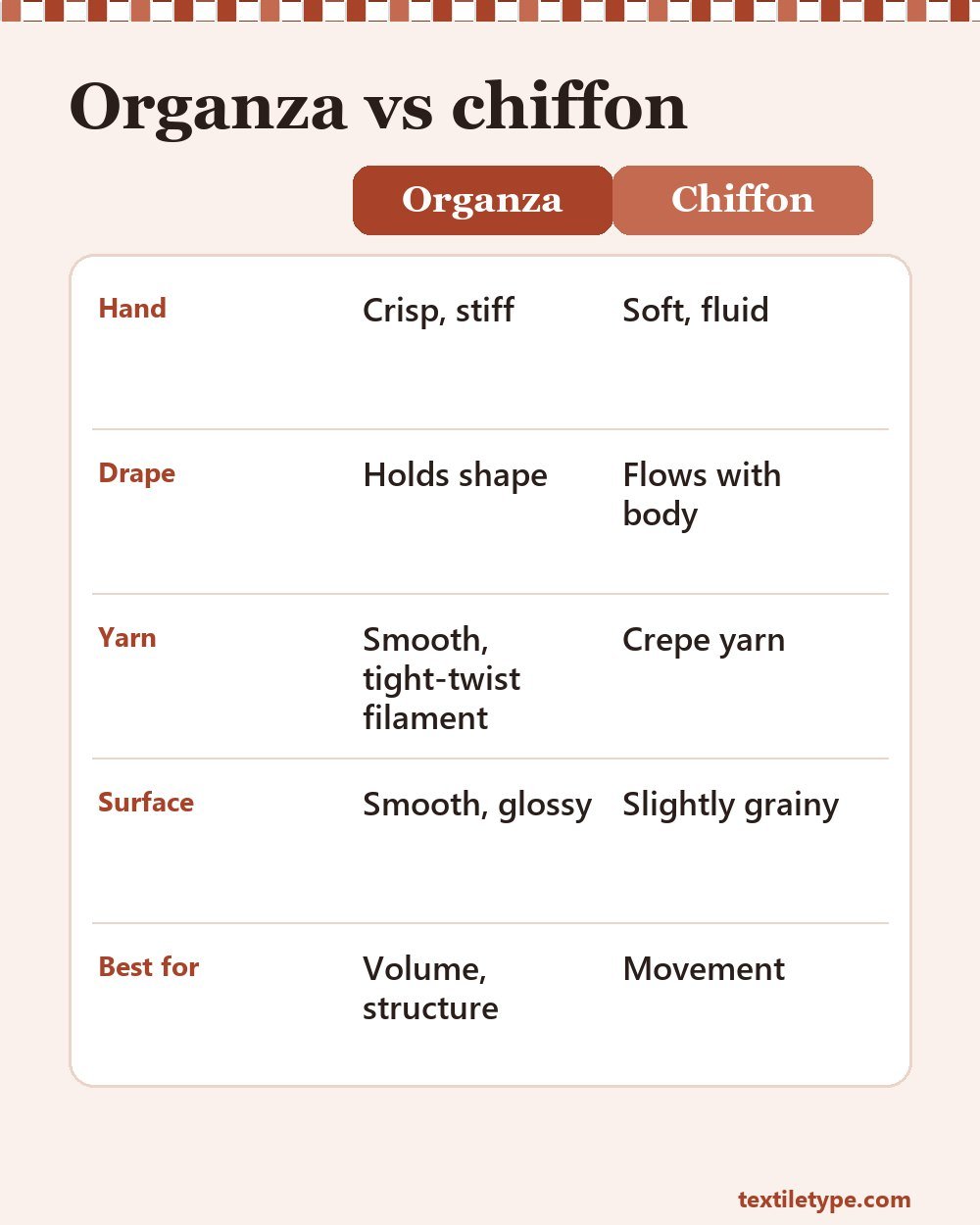
Organza vs chiffon
Both are sheer plain weaves made with twisted yarns, and both come in silk and polyester. Chiffon uses crepe yarns twisted in alternating directions, which give it a fluid drape and a faintly grainy surface. Organza uses smooth, tightly twisted filaments and ends up crisp and stiff. Pick chiffon when you want movement that follows the body; pick organza when you want volume that stands away from it.
Organza vs organdy
Organdy is the cotton cousin. It is a lightweight, sheer, crisp plain weave, usually cotton, made stiff by a brief acid treatment called parchmentizing. Expect organdy to look more matte and organza to look more lustrous. Milliners and costumers use both for structure.
Organza vs tulle, briefly
Tulle is not woven at all. It is a fine net with small, usually hexagonal openings. Both build volume in skirts and veils, but organza gives a smooth, glossy surface while tulle gives an airy mesh. A full head-to-head comparison of the two is coming to the site soon.
The hidden jobs organza does in sewing
Organza has a second career inside other garments, and it is the reason serious sewists keep a few yards of silk organza in the cupboard.
- Sew-in interfacing. The Home Sewing Association’s silk fact sheet lists organza among common interfacings for silk, and notes that fusible products often bubble or separate on fine silks. Silk organza adds body without bulk.
- Underlining. New Mexico State University Extension lists organza (for silk) as a crisp underlining option for very light to lightweight fabrics. Underlining is a layer cut from the same pattern pieces and sewn as one with the fashion fabric, so it adds support and strengthens seams.
- Press cloth. A scrap of ivory silk organza makes a favorite pressing cloth because you can see through it to line up seams, and silk handles iron heat far better than synthetics.
- Sleeve heads and seam finishes. Couture sewists also use strips of silk organza to support sleeve caps and as a light binding for raw edges.
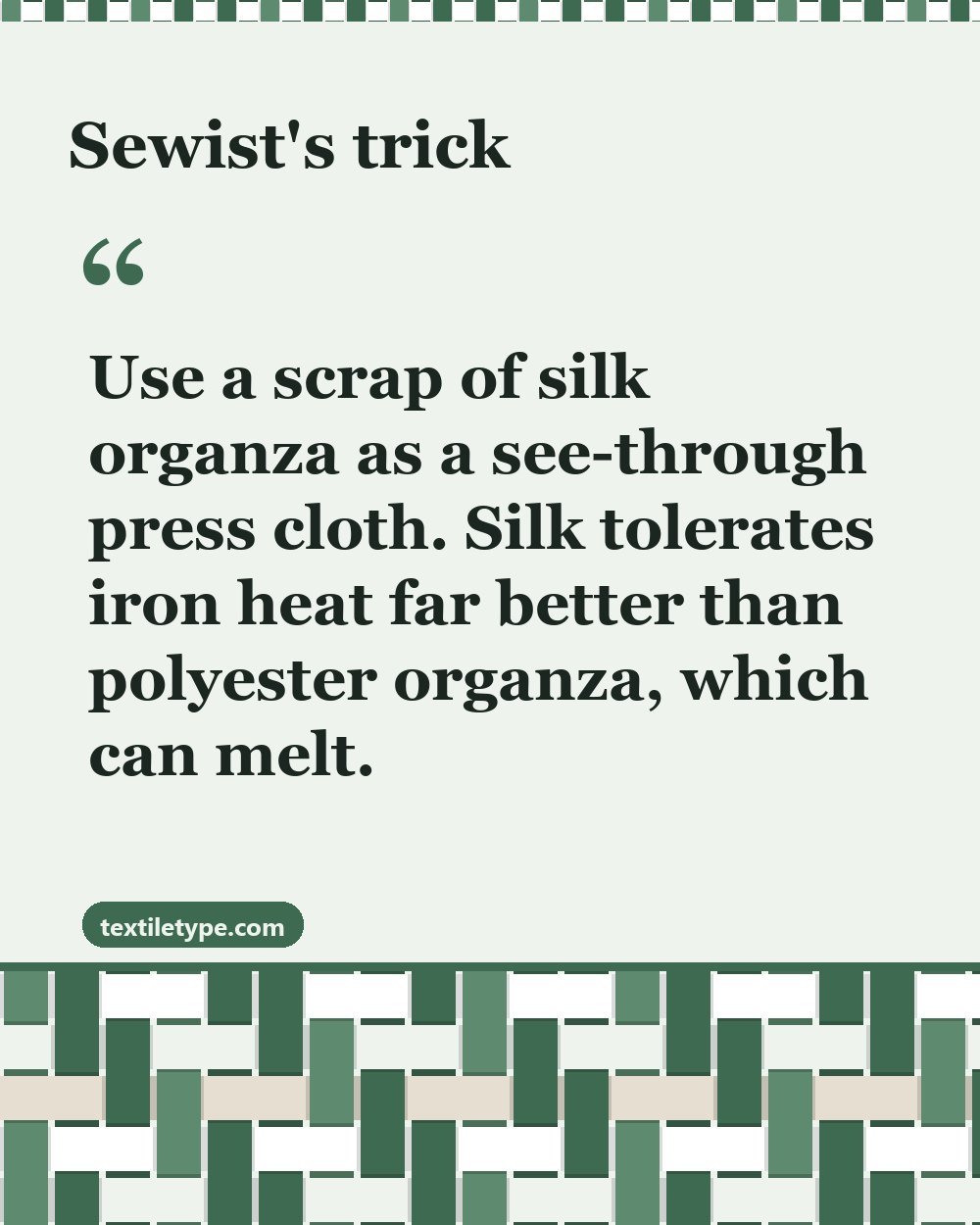
Be careful with the press cloth trick: it only works with silk organza. A polyester organza press cloth can melt onto your iron.
A couture-focused look at using silk organza for underlinings, interfacings and structure, the behind-the-scenes uses described above.
Sewing organza so it stays crisp
Organza is easier to handle than chiffon because it does not slither as much, but it frays freely and every seam shows through. Plan the insides as carefully as the outside.
- Check the fiber first. Silk and synthetic organza need different pressing temperatures, so do a quick test press on a scrap before you cut.
- Cut on a flat, firm surface with sharp shears or a rotary cutter, and use weights or fine pins placed inside the seam allowance.
- Use a fine, fresh needle. For finely woven silks, a size 70/10 universal or Microtex needle is a common recommendation. A fine needle avoids visible holes and pulled threads.
- Enclose every raw edge. French seams are the classic choice because the edges are hidden inside a narrow tube, which matters on a see-through fabric.
- Hem narrow. A narrow rolled or baby hem suits organza; a deep hem shows as a solid band.
- Press as you go at the lowest effective heat, with a press cloth on the right side to avoid shine.
A milliner compares silk organza with cotton organdy, handy if you are choosing a crisp sheer for structure.
Washing, pressing and storing organza
Start with the care label and the fiber line. Silk organza is usually labeled dry clean, and that is the safe route for structured, beaded or lined pieces. Synthetic organza can often be washed gently.
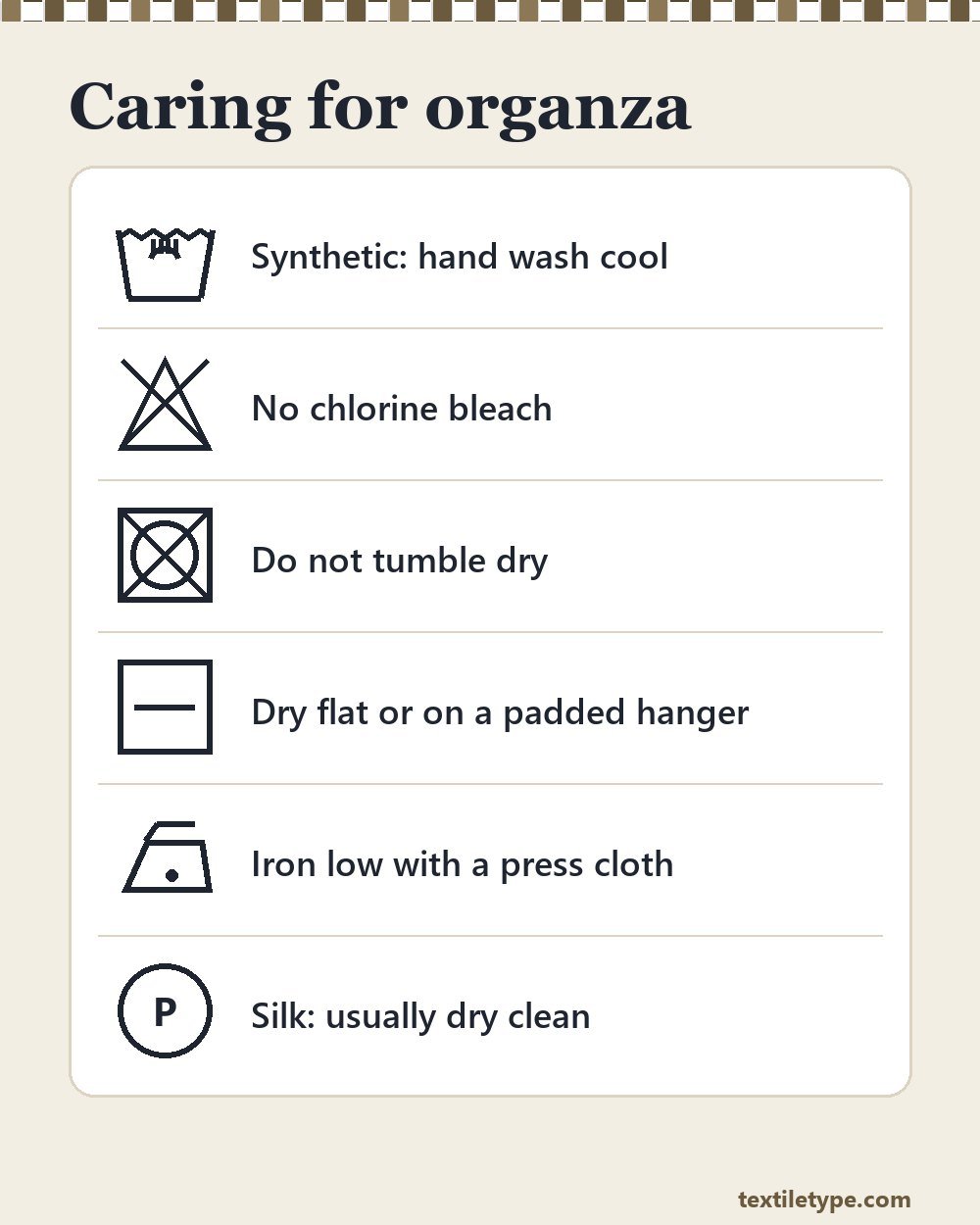
- Silk organza: dry cleaning is the usual recommendation. If you want to wash it, test a scrap first in cool water with a very mild soap, and expect it to lose some crispness.
- Synthetic organza: hand wash cool or use a delicate cycle in a mesh bag, without long soaking.
- Skip the dryer. Lay flat or hang on a padded hanger out of direct sun.
- Press low. Use the lowest effective setting and a press cloth; polyester and nylon can glaze or melt.
- Avoid chlorine bleach on silk entirely.
- Store loosely. Roll yardage around a tube or hang garments with room to breathe; hard folds can leave lasting creases in crisp sheers.
Organza often turns up as an overlay on a smoother base fabric, and our satin guide explains that common partner. For more sheers and staples, browse all Textile Type fabric guides.
Organza FAQ
Is organza see-through?
Yes. Organza is sheer by design, which is why it is usually used as an overlay, a sleeve or a layer over a lining. Darker colors and multiple layers reduce the transparency.
Is organza itchy?
It can feel scratchy against bare skin, especially stiff synthetic organza with cut edges. Silk organza is usually softer. A lining or enclosed seams keep organza away from your skin.
Does organza wrinkle?
Organza tends to spring back from light crumpling but can hold sharp creases if crushed or folded hard. Hang it or roll it for storage, and press creases out at low heat with a press cloth.
What is the difference between silk organza and regular organza?
Silk organza is woven from silk and is the traditional, more expensive version, softer to the touch and tolerant of a hot iron. “Organza” on its own in a store usually means polyester or nylon, which is cheaper and more heat sensitive.
Sources and further reading
- Wikipedia: Organza
- Victoria and Albert Museum: Dress fabric, shot organza, Ascher Ltd, 1956
- Journal of the Korean Society of Clothing and Textiles: Persimmon juice treatment and hand values of silk organza
- Home Sewing Association: Fabric facts, silk
- NMSU Extension: Selecting interfacings, underlinings and linings