Interlock is the knit that looks like jersey from both sides. So, what is interlock fabric? It is a double knit made by locking two 1×1 rib fabrics together as they are knitted, which gives you a smooth, dense cloth with no wrong side, edges that stay flat, and a calmer, more stable stretch than a plain T-shirt knit.
If you sew, interlock is the knit that forgives you. If you shop for baby clothes, turtlenecks or better-quality tees, you have probably handled it without knowing the name.
Our jersey guide and rib knit guide already cover how loops, wales and courses work, so this page sticks to what makes interlock different: how the two ribs lock together, how to spot it on the bolt, how it compares with jersey, and how to sew and wash it.
Interlock at a glance
- Fabric type
- Weft-knitted double knit, made on two sets of needles
- Built from
- Two 1×1 rib fabrics knitted into each other
- Two sides
- Look the same, smooth on both faces
- Edges
- Cut edges lie flat instead of curling
- Stretch
- Mostly crosswise, very little lengthwise, less than rib
- Typical uses
- Baby clothes, T-shirts, turtlenecks, knit dresses, children’s wear
On this page
What is interlock fabric made of: two ribs in one
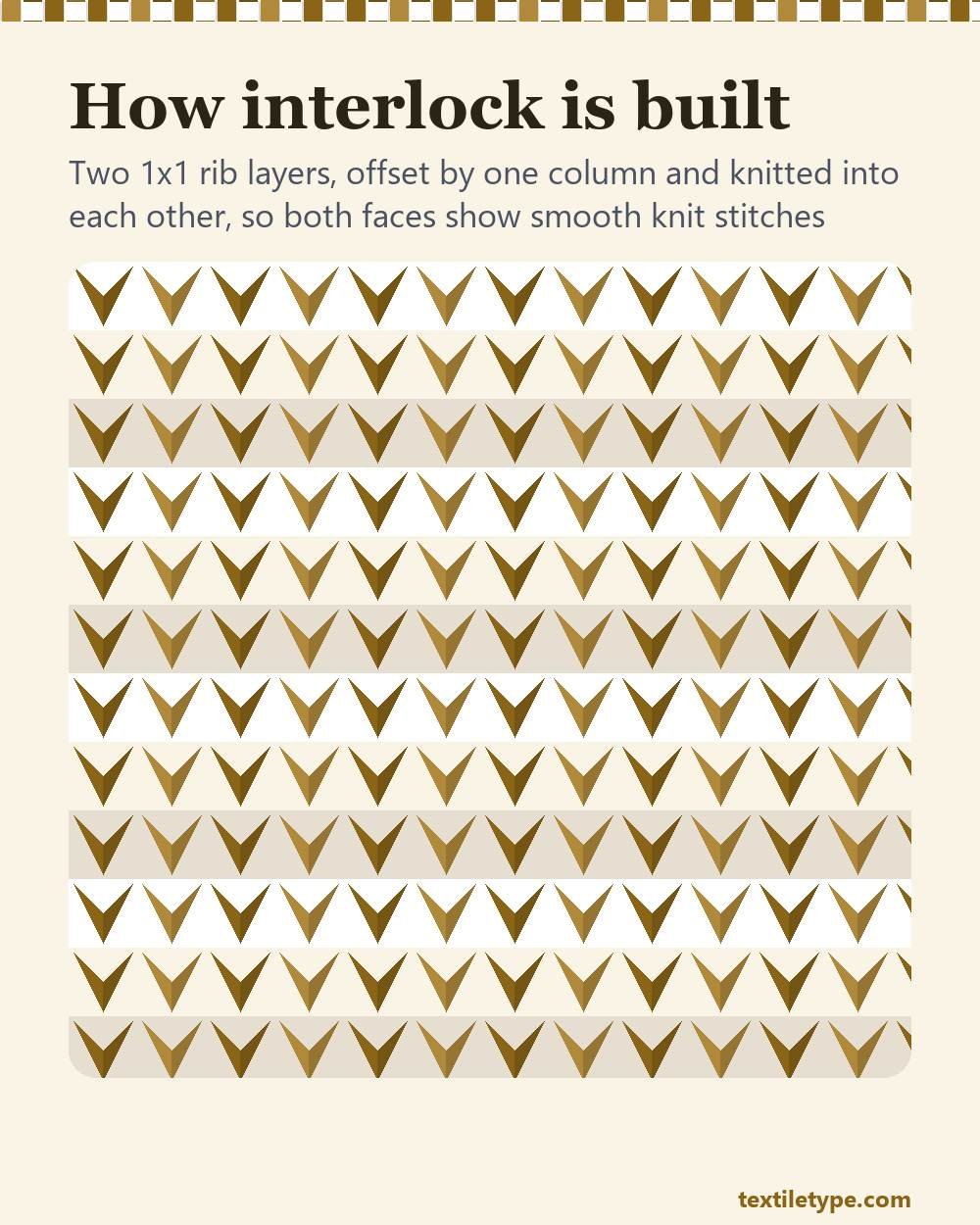
Start with a 1×1 rib, the kind that alternates one knit column with one purl column. Now imagine a second 1×1 rib sitting right behind it, offset by one column, so that its knit columns fill the gaps in the first one. Knit those two layers into each other as they form and you have interlock. The textile resource FabricLink describes it in almost those words: a variation of rib knit that resembles two separate 1×1 rib fabrics that are interknitted.
On a circular knitting machine, this happens between two sets of needles: the cylinder (the upright ring of needles) and the dial (a flat ring of needles above it). Cotton Incorporated’s CottonWorks site explains that for rib the needles on the two beds are staggered, while for interlock they sit directly opposite each other. To stop them clashing, the machine alternates which set is active, and the pattern repeats every two yarn feeds instead of every one.
The result is that each face of the fabric shows only the smooth knit side of the loops. The purl bumps are buried in the middle, where the two layers hold hands.
A short explainer on interlock’s structure, stretch and performance, handy if you want to see the double layer up close.
How to recognize interlock in the store
Fabric labels are not always helpful, and plenty of bolts just say “knit.” These quick checks separate interlock from single jersey in under a minute.
- Flip it over. Both sides show fine lengthwise lines of V-shaped stitches. Jersey has Vs on one side and bumpy rows on the other.
- Look at a cut edge. Interlock lies flat. Jersey rolls up, sometimes enthusiastically.
- Pull lengthwise. Interlock barely moves along its length. Threads Magazine describes it as having almost no lengthwise stretch.
- Pull crosswise. It gives, then recovers in a calm, even way rather than snapping back like rib.
- Pinch it. It feels thicker and more substantial than jersey of the same fiber.
- Hold it to the light. The double layer makes it more opaque than most single knits.
Interlock vs jersey vs rib
Interlock and jersey are often sold side by side for the same projects, which is where confusion starts. Rib is the third cousin in the room, since interlock is built from it. The table pulls together what teaching material from NPTEL, CottonWorks and Threads Magazine says about each. Treat it as general tendencies; fiber, yarn and weight shift the details.
| Feature | Single jersey | 1×1 rib | Interlock |
|---|---|---|---|
| Needle sets | One | Two, staggered | Two, directly opposite |
| Face and back | Different | Same | Same, smooth on both |
| Cut edges | Curl | Lie flat if knitted correctly | Lie flat |
| Crosswise stretch | Good | High, strong snap-back | Good, lower than rib |
| Lengthwise stretch | Some | Some | Almost none |
| Thickness | Thin | Thicker | Similar to rib but more compact |
| Runs and laddering | Can run | Unravels from the last knitted end | Unravels only from the last knitted end |
| Typical jobs | Tees, tops, linings | Cuffs, neckbands, fitted pieces | Baby clothes, tees, turtlenecks, dresses |
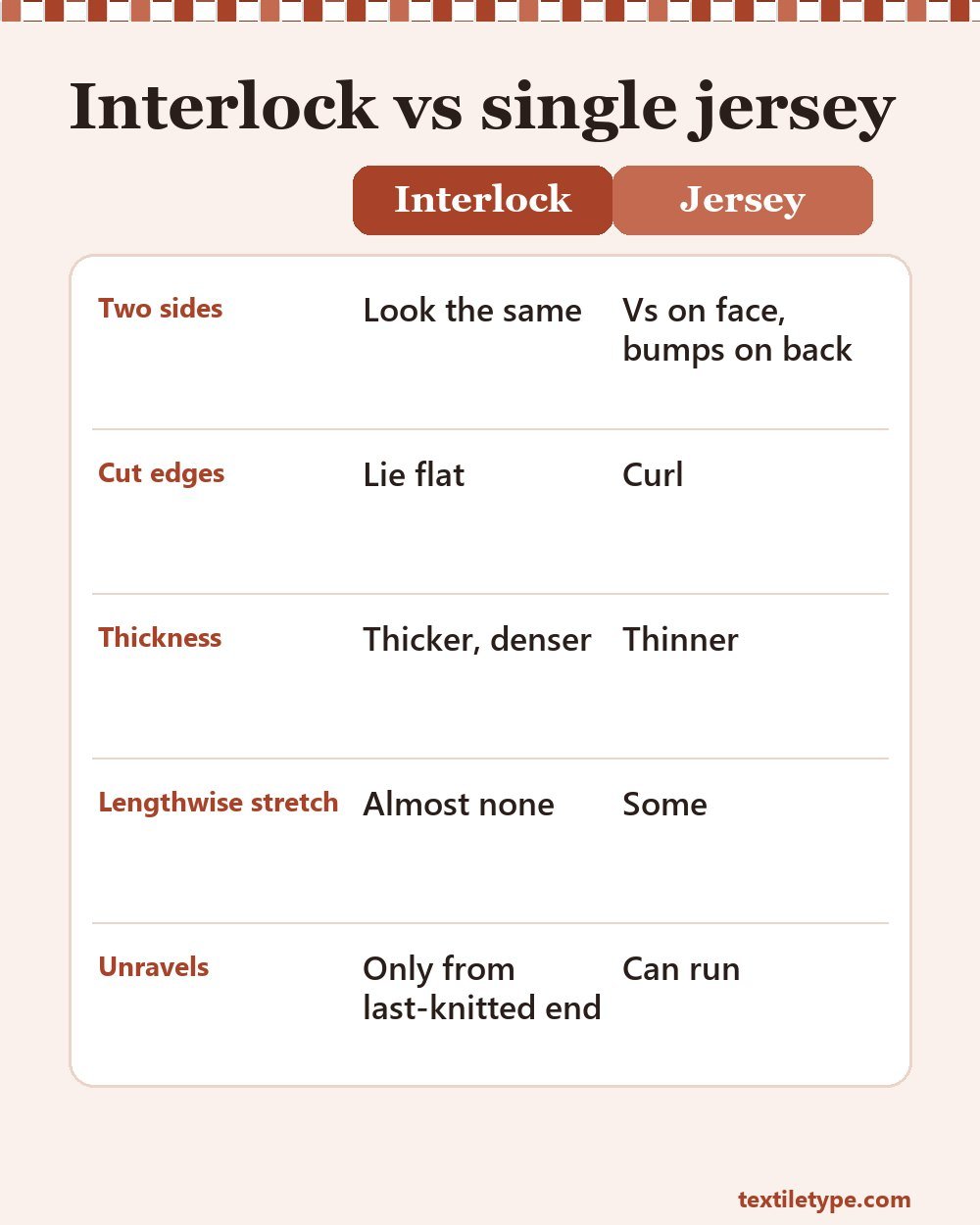
The short version: pick jersey when you want light drape and a little cling, interlock when you want a smoother, steadier knit that hides what is underneath, and rib when you need grip and snap-back at an edge.
Why interlock lies flat and keeps its shape
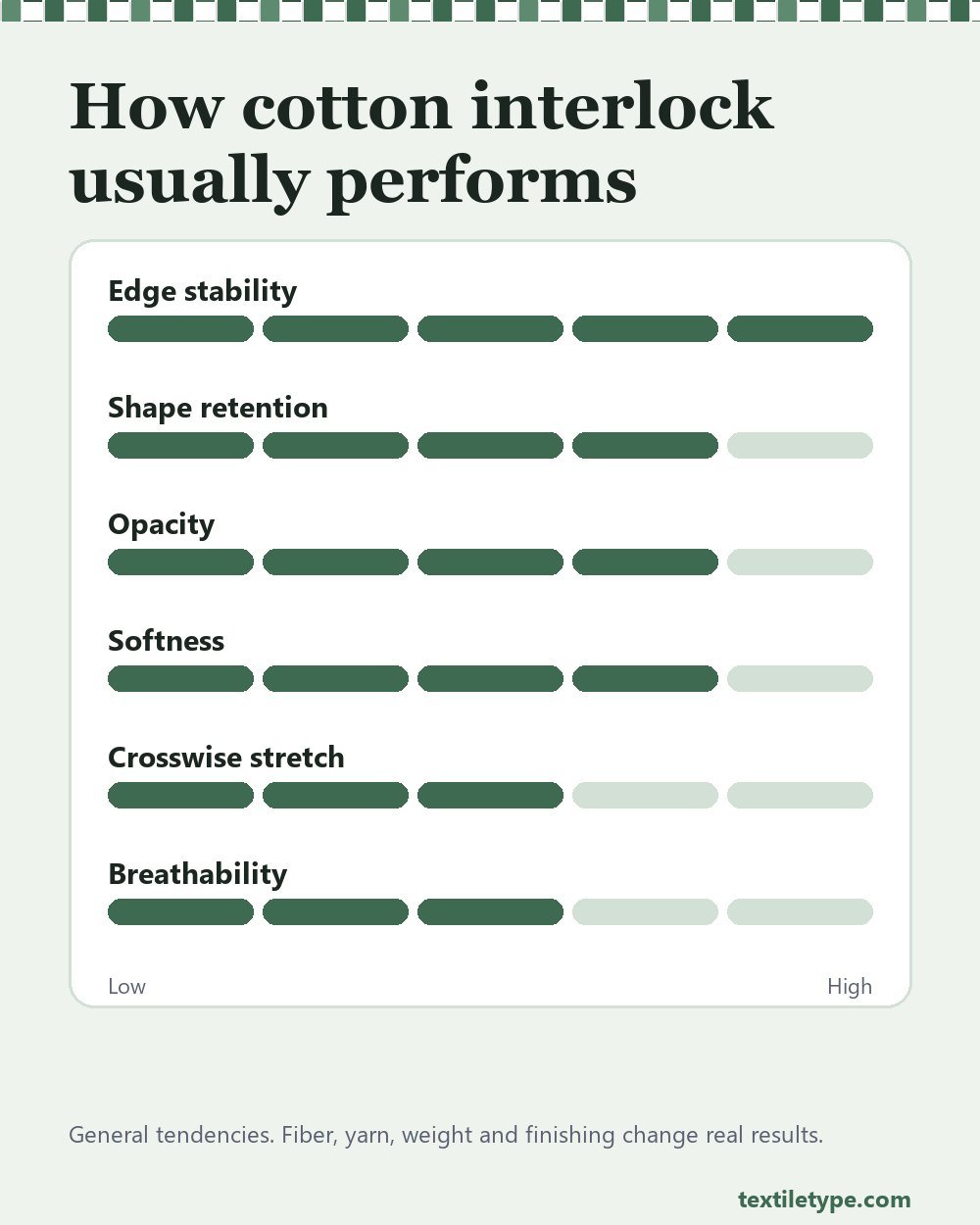
Single jersey curls because its face and back sit under different tension, so the edge rolls toward one side. Interlock has a knit face on both sides, so those forces cancel out. That balance is why CottonWorks describes interlocks as very stable fabrics with no curling, and why a textile article on Fibre2Fashion says the fabric neither curls nor ladders.
The interlocking itself also reins in stretch. NPTEL’s knitting lesson (a course from India’s Institute of Technology program) puts the lower stretch of interlock, compared with the rib it is built from, down to the interlocking of the two structures. In plain words: each rib layer wants to stretch, and its partner holds it back.
There is a density effect too. The same NPTEL lesson notes that interlock is generally heavy and has the least porosity of the three basic knit structures it compares (jersey, rib and interlock). Fewer gaps mean a smoother surface, better coverage and a fabric that looks tidier after wear, though it also means a little less airflow than an open jersey.
What interlock is used for
Interlock earns its keep wherever comfort and good behavior both matter.
- Baby and children’s clothes. CottonWorks notes that combed cotton interlock can be very soft, and lists baby clothes among its uses; Threads Magazine also recommends it for children’s wear.
- T-shirts and turtlenecks. Both CottonWorks and Threads name these. The weight and opacity make a tee feel more substantial.
- Knit dresses and casual skirts. The smooth face and steady shape suit simple silhouettes that would look flimsy in single jersey.
- Underwear and sportswear. Fibre2Fashion lists underwear, shirts and sportswear as typical interlock end uses.
- Layering pieces. CottonWorks describes double knits in general as good for heavier garments that need structure or are worn in layers.
Interlock also has relatives you may recognize. Fibre2Fashion lists Ponte di Roma among the fabrics derived from the interlock structure, which explains why ponte shares interlock’s flat edges and firm hand. If you are comparing weights across these knits, our explainer on GSM in fabric shows how to read the number on the listing.
The trade-offs
Interlock is pleasant to wear and easy to sew, but it is not a free upgrade.
- It costs more. CottonWorks points out that double knits use more yarn than single knits, which raises the fabric price.
- It is heavier. Great for a winter turtleneck, less great for a sticky August.
- It stretches less than rib. For a snug cuff or neckband, a true rib still does the job better.
- It has little lengthwise give. Leggings and close-fitting activewear usually need spandex or a different knit.
- It drapes less. If you want a fluid, swishy dress, a jersey in viscose or modal will move more.
Sewing interlock knit
Flat edges make interlock one of the calmer knits to cut and pin. Two things still trip people up: its crosswise stretch and its one unravelling end. This order of work keeps both in check.
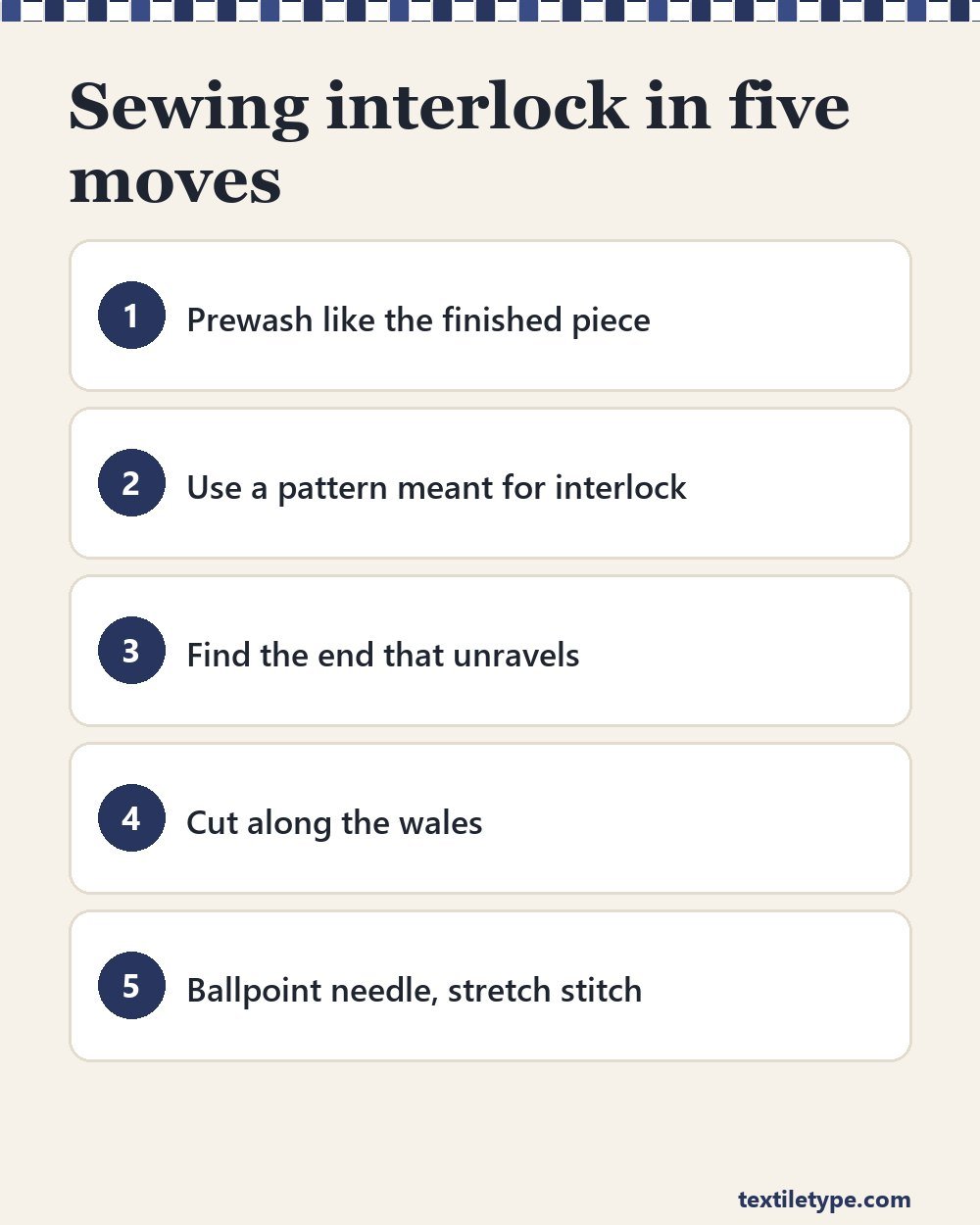
- Prewash the fabric the way you will wash the finished piece, so any shrinkage happens before you cut.
- Check the pattern. Threads Magazine advises using a pattern designed for interlock knits, or being ready to adjust, because interlock stretches more crosswise than some double knits.
- Find the running end. Tug gently at each cut end; the end that ladders is the last-knitted end. Plan hems so that edge gets finished and is not left raw at a point of strain.
- Cut along the wales. Line the grainline up with the lengthwise columns of Vs, which are visible on both faces.
- Use a ballpoint or jersey needle and a stretch stitch, a narrow zigzag or a serger.
- Press with care. Use a temperature that suits the fiber and lift the iron rather than sliding it, so the knit does not grow.
A sourcing guide that compares single jersey with interlock knits, useful when you are choosing between the two for a garment.
Washing and drying interlock
Interlock’s care comes from its fiber first. Cotton interlock acts like other cotton knits: it can shrink a little if it meets high heat, especially the first time. Polyester interlock barely changes. Blends land somewhere in between, so the label wins every argument.
- Wash cool or warm on a normal or gentle cycle, inside out.
- Skip chlorine bleach on colors; check the label for whites.
- Tumble dry low, or dry flat if the piece is heavy.
- Fold knit dresses and turtlenecks for storage instead of hanging.
Interlock fabric FAQ
Is interlock stretchy?
Yes, mostly across the width. It has almost no lengthwise stretch and less crosswise stretch than rib, but it recovers well, so it suits tees and children’s clothes that need comfort without bagging.
Is interlock better than jersey?
Neither is better in every case. Interlock is thicker, smoother on both sides, more opaque and easier to sew because it lies flat, while jersey is lighter, drapier, cheaper and cooler in hot weather.
Does interlock fabric curl?
No, or barely. Both faces have the same structure, so the tension that rolls jersey edges is balanced out, which is why sewists like it for beginner knit projects.
Is interlock the same as double knit?
Interlock is one type of double knit. The term double knit also covers rib, Ponte di Roma and double-knit jacquards, all made on two sets of needles.
Explore more knits and wovens in our fabric guides.