Viscose is the fabric that feels like silk, hangs like silk, and then shrinks a size in a warm wash as if to remind you it is not silk. If you have ever bought a floaty summer dress labeled “100% viscose” and wondered what you actually paid for, this guide answers that question in plain English.
So, what is viscose fabric? It is a soft, drapey cloth spun from cellulose, usually taken from wood pulp, that has been dissolved and turned back into fibers. That makes it a semi-synthetic: the raw material grows on trees, but the fiber itself is made in a factory. Below you will find how it is made, how it behaves on your body and in the wash, how to read the label, and what to weigh before buying it.
Viscose at a glance
- Fiber type
- Regenerated cellulose (a type of rayon)
- Usual source
- Wood pulp; bamboo and other plants are also used
- Feel
- Smooth, cool, soft, with a fluid drape
- Best for
- Dresses, blouses, linings, scarves, summer tops
- Weak spot
- Much weaker when wet, so it shrinks and stretches easily
- Care
- Follow the label; gentle cool wash or dry cleaning, air dry flat
On this page
What is viscose fabric, exactly?
Cotton, linen and hemp are cellulose that a plant has already arranged into usable fibers. Viscose takes a shortcut and a detour at the same time. Manufacturers start with purified cellulose pulp, dissolve it into a thick honey-like liquid, then push that liquid through tiny holes to form brand-new filaments. The plant supplies the molecule; the factory decides the fiber’s length, thickness and shine.
The name comes from that thick intermediate liquid, which chemists called viscose because it is so viscous. British chemists Charles Cross, Edward Bevan and Clayton Beadle patented the process in 1892, and the UK company Courtaulds began commercial production of viscose rayon in 1905. For decades it was marketed as “artificial silk,” which tells you exactly what it was trying to imitate.
Because the fiber is made rather than grown, it can be engineered to look matte or glossy, to be fine enough for chiffon-like blouses or chunky enough for velvet pile. That flexibility is why you find viscose in everything from cheap fast-fashion tops to expensive evening wear.
A short HowStuffWorks explainer on what viscose is and the sustainability questions around it, useful if you prefer to watch before you read on.
From tree to thread: how viscose is made
The viscose process is a piece of 19th-century chemistry that is still running today. The broad strokes are the same everywhere, although each mill tunes the details.
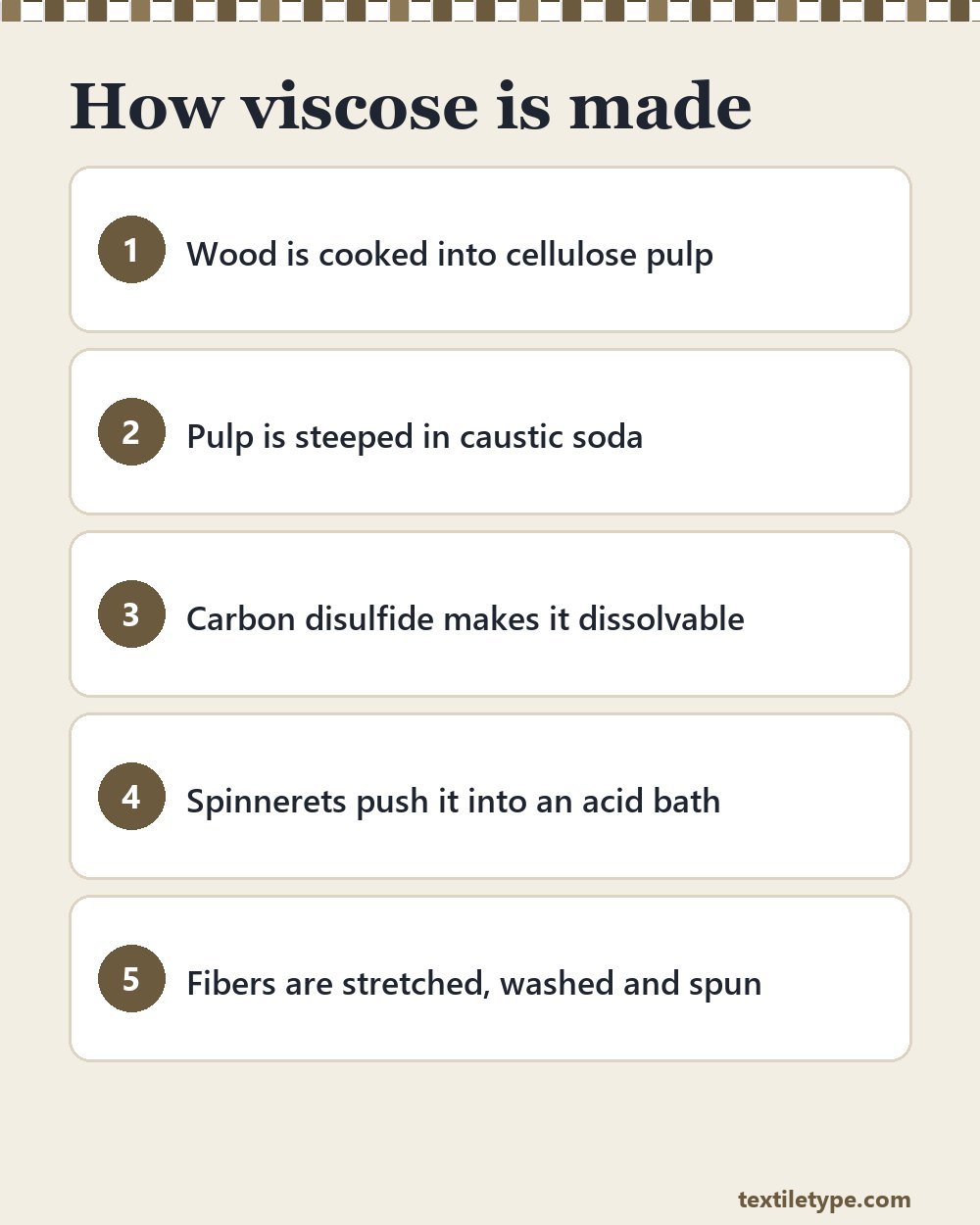
- Pulping. Wood (often eucalyptus, beech, pine or spruce) is chipped and cooked into a purified cellulose pulp, which arrives at the fiber plant as thick sheets.
- Steeping. The pulp is soaked in sodium hydroxide (caustic soda), which swells it into “alkali cellulose.”
- Xanthation. Carbon disulfide is added, turning the cellulose into cellulose xanthate, an orange crumb that can dissolve.
- Dissolving and ripening. The xanthate is dissolved in more dilute caustic soda to make the viscous solution, then left to ripen, filtered and degassed.
- Spinning. The solution is forced through a spinneret, a showerhead with very fine holes, into an acid bath. The acid turns the liquid back into solid cellulose filaments.
- Finishing. The filaments are stretched, washed and either wound as continuous yarn or cut into short staple fiber to be spun like cotton.
The chemistry matters to you as a shopper for two reasons. First, the regenerated fiber is pure cellulose again, so it behaves a lot like cotton in some ways (it breathes, it absorbs water, it does not melt under an iron). Second, the chemicals involved, especially carbon disulfide, are the reason viscose gets so much scrutiny from environmental groups. More on that below.
Viscose vs rayon and its cousins
Here is the naming tangle in one sentence: viscose is a type of rayon, and in practice the two words describe the same fiber. US labeling rules from the Federal Trade Commission use “rayon” as the generic name for fibers made of regenerated cellulose, and the FTC itself describes viscose as the same thing as rayon. Shoppers in Europe and much of Asia see “viscose” on labels more often, while US tags still tend to say “rayon.”
Modal and lyocell are newer members of the same family. They start from cellulose too, but they are made with different process conditions or solvents that change how strong and stable the fiber is, especially when wet.
| Fiber | How it differs | Wet strength | Typical label wording |
|---|---|---|---|
| Viscose (regular rayon) | The original process using caustic soda and carbon disulfide | Low | Rayon, viscose |
| Modal | A modified viscose process that produces a stronger fiber | Higher than viscose | Modal, rayon |
| Lyocell | Dissolves cellulose directly in an amine oxide solvent, without carbon disulfide | Higher than viscose | Lyocell (the FTC allows it as an alternative to rayon) |
How viscose feels and wears
Put on a viscose blouse and the first thing you notice is the drape. The fabric falls straight down and moves with you rather than holding its own shape, which is why designers love it for wide-leg trousers, slip dresses and anything meant to swish. It usually feels cool and smooth against the skin, and it takes dye beautifully, so prints look saturated and crisp.
Because it is cellulose, viscose breathes and absorbs moisture readily, generally more than cotton does. On a humid day that can feel pleasant, although it also means sweat marks show on darker colors. It does not build up static the way polyester often does.
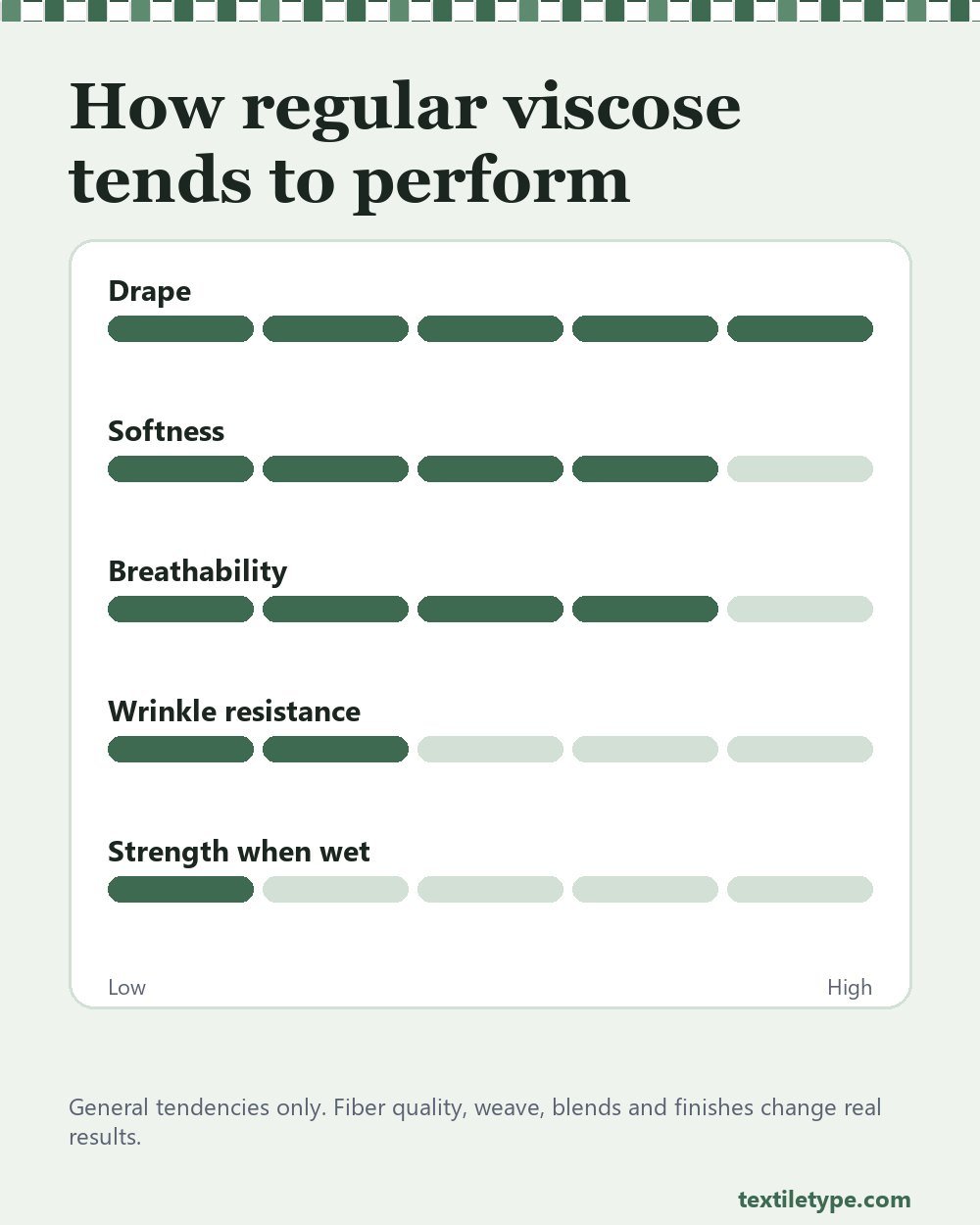
The downsides show up with wear. Viscose creases easily, pills on rub points like underarms in some knits, and can lose its shape at elbows and knees. Higher-quality viscose (longer fibers, denser weaves, good finishing) holds up noticeably better than bargain versions, so two “100% viscose” garments can age very differently.
Who should skip it
If you want a shirt you can throw in a hot wash and tumble dryer without a second thought, viscose is not your fabric. Look at cotton or polyester blends instead. If you want drape and softness and you are happy to wash gently, viscose is a good value way to get a silky look.
The wet-strength catch
This is the single most useful thing to know about viscose. Regular viscose loses a large share of its strength when it gets wet. Textile references give different figures, often around half of its dry strength, but they all agree the drop is big. Wet fibers stretch, swell and rearrange, and when they dry under heat or tension they can lock into a shorter, distorted shape.
That is why a viscose top can come out of the washer a size smaller, or with one side longer than the other, and why older care guides recommend dry cleaning for regular viscose rayon. It is also why viscose can feel stiff after a wash: the swollen fibers dry in a slightly rougher arrangement until the fabric is pressed.
How to wash viscose without shrinking it
Start with the care label, since the manufacturer may have pre-shrunk the fabric or used a stabilizing finish. If the label allows washing, this routine keeps most viscose garments in good shape.
- Wash viscose by hand in cool water with a mild detergent, or use the delicate cycle in a mesh bag.
- Do not soak viscose for long; swish gently and rinse in water at the same cool temperature.
- Press water out with a towel instead of wringing; roll the garment in the towel and squeeze.
- Dry viscose flat or on a padded hanger away from direct heat; skip the tumble dryer.
- Iron viscose inside out on a medium-low setting while slightly damp, or use a steamer.

If a piece has already shrunk a little, you can sometimes ease it back by soaking it in cool water with a little hair conditioner, gently stretching it toward its original shape and drying it flat. Results vary, and lined or structured garments are best left to a professional cleaner.
A practical care walkthrough for rayon clothing, which covers viscose too, if you want to see the gentle washing and drying steps in action.
Reading the label like a pro
Labels can tell you a lot once you know the code words.
| You see | What it means |
|---|---|
| 100% viscose / 100% rayon | Regular regenerated cellulose fiber. Expect drape and softness, and gentle care. |
| Rayon made from bamboo | Viscose whose cellulose came from bamboo pulp. Same care as other viscose. |
| Viscose/elastane blend | Stretch added for fitted knits. Keep heat low, since elastane dislikes it. |
| Viscose/polyester blend | Polyester adds wrinkle resistance and wet strength; usually easier to wash. |
| Viscose/linen blend | Linen texture with softer drape; creases easily, wash cool. |
| Dry clean only | Often a sign the maker could not guarantee the fabric would survive washing. |
The environmental questions
Viscose sits in an awkward middle ground. Its raw material is renewable and the finished fiber is cellulose, which is often described as biodegradable under the right conditions. The process, however, uses carbon disulfide, a toxic chemical that has been linked to health problems for workers when factories do not control it properly, and poorly run plants have been criticized for air and water pollution. Wood sourcing is another concern, since pulp can come from forests that were not managed responsibly.
Lyocell was developed partly to avoid carbon disulfide altogether, and some producers now sell viscose made in more tightly controlled, lower-emission processes with traceable wood. If sustainability matters to you, look for brands that name their fiber supplier and their forest certification, and treat vague “eco viscose” claims with healthy suspicion. You can compare viscose with other fibers by browsing the fabric guides, and the about page explains how these guides are researched.
Viscose fabric FAQ
Is viscose a natural or synthetic fabric?
Neither, strictly. Viscose is semi-synthetic: it is made from natural cellulose, usually wood pulp, that is chemically dissolved and regenerated into new fibers in a factory.
Is viscose good quality?
It can be. Well-made viscose drapes beautifully and feels soft, but quality varies widely. Dense weaves, good finishing and careful washing make the biggest difference to how long it lasts.
Does viscose shrink?
Regular viscose can shrink noticeably, especially in warm water or a hot dryer, because the fibers lose much of their strength when wet. Washing cool and drying flat prevents most of it.
Is viscose the same as rayon?
Yes, in everyday use. Viscose is the most common type of rayon, and the FTC describes rayon and viscose as the same fiber. Modal and lyocell are related fibers made by different processes.