Hemp fabric is cloth made from the long fibers in the stalk of the hemp plant, Cannabis sativa, and it has been turned into rope, sailcloth and clothing for thousands of years. So what is hemp fabric like to wear? Honestly, that depends on how the fiber was processed and what it was blended with.
This guide sorts out the confusion: what the fiber is (and why it will not get anyone high), whether hemp fabric is soft or scratchy, which kinds of hemp clothing are worth buying, how it compares with linen, and which environmental claims hold up.
Short version: modern hemp ranges from canvas-tough to T-shirt soft, and the label tells you which one you are holding.
Hemp fabric at a glance
- Fiber type
- Natural cellulose, a bast (stem) fiber
- Plant
- Industrial hemp, Cannabis sativa
- Feel
- Firm and dry when raw; soft when cottonized or blended
- Best traits
- Long, strong fibers, durable, dyes well
- Watch for
- Wrinkles, stiffness in pure hemp wovens, vague eco claims
- Typical uses
- Canvas, jeans, T-shirts, shirts, bags, bedding
On this page
What is hemp fabric made from?
Hemp is a tall, fast-growing plant, and the textile fiber comes from the bast layer just under the bark of its stalk. The Discover Natural Fibres Initiative describes the plant reaching about 4 meters, and Britannica notes that its fiber strands are usually longer than 1.8 meters (about 6 feet). Like flax, hemp fiber is mostly cellulose.
The obvious question gets an obvious answer: no, a hemp shirt cannot get anyone high. Textile fiber comes from the stalk, and under US law “hemp” means Cannabis sativa with no more than 0.3 percent THC on a dry-weight basis. The 2018 Farm Bill took hemp meeting that limit off the list of controlled substances, and a 2025 law tightened the definition to count total THC while explicitly keeping industrial hemp, the kind grown for fiber and seed, inside it.
Once the fiber is stripped away, what remains is the woody inner core, called hurd or shiv. It never goes near your wardrobe; it ends up in products such as animal bedding, building materials and fiberboard.
From stalk to yarn, briefly
Hemp starts out much like flax. Stalks are retted (partly rotted to loosen the fiber), then broken and cleaned to separate fiber from woody core. If you want the full step-by-step for that bast-fiber routine, our guide to what linen fabric is walks through it. Where hemp differs is what happens next, and that is what decides how your shirt feels.
| Processing route | What happens | What it becomes |
|---|---|---|
| Long-line hemp | Long fibers kept intact and spun like linen | Crisp, linen-like wovens and canvas |
| Decortication only | Machine crushes stalks and strips fiber from the core | Fiber bundles still glued by lignin and pectin, better for nonwovens and industrial uses |
| Degummed | Natural gums removed, chemically or with enzymes | Finer, softer, more spinnable fiber |
| Cottonized | Fiber shortened and softened to cotton-like length | Runs on cotton spinning machinery, usually blended with cotton |
Hemp Traders follows hemp from decortication to finished textiles, a good visual for the processing routes in the table above.
Is hemp fabric soft?
It can be, and it is getting softer every decade. Old-school 100% hemp wovens feel firm, dry and a little rough, a lot like heavy linen. Cottonized hemp blended with cotton feels much closer to ordinary cotton. Levi’s, for example, launched denim in 2019 using what it called cottonized hemp, which it described as hemp fiber softened to feel like cotton, in a cotton-hemp blend.
Hemp sellers widely say the fabric softens with every wash, and that matches how other stiff bast fabrics behave as their fibers relax, though the timeline varies by fabric. What you feel in the store is roughly the worst it will feel.
Rough guide to softness by type:
- Hemp canvas and heavy twill: firm and structured. Great for bags, aprons and work pants; not for sensitive skin.
- Hemp/cotton jersey: soft from the start. This is the usual hemp T-shirt. Our explainer on jersey fabric covers how that knit behaves.
- Hemp/cotton or hemp/Tencel wovens: softer than pure hemp, with some of its texture.
- Hemp/silk blends: less common, with more drape and a subtle sheen than pure hemp.
Fabric weight changes the feel too. A light hemp shirting around the low end of the scale drapes; a heavy canvas stands up on its own. If a listing gives grams per square meter, our guide to GSM in fabric explains how to read it.

Hemp vs linen
These two are close cousins, which is why they get mixed up. Both are bast fibers, both wrinkle, both are prized for summer and both feel crisp before they are broken in. The practical differences:

- Hand: pure hemp usually feels a bit drier and coarser than linen of similar weight; linen tends to have more luster.
- Blending: hemp is far more often cottonized and blended with cotton, so “hemp” clothing is frequently a hemp-cotton mix.
- Look: both have slubby, textured yarns. Many shoppers cannot tell them apart without a label.
- Price: both usually cost more than cotton; neither is reliably cheaper than the other.
A short, odd history
Hemp has one of the stranger CVs in textiles. Britannica records hemp in China as early as 2800 BCE, spreading to the Mediterranean early in the Christian era and across Europe in the Middle Ages, where it became a staple for rope, sacking and sailcloth. The word canvas itself traces back through Old North French to the Latin cannabis, according to Etymonline and Merriam-Webster.
In the United States, the hemp story twisted. During World War II the US Department of Agriculture released a 1942 film, Hemp for Victory, urging farmers to grow hemp for rope and other war materials. Afterward the crop faded under drug laws until the 2018 Farm Bill reopened legal commercial growing. Today, Discover Natural Fibres Initiative figures put almost half of world hemp fiber production in China, which is also the largest exporter of hemp textiles.
Buying hemp clothing: a quick decision guide
Hemp clothing makes sense for some wardrobes more than others. Use this as a starting point.
| If you want… | Look for | Skip |
|---|---|---|
| A soft everyday tee | Hemp/cotton or hemp/organic cotton jersey | Heavy 100% hemp knits |
| Tough work pants or jeans | Hemp/cotton denim or twill | Lightweight blends that wear thin |
| A cool summer shirt | Light hemp or hemp/linen plain weave | Dense canvas weights |
| Tote bags, aprons, upholstery | Hemp canvas or duck | Anything labeled only “hemp blend” with no percentages |
| Silky drape | Hemp silk or hemp/Tencel | Expecting pure hemp to drape |
Weaving Vibes tackles common myths about hemp fabrics, useful context before you pay a premium for hemp clothing.
Environmental claims, with asterisks
Hemp has a strong green reputation, and some of it is earned. The plant grows tall quickly, and the Discover Natural Fibres Initiative says it grows without agrochemicals and captures a lot of carbon. Every part of the stalk can find a use, from fiber to hurds.
The asterisks matter, though. Farming practices vary by country and grower. Turning stiff bast fiber into soft clothing often means degumming, and conventional degumming uses chemicals and energy, so a buttery-soft hemp tee is not automatically low impact. Blends complicate things further, since the cotton or synthetic in the mix carries its own footprint. Treat “sustainable hemp” as a question to ask the brand rather than a promise: where was it grown, how was it processed, and what percentage of the garment is actually hemp?
Washing and caring for hemp
Hemp is sturdy, so care is mostly about avoiding shrinkage and making ironing easier. These are general habits that work for most hemp and hemp-blend clothing; the care label wins if it says otherwise.
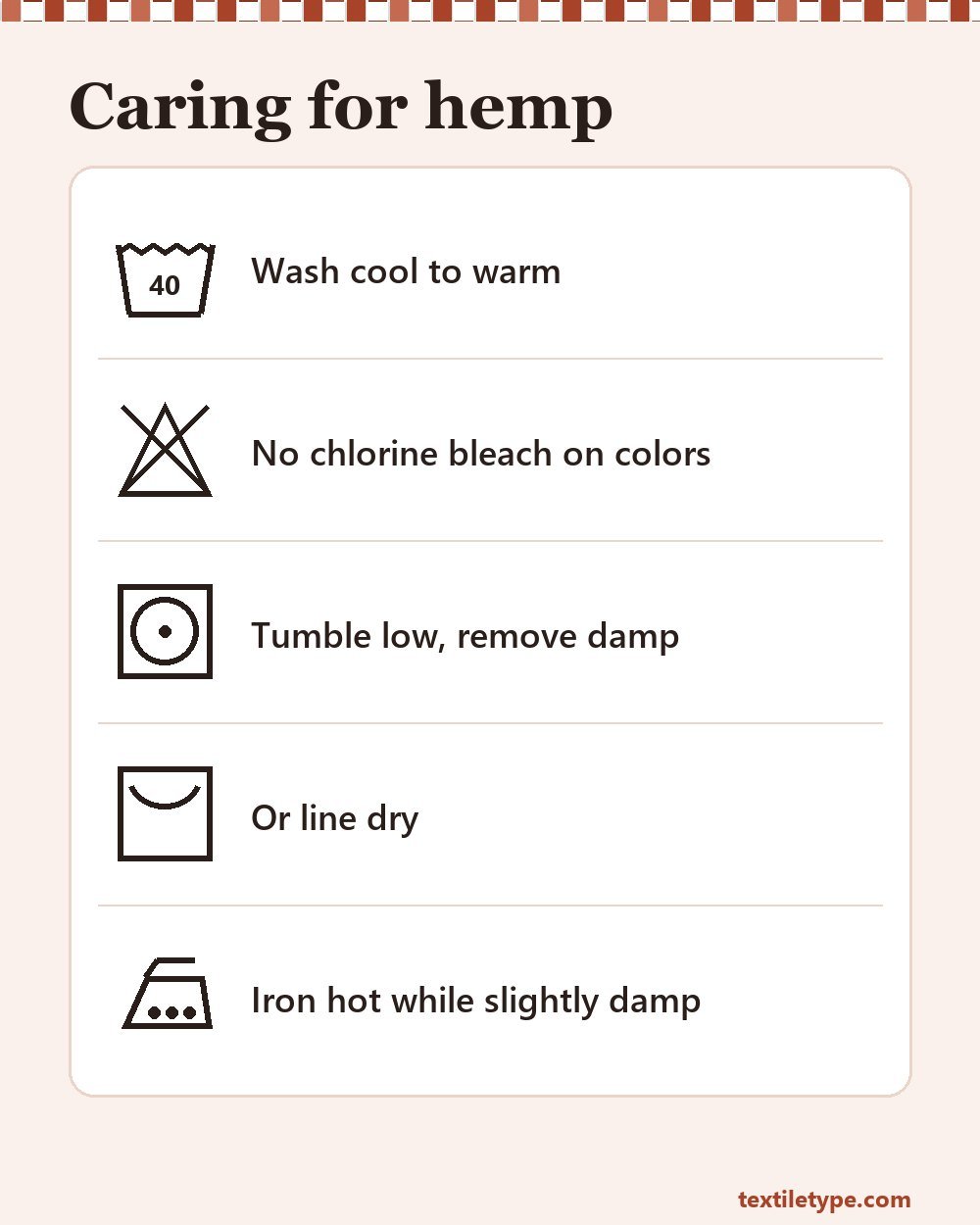
- Wash in cool or warm water with similar colors; new, dark hemp can release some dye in the first few washes.
- Skip chlorine bleach on colors; it weakens cellulose fibers and fades dye.
- Line dry, or tumble on low and remove while slightly damp to limit shrinkage and creasing.
- Iron on a hot setting or steam while the fabric is still a little damp.
- Expect cottonized hemp/cotton knits to behave like cotton knits, including some shrinkage if dried hot.

More fiber profiles live in our fabric guides.
Hemp fabric FAQ
Is hemp fabric itchy?
Heavy, pure hemp wovens can feel rough at first, especially on sensitive skin. Cottonized hemp blends and hemp jersey usually feel close to ordinary cotton, and hemp tends to soften with washing.
Is hemp clothing better than cotton?
It is not automatically better. Hemp fiber is long and strong and can make very durable fabric, but comfort, price and footprint depend on processing, blend and brand, so compare specific garments.
Does hemp fabric shrink?
It can, particularly in hot water or a hot dryer. Washing cool to warm and drying low or on the line keeps shrinkage small.
Is hemp fabric legal in the US?
Yes. Hemp textiles and garments are legal, and US law defines hemp as Cannabis sativa with no more than 0.3 percent THC on a dry-weight basis.