Ramie is the natural fiber most people own without realizing it, usually hiding on a care label as “55% ramie, 45% cotton”. So what is ramie fabric? It is cloth made from the stem fiber of a nettle-family plant, Boehmeria nivea, native to China and also called China grass. It looks a lot like linen, with a bit more sheen, and it has some quirks worth knowing before you buy or sew it.
This guide covers where ramie comes from, why it needs a chemical bath that linen skips, the trade loophole that filled 1980s closets with ramie sweaters, how ramie and linen compare, whether ramie shrinks, and how to keep it from cracking along its folds.
Pronunciation, for the record: the Ohio State University Extension fact sheet on ramie accepts both RAY-mee and RAH-mee.
Ramie at a glance
- Fiber type
- Natural cellulose, a bast (stem) fiber
- Plant
- Boehmeria nivea, nettle family; “China grass”
- Looks like
- Linen with more luster
- Strengths
- Very strong, stronger wet, absorbent, holds color well
- Weak spots
- Stiff, low stretch, wrinkles, weak at sharp folds
- Most common form
- Blends, especially ramie/cotton
On this page
What is ramie fabric?
Ramie is a leafy perennial in the Urticaceae, the nettle family, though unlike stinging nettles its hairs do not sting. Its fiber sits in the bark layer of the stems, which makes it a bast fiber like flax (linen) and hemp. Britannica describes the fiber as native to China and lists China as the leading producer, with Japan, Taiwan, the Philippines and Brazil among the others.
Once cleaned, the fiber is nearly pure cellulose. PROTA, a plant-resources database, says properly degummed ramie contains 96 to 98 percent alpha-cellulose, which is unusually high for a plant fiber. That purity is why good ramie comes out bright white and takes dye so well.
The finished cloth looks very much like linen: a slightly uneven, textured yarn, a crisp hand and a natural sheen that is often a touch silkier than flax. Fine ramie can look almost like a dull silk; coarse ramie looks like rough linen.
Why ramie gets degummed
Flax gives up its fiber after retting, the slow field or water rot covered in our guide to what linen fabric is. Ramie does not cooperate so easily. Its fibers are locked in heavy plant gums, and Britannica notes that extraction and cleaning are expensive because several steps are needed to free the raw fiber from those adhesive gums.
- Decorticating. The bark and fibrous ribbons are stripped from the harvested stems, traditionally by hand, now often by machine.
- Drying. The raw ribbons, still stiff with gum, are dried for sale or storage.
- Degumming. The fiber is cooked in a chemical bath to dissolve the gums. A research protocol published in JoVE describes traditional degumming as scouring raw ramie in concentrated sodium hydroxide under high pressure for 6 to 8 hours, a process that uses a lot of energy and produces heavily polluted wastewater.
- Washing, softening and drying. The cleaned fiber is rinsed, often bleached and softened, then dried.
- Spinning. The fiber is spun into yarn, very often with cotton.
That chemical step is the main reason ramie, for all its strength, never became as cheap or common as cotton. Researchers are working on gentler enzyme and reduced-alkali methods, but the conventional process is still harsh.
Wild Heart follows ramie from harvest to cloth, which shows how much hand work goes into separating the fiber from the plant.
The 1980s ramie sweater boom
If a parent’s closet held a stack of ramie-cotton sweaters, there is a trade-policy reason. In the early 1980s, US import quotas on textiles covered wool, cotton and man-made fibers, but not silk, ramie or other minor natural fibers. An Ohio State University Extension fact sheet notes that importers took advantage of that gap, and garments made mostly of ramie poured in.
The loophole did not last. According to the US International Trade Commission, silk blends, linen and ramie products were brought under the Multifiber Arrangement, the international quota system for textiles, effective August 1, 1986. Ramie blends stayed in stores, but the sweater surge cooled.
Ramie’s strengths and quirks
Ramie is a fiber of contrasts: tough in a straight pull, fragile at a crease.
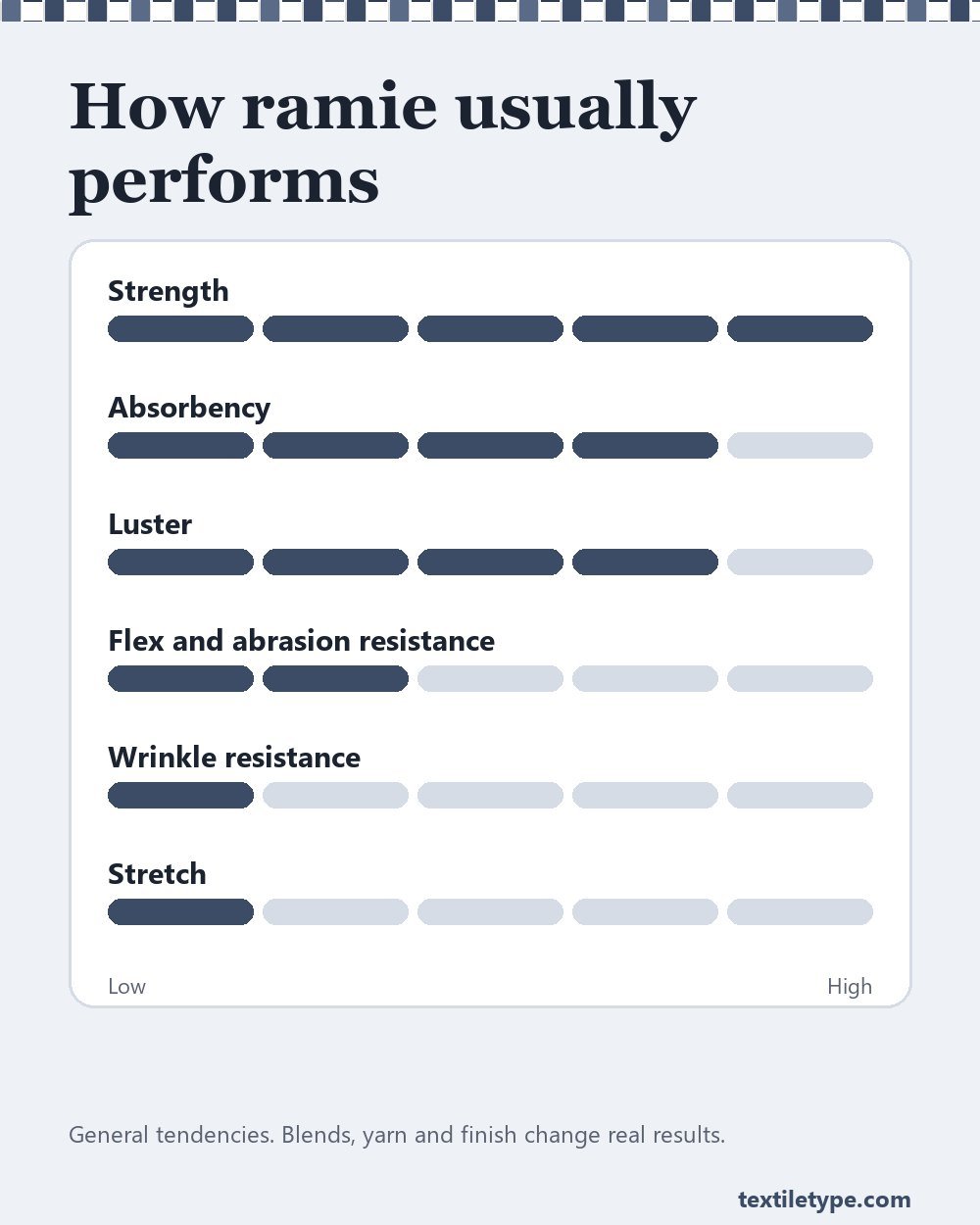
What ramie does well
- Strength. Britannica describes ramie fiber as stronger than flax, cotton or wool, and it gets stronger when wet. That is why it has long been used for rope, twine and sails.
- Absorbency. The Ohio State fact sheet credits its porous crystal structure with higher absorbency than other cellulose fibers, which makes it comfortable in hot weather.
- Color and luster. It takes dye well and keeps a natural sheen.
- Resistance. The same source lists good resistance to rot, light, mildew and alkalis.
Where ramie struggles
- Low stretch. Ramie is stiff and somewhat brittle, with little give.
- Fold damage. Repeated creasing in the same place can break fibers, so knife-sharp pleats and hard-folded storage wear it out.
- Wrinkles. Like linen, it crumples easily unless blended or finished.
- Abrasion. Abrasion resistance is low, so collar edges and cuffs can scuff.
- Dark color crocking. Deep shades may rub off onto other fabrics and lose vibrancy over many washes.
Ramie vs linen
Ramie and linen are easy to confuse in a shop, and sellers sometimes market ramie as a linen alternative. Here is how they generally differ.
| Trait | Ramie | Linen |
|---|---|---|
| Plant | Boehmeria nivea, nettle family | Flax, Linum usitatissimum |
| Main growing region | China and East Asia | Western Europe |
| Fiber extraction | Chemical degumming | Retting in the field or water |
| Look | Linen-like texture, more sheen | Textured, softer luster |
| Hand | Crisp; Ohio State calls it softer than linen | Crisp, relaxes with washing |
| Fold resistance | Poor, can crack at sharp creases | Better, though repeated creasing still wears it |
| Typical form | Mostly blended, often with cotton | Often 100%, also blended |
| Price | Usually lower than linen | Usually higher |
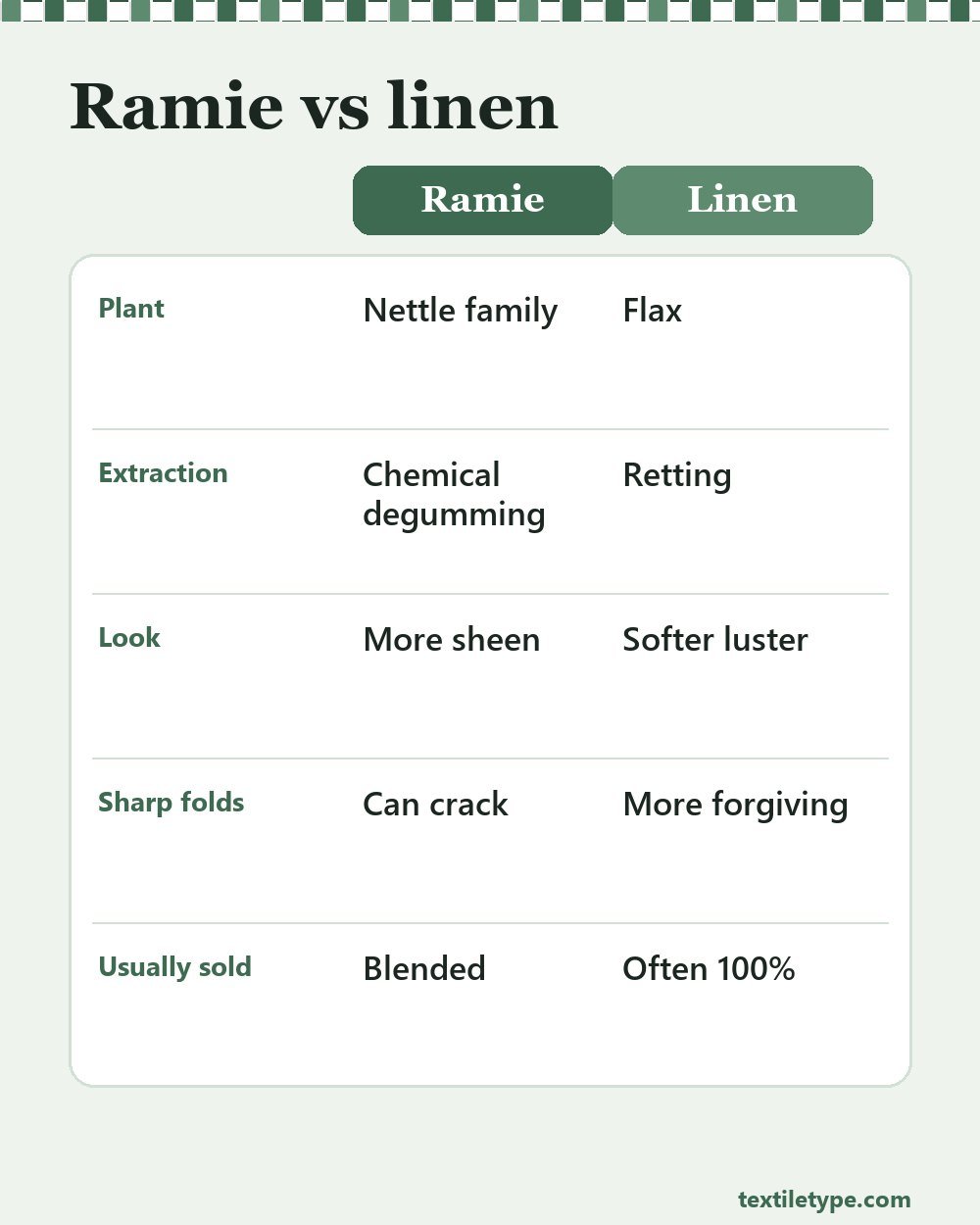
Pick linen if you want a 100% natural-fiber garment that ages softly and tolerates pleats and creases. Pick a ramie blend if you want the linen look with more sheen, at a lower price, and you are happy to store it hanging. The third bast cousin, hemp fabric, sits closer to linen in feel and is more often cottonized for softness.
Does ramie shrink? Care that works
Ramie fiber itself is fairly dimensionally stable; Swicofil, a Swiss fiber supplier, says it keeps its shape and does not shrink. Finished fabrics are another matter. Knits, loose weaves and ramie-cotton blends can still shrink, and the Ohio State fact sheet notes that color, shrinkage or blend fibers may call for lower temperatures even though high heat does not harm the fiber. Treat a ramie blend roughly like its cotton partner. If you know linen’s habits, our guide on whether linen shrinks explains the same relaxation effect.
The fact sheet reports Ohio State’s own garment testing, which gives unusually specific guidance:
| Method | How it did in Ohio State testing | Use it when |
|---|---|---|
| Dry cleaning | Best color, shape and wrinkle-free results | Tailored pieces, dark colors, anything labeled dry clean |
| Hand wash, cool water, dry flat | Most strongly recommended home method for knits and wovens | Sweaters and blouses |
| Machine wash cold, gentle, line dry | Outperformed warm wash with tumble drying | Everyday ramie/cotton tops and pants |
| Warm wash, tumble dry | Weakest of the methods tested | Best avoided |
Where you’ll find ramie
Pure ramie exists but is less common than blends. The Ohio State fact sheet names 55% ramie / 45% cotton as the most typical blend, available as woven fabric and sweater knits. Blending softens the hand and tames wrinkling, though it gives up much of ramie’s sheen. Adding polyester improves wrinkle resistance and shrinkage control.
- Clothing: summer shirts, dresses, suiting, sweaters and knit tops.
- Home: table linens, curtains and upholstery.
- Traditional and industrial: rope, twine, sailcloth and canvas, where wet strength counts.

Fineas Jackson asks why such a strong, long-used fiber fell out of everyday wardrobes, a nice companion to the history above.
Who should skip ramie (and who should not)
- Skip it if you love sharp trouser creases, pleated skirts or stacking clothes folded on shelves, or if you want something soft and stretchy against the skin.
- Skip it for hard-wearing collars and cuffs that rub all day, unless it is blended with a tougher fiber.
- Try it if you like the linen look at a gentler price and run warm in summer.
- Try it for table linens and curtains you will iron flat and hang rather than fold.
Explore more natural fibers in our fabric guides.
Ramie fabric FAQ
Is ramie better than linen?
Neither is simply better. Ramie is very strong, lustrous and usually cheaper, but it handles sharp folds and abrasion poorly; linen is more forgiving and is often sold as 100% fiber.
Is ramie a natural fiber?
Yes. Ramie is a plant bast fiber from the stems of Boehmeria nivea, though its gums are removed with a chemical degumming process before spinning.
Does ramie wrinkle?
Yes, about as easily as linen. Blends with cotton or polyester and wrinkle-resistant finishes reduce creasing.
Is ramie itchy?
Coarse ramie can feel stiff or slightly scratchy, especially in knits. Fine ramie and ramie-cotton blends are usually comfortable, so check the fiber mix and feel the fabric before buying.
Sources and further reading