Polyester is probably the fiber you own the most of, whether or not you ever chose it on purpose. Flip the tags on your gym shirts, fleece jacket, curtains and that “silky” blouse, and the same word keeps showing up. This page answers what is polyester fabric in plain terms, then gets practical: why it can feel clammy in July, what the real safety questions are, and how to stop it going gray, pilled or smelly.
The short version: polyester is a plastic, usually the same family of plastic as a soda bottle, melted and pulled into very long, thin strands. Nearly everything good and bad about it traces back to that origin.
Polyester at a glance
- Fiber type
- Synthetic (manufactured polymer)
- Most common polymer
- PET, polyethylene terephthalate
- Water uptake
- Very low, about 0.4% commercial moisture regain
- Feel
- Smooth to crisp; yarn and finish change it a lot
- Big strengths
- Strong, wrinkle resistant, quick drying
- Watch-outs
- Holds oily stains and odor, melts under high heat
- Care
- Cool to warm wash, low dryer, low iron
On this page
What is polyester fabric, chemically speaking
In the United States, “polyester” is a generic fiber name with a legal definition. The Federal Trade Commission describes it as a manufactured fiber made from a long-chain synthetic polymer that is at least 85 percent by weight an ester of a substituted aromatic carboxylic acid. Translated out of chemistry: a family of plastics, with polyethylene terephthalate (PET) by far the most common one in clothes and home textiles.
PET is made by reacting terephthalic acid with ethylene glycol. Most of that raw material comes from oil and gas. Textile Exchange estimates that about 88 percent of polyester fiber is fossil-based, and most of the remainder is recycled.
The FTC rule also allows two sub-names inside the polyester family, which explains a couple of baffling tags. “Triexta” may be used when the glycol in the polymer is mostly 1,3-propanediol, and “elasterell-p” covers a stretchy fiber built from two polymers. Both are still polyester.
Polyester is also the most produced fiber on the planet by a wide margin. Textile Exchange’s Materials Market Report puts it at 59 percent of all fiber made worldwide in 2024, with cotton a distant second.
How polyester is made, from chips to yarn
Polyester skips the farm entirely. The whole process happens in chemical plants and spinning mills, and it runs roughly like this:
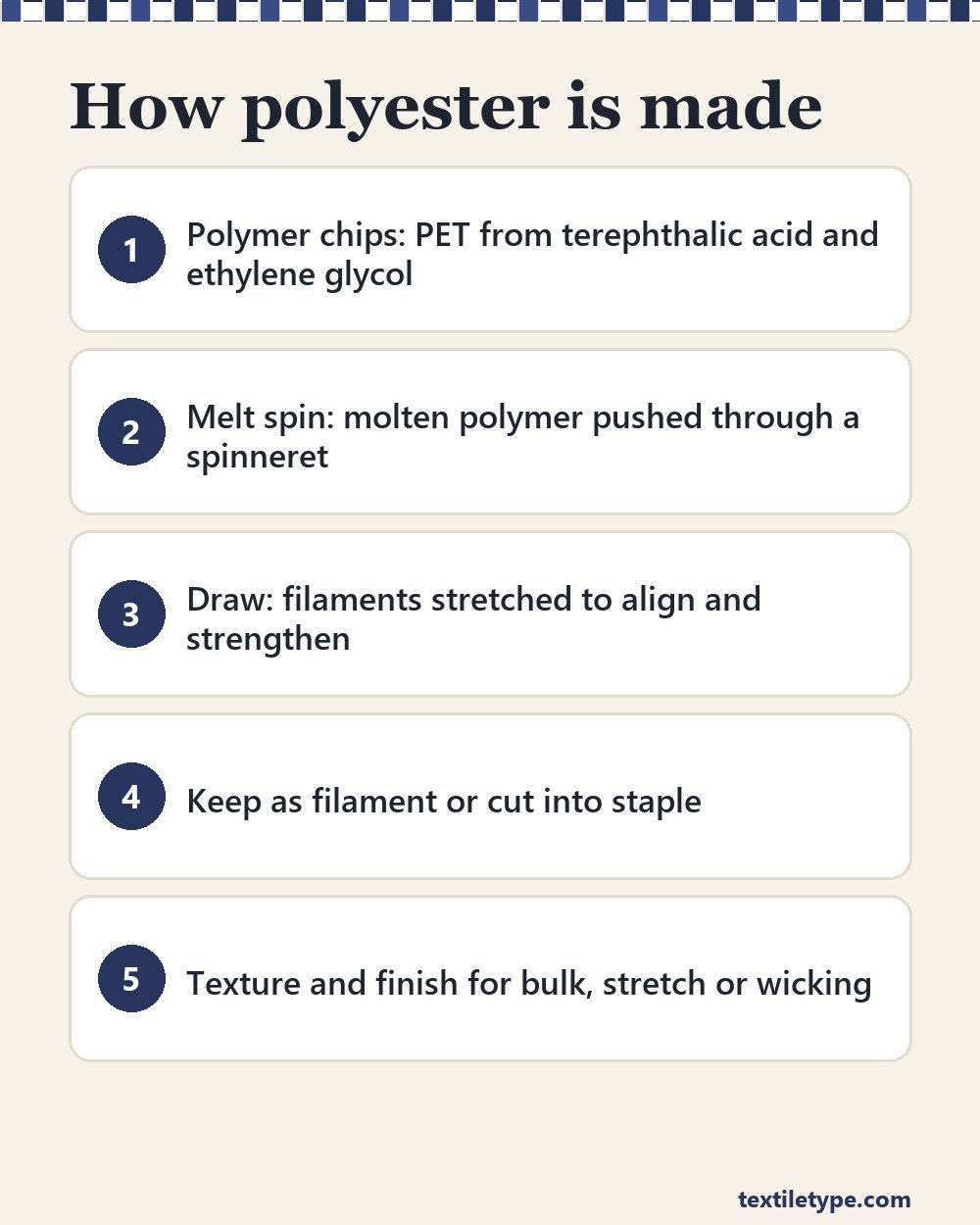
- Make the polymer. Terephthalic acid and ethylene glycol react under heat to form long PET chains, often cooled and cut into small chips.
- Melt spin. The polymer is melted and pushed through a spinneret, a metal plate with tiny holes, and the streams harden as they cool.
- Draw. The fresh filaments are stretched, which lines the molecules up along the fiber and makes it much stronger.
- Choose a form. Long continuous filaments make smooth, slippery yarns; filaments crimped and cut short (staple) can be spun like cotton or blended with it.
- Texture and finish. Crimping adds bulk and stretch, and finishes add softness, wicking or water repellency.
Recycled polyester follows the same melt-and-spin route, starting from flakes of used plastic instead of new chips. Textile Exchange reports that about 98 percent of recycled polyester still comes from plastic bottles rather than old clothing, so a recycled tag usually means “former bottle”, not “former shirt”.
Because polyester is thermoplastic (it softens with heat and firms up again as it cools), mills can heat-set it. A pleat or crease pressed in at high temperature stays put through normal washing, which is the whole trick behind permanent pleats.
A How It’s Made factory segment showing how polyester is produced.
A short history: wartime secret to wardrobe staple
Polyester is younger than nylon and older than most of your relatives’ leisure suits. The key dates:
| Year | What happened |
|---|---|
| 1941 | John Rex Whinfield and James Tennant Dickson of the Calico Printers’ Association in Lancashire, England, patent a polyester fiber made from terephthalic acid and ethylene glycol. |
| 1946 | Wartime restrictions lift and the invention is made public. |
| 1947 | The Calico Printers’ Association assigns its rights outside the US to ICI, which develops the fiber as Terylene. |
| 1953 | DuPont, holder of the US rights, starts the first US commercial polyester fiber production, sold as Dacron. |
| 2024 | Polyester reaches 59% of global fiber output. |
The fiber’s early reputation leaned heavily on “wash and wear”: shirts that came out of the machine without needing an iron. That selling point still holds today.
Is polyester breathable?
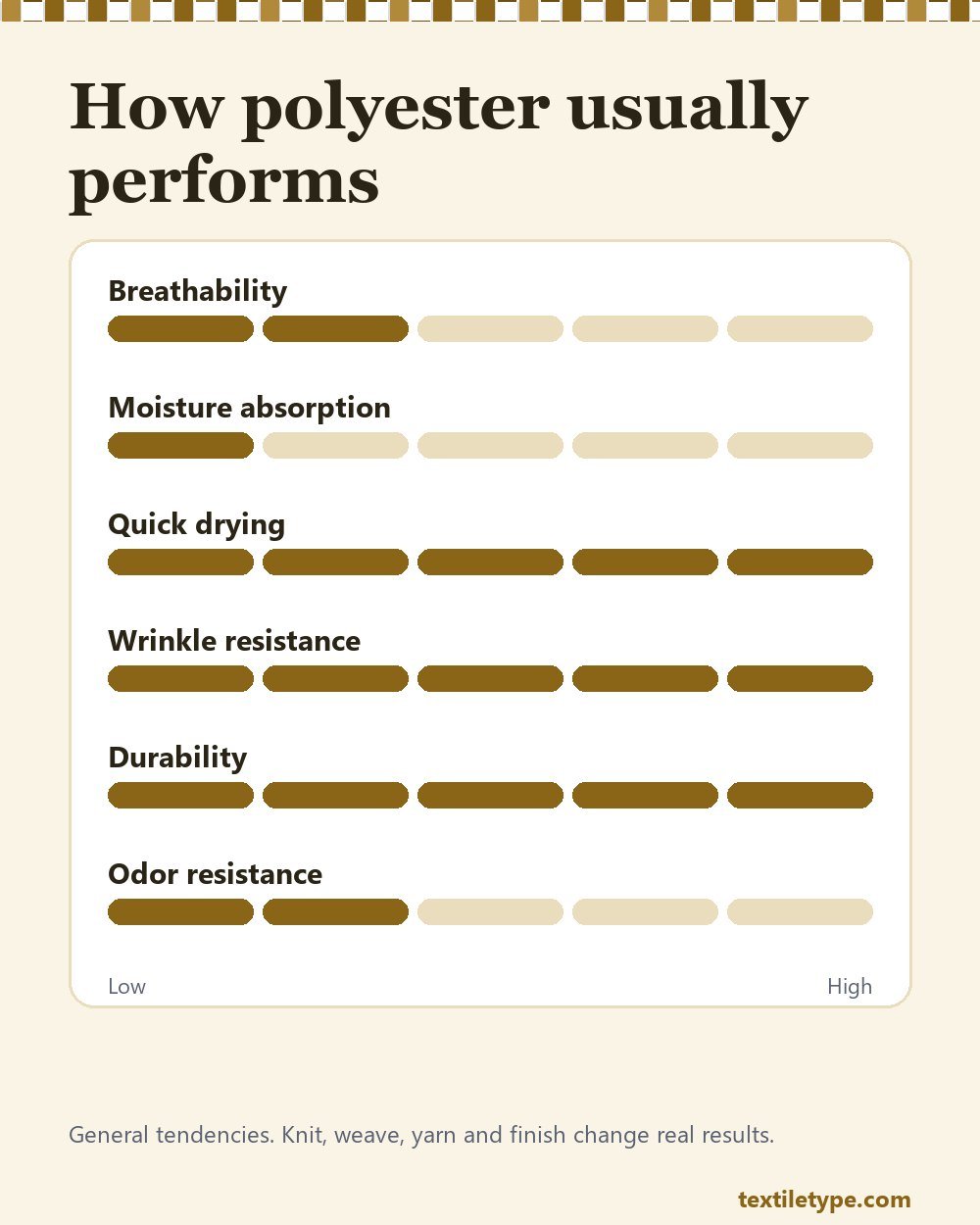
Air moves through a polyester fabric about as well as through any other fabric of the same weight and weave. The real issue is moisture. The fiber itself barely absorbs water: the commercial moisture regain figure used in the textile trade is about 0.4 percent, compared with 11 percent for rayon. Sweat has nowhere to soak in, so it either sits on your skin or travels along the outside of the fibers.
That cuts both ways.
- Where it works: in a loose knit built to wick, sweat spreads thin across the fabric and evaporates fast. That’s why so much running gear is polyester and why it dries on a hotel towel rail overnight.
- Where it fails: in a tightly woven, smooth polyester blouse or lining, vapor gets trapped and you get that sealed-in, clammy feeling.
- The smell problem: polyester tends to hold onto body oils, and University of Georgia Extension notes it can hold perspiration odor. Gym shirts that still smell after washing are usually a polyester story.
For still, sticky heat where you want a fabric that absorbs, a cellulose fiber usually feels better. Linen is the classic choice; cotton and rayon also absorb far more water than polyester does.
Is polyester safe to wear?
The worries people raise about polyester tend to be broad (“it’s plastic on your skin”), while the documented issues are narrower and more useful to know. Here’s how the common claims hold up.
| Common claim | What the sources actually support |
|---|---|
| “Polyester irritates skin.” | The documented problem is dye allergy in some people. DermNet lists disperse dyes, the class used on polyester and acetate, among common textile allergens, naming Disperse Blue 106 and 124 as frequent culprits. |
| “An OEKO-TEX tag means it’s eco-friendly.” | STANDARD 100 means every part of the item, down to thread and buttons, was tested against a list of harmful substances. It does not rate how the fabric was produced. |
| “It only sheds microfibers in the wash.” | A 2020 University of Plymouth study found polyester garments shed up to 400 fibers per gram in 20 minutes of ordinary wear, and up to 4,000 per gram in a wash. |
| “Synthetics catch fire easily.” | Polyester tends to melt and shrink away from a small flame. The risk is that molten fiber can drip and stick to skin. |
What to do with that:
- Wash new clothes before wearing them. DermNet suggests this for people prone to textile dye reactions.
- If you get a rash where clothing rubs (waistbands, thighs, underarms), a dermatologist can patch test for dye allergies.
- If chemical residues worry you, an OEKO-TEX STANDARD 100 label is a reasonable filter.
- Skip loose polyester sleeves near open flames, such as campfires or gas burners.
On microfibers, a 2024 University of Leeds study found that fabric traits like yarn type and knit or woven construction influenced shedding more than washing conditions did. That suggests buying fewer, better-made pieces may matter more than fiddling with wash settings.
NBC Select’s short explainer on whether polyester is bad for you and what to know about it.
Polyester label terms, decoded
US labels must name each fiber that makes up 5 percent or more of the weight, in order from most to least. Here is what the common polyester wording means.
| Label says | What it tells you |
|---|---|
| 100% polyester | All fibers are polyester. Weave, yarn and finish can still make it feel like satin, fleece or canvas. |
| Recycled polyester | Polyester spun from recycled PET, mostly bottles. It behaves much like new polyester. |
| 65% polyester, 35% cotton | A poly-cotton blend. More polyester means fewer wrinkles and faster drying; more cotton means more absorbency. |
| Microfiber | Very fine fibers, often polyester or a polyester and nylon mix. Soft and dense: sheets, cleaning cloths, faux suede. |
| Fleece | A polyester knit brushed to raise a soft pile. Warm, light, and prone to pilling. |
| Dacron, Terylene | Historic brand names for polyester. |
| Triexta, elasterell-p | FTC-approved sub-names within the polyester family. |
Satin, chiffon and georgette are weaves or fabric styles, so they can be polyester, silk or something else. The fiber line on the tag is what tells you which. If you’re comparing polyester with man-made fibers that come from wood instead of oil, our guide to viscose covers the other side.
How to wash, dry and iron polyester
Polyester is easy to wash, which is half its appeal. The two things it does badly are oily stains and heat, so the routine is built around those.
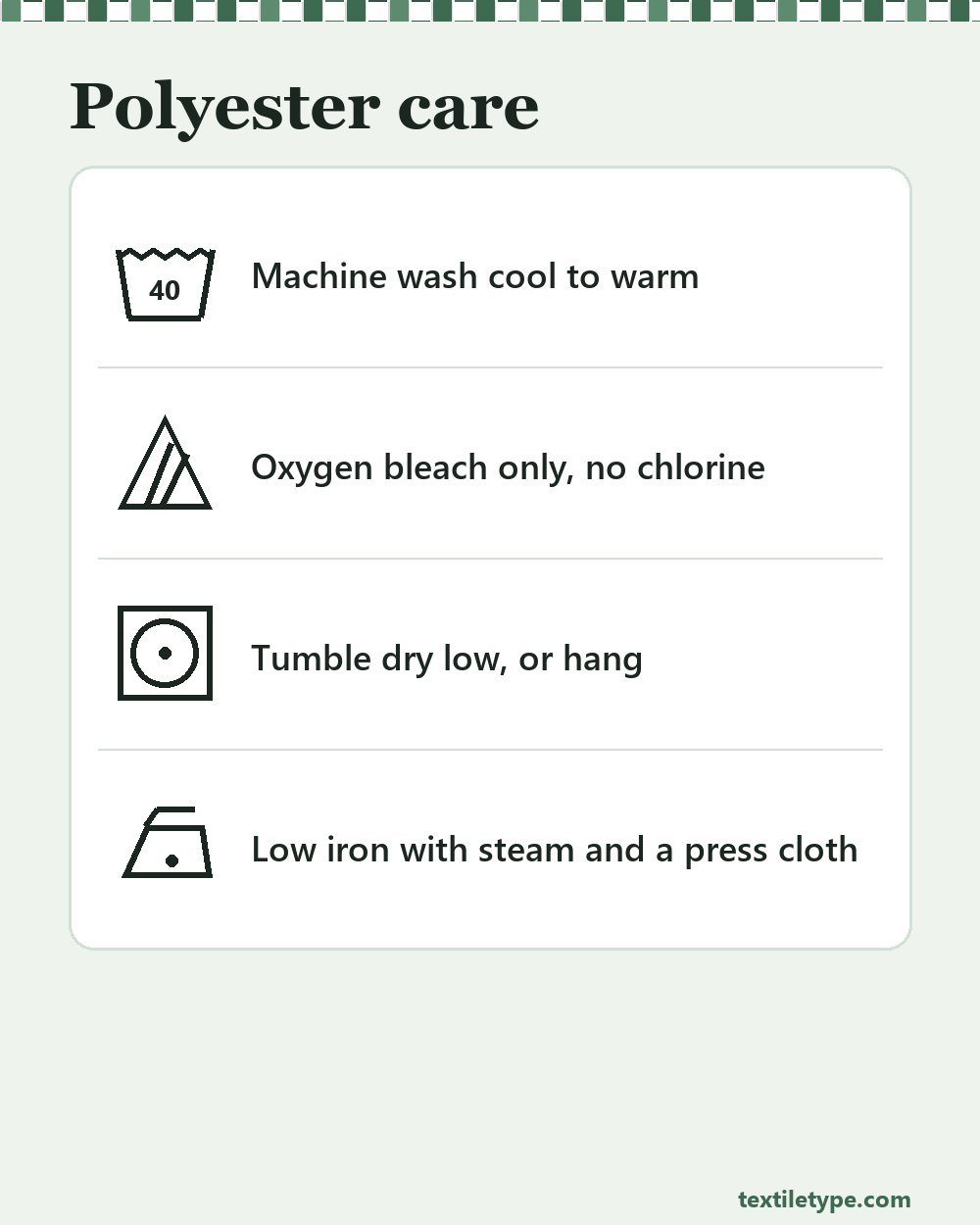
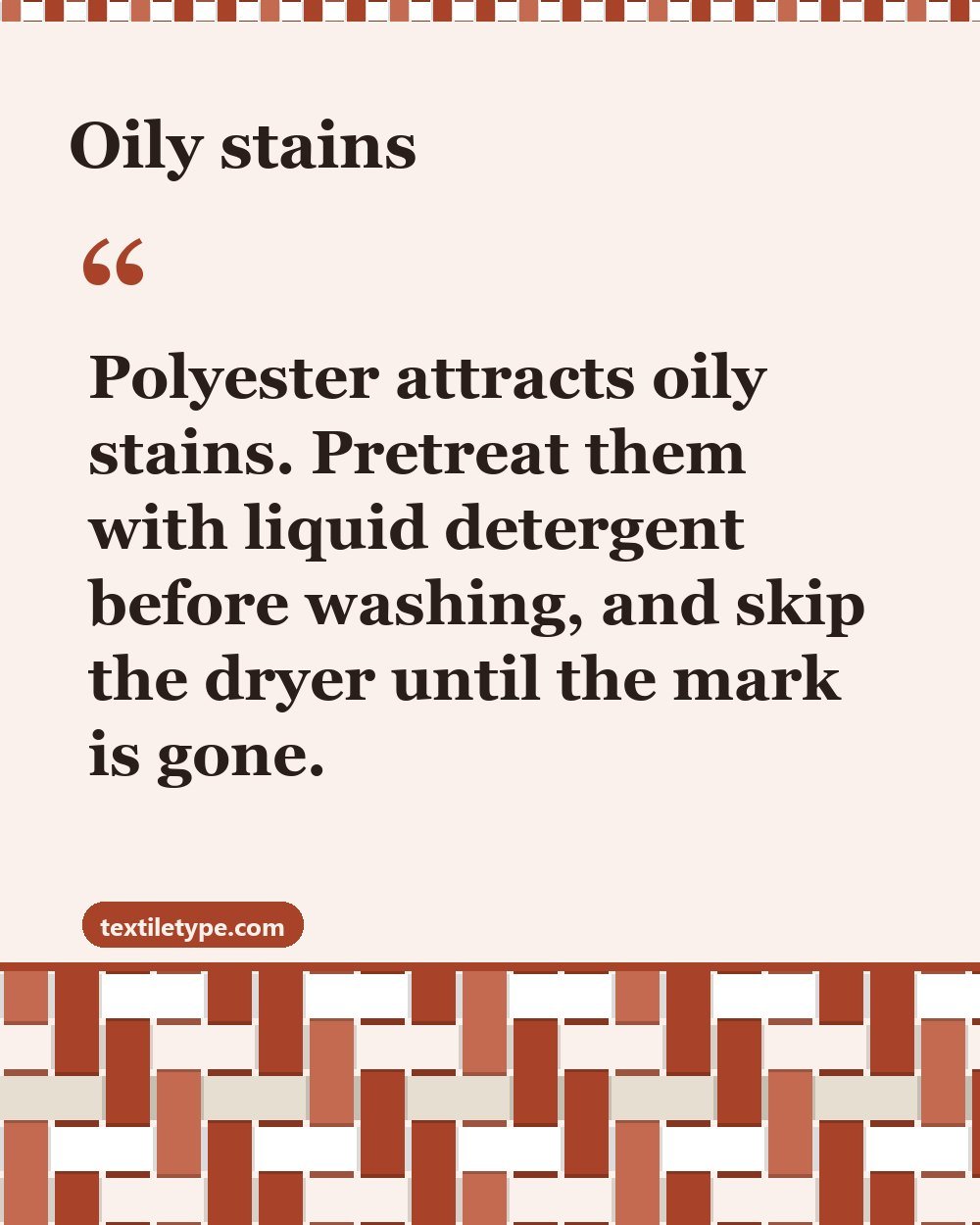
- Treat greasy spots first. Extension specialists note that synthetic fibers have an affinity for oily stains, and fresh ones lift much more easily. Rub a liquid detergent into salad dressing or lotion marks before washing.
- Wash cool to warm. Low to medium water temperatures are the standard extension advice for synthetics.
- Bleach with oxygen, not chlorine. UGA Extension recommends oxygen bleach for polyester whites that are going gray.
- Check before you dry. Dryer heat can set a stain for good, so air-dry anything still marked and treat it again.
- Dry low or hang. High heat can distort or even melt synthetics. Polyester dries fast on a hanger anyway.
- Iron low, with steam. Use the synthetic setting and a press cloth to avoid shiny patches.
Two more habits help. Turning garments inside out cuts down rubbing, which can mean fewer pills; polyester fibers are strong enough to hold pills on the surface instead of letting them break off, so prevention beats removal. And let sweaty gym clothes dry out before they go in the hamper, then wash them soon.
Save this routine to your notes:
- Polyester: pretreat oily stains with liquid detergent
- Wash cool to warm, inside out
- Oxygen bleach only, no chlorine
- Tumble dry low or hang to dry
- Iron on low with steam and a press cloth
Polyester pros and cons: pick it or skip it
Polyester is a tool, and it’s good at specific jobs. The University of Georgia Extension sums up its strengths as wrinkle resistance, strength, and resistance to abrasion, sunlight, mildew and moths, with the trade-offs being static, pilling, body oils and heat sensitivity.
Pick polyester if:
- You need travel clothes that come out of a suitcase looking presentable.
- You want activewear designed to wick and dry quickly.
- The item lives outdoors or in sun: patio cushions, flags, rain shells.
- You want pleats that stay sharp through the wash.
Skip it, or pick a blend, if:
- You sweat heavily in still heat and want a fabric that absorbs.
- You have reacted to clothing dyes before.
- Odor retention drives you up the wall in workout gear.
- You want to cut down on synthetic fibers in your wardrobe.
For more fabric comparisons, browse all our fabric guides.
Polyester fabric FAQ
Is polyester a type of plastic?
Yes. Most polyester fabric is PET, the same polymer family used for many drink bottles, spun into fibers instead of molded into containers. That’s why recycled bottles can become fleece.
Does polyester shrink in the wash?
Usually very little. Polyester is generally resistant to shrinking because it’s heat-set at the mill, but high dryer heat can still distort it, so a low setting is the safe default.
Is polyester bad for sensitive skin?
For most people the fiber itself isn’t the trouble, but some are allergic to the disperse dyes used to color it. If a rash shows up where clothes rub, ask a dermatologist about patch testing.
Why does my polyester shirt still smell after washing?
Polyester tends to hold body oils, and odor clings to them. Wash workout gear soon after wearing, pretreat the underarms, and avoid leaving damp clothes balled up in the hamper.
Sources and further reading