Jersey is the fabric most of your T-shirts are made of, and probably the one you think about least. So, what is jersey fabric? It is a single knit: one yarn looped row after row into a soft, stretchy cloth that is smooth on one side and bumpy on the other.
That simple loop structure explains almost everything jersey does, good and bad. It is why your tee stretches without any spandex, why a cut edge rolls up like a window shade, and why a cotton shirt can come out of the dryer a little shorter than it went in.
Below you will find how the loops work, how to spot the right side, where the name came from, which fibers jersey comes in, and practical advice for sewing and washing it.
Jersey at a glance
- Fabric type
- Weft knit, also called plain knit or single knit
- Common fibers
- Cotton, viscose, polyester, wool, often with a little spandex
- Stretch
- More across the width than along the length
- Two sides
- Columns of V shapes on the face, rows of bumps on the back
- Watch for
- Curling cut edges, runs from snags, shrinking in cotton
- Typical uses
- T-shirts, dresses, leggings, loungewear, sleepwear
On this page
- What is jersey fabric made of: loops, wales and courses
- How to tell the right side from the wrong side
- Why it is called jersey
- Types of jersey knit and the fibers behind them
- Cotton jersey and the shrinkage question
- Pros and cons of jersey
- Sewing jersey knit without wavy seams
- Washing and drying jersey
- Jersey fabric FAQ
What is jersey fabric made of: loops, wales and courses
Woven fabrics such as twill are built from two sets of yarns crossing each other at right angles. Knits work differently. A knitting machine pulls yarn into a loop, then pulls the next loop through that one, and keeps going until the loops hold each other together. Jersey is a weft knit, which means the yarn travels across the width of the fabric, the same direction a weft yarn runs in weaving.
Two words make knit fabric much easier to read:
- Course: a horizontal row of loops, running across the fabric.
- Wale: a vertical column of loops, running along the length.
In jersey, every loop is drawn through to the same side of the fabric. That one rule creates the look you know. On the face, the legs of each loop line up into neat columns of little V shapes. On the back, the tops of the loops show as rows of tiny bumps. Machines make single jersey on one bed of needles, which is why it has a definite face and back.
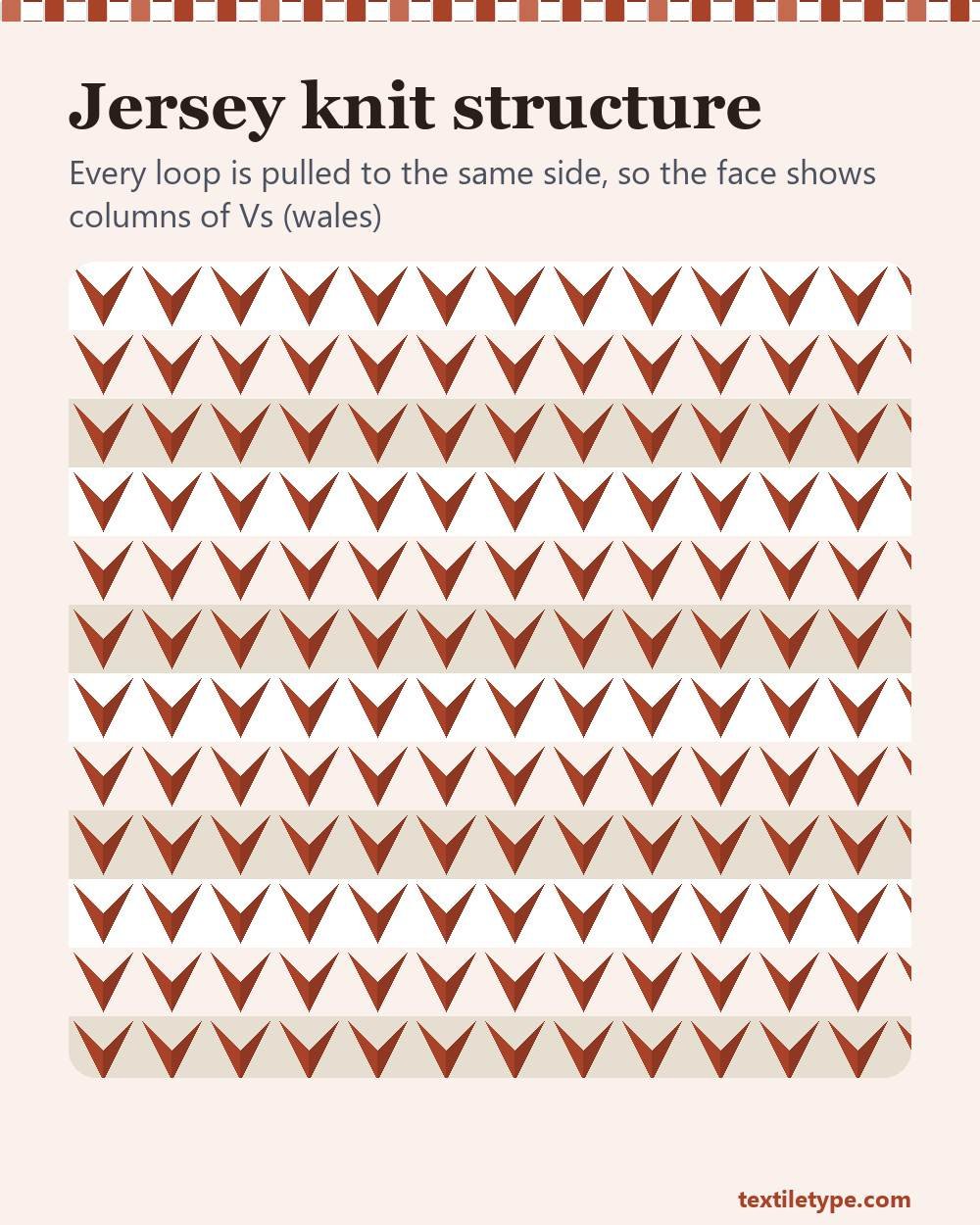
The loops also explain jersey’s personality. Loops can open and close, so the fabric stretches with no elastic fiber at all, and it gives more across the width than along the length. The face and back sit under different tension, so a cut edge curls. And if a loop breaks, the column above or below it can unravel into a run, the same way a stocking ladders.
A short explainer on single jersey’s structure and how it is produced, useful if you want to see the loops move.
How to tell the right side from the wrong side
Jersey does have a right side, and sewing a sleeve in backwards is a rite of passage nobody needs twice. Use this quick check before you cut.
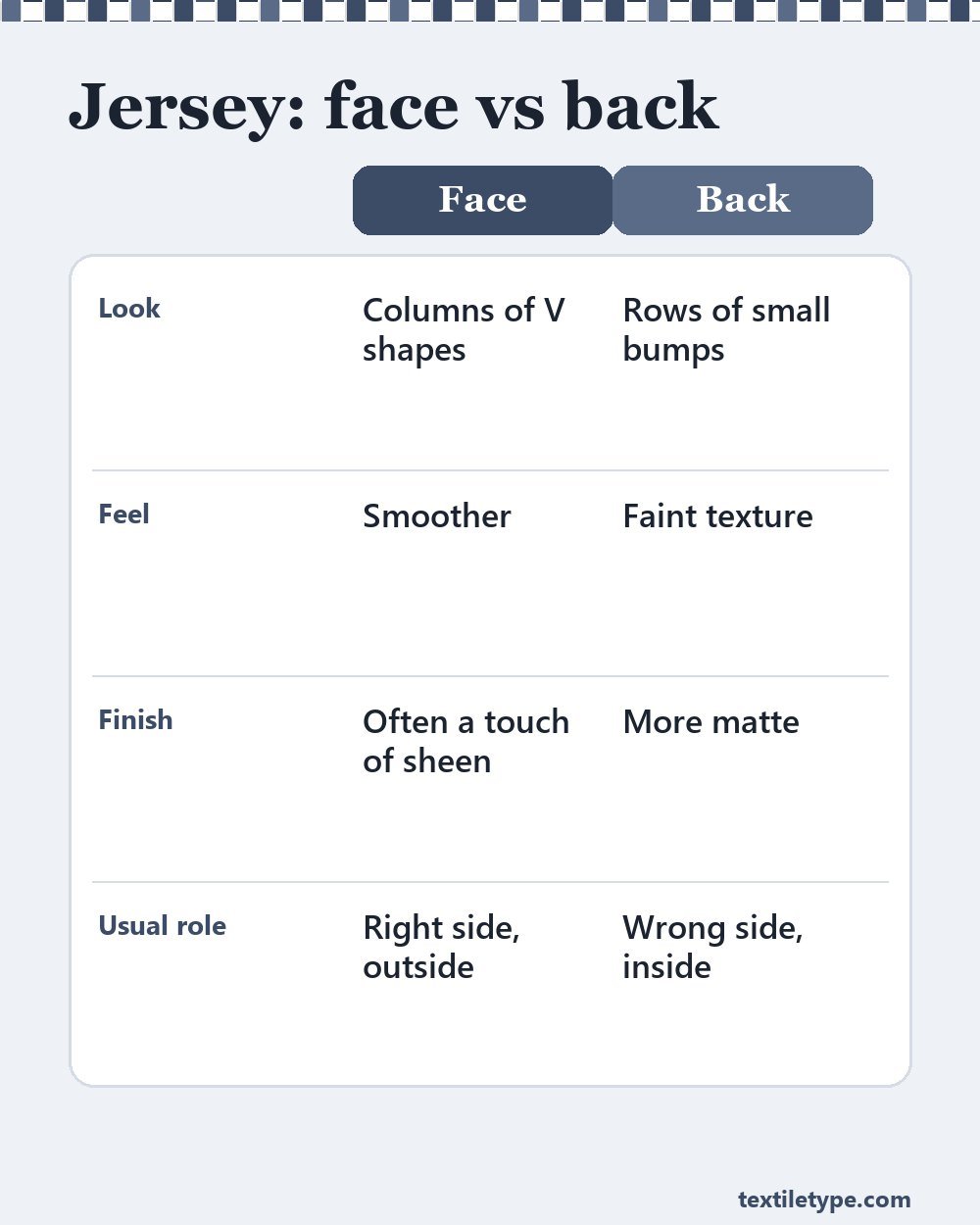
- Look for the Vs. The face shows vertical columns of small V shapes, a bit like rows of tiny braids. That is usually the right side.
- Look for the bumps. The back shows horizontal rows of little loops. It reads flatter and more matte.
- Run a fingertip over both. The face usually feels smoother. The back has a faint texture.
- Stretch a cut edge. Single jersey edges roll, but the direction differs between the lengthwise and crosswise edges, so treat curl as a backup clue rather than proof.
- No difference at all? If both sides show Vs and nothing curls, you are probably holding interlock or another double knit, which has no technical face or back.
Why it is called jersey
The fabric takes its name from Jersey, the island off the coast of Normandy that belongs to the Channel Islands. Knitted cloth from the island was used for fishermen’s clothing, and the knitted pullovers sailors wore became known as jerseys too. Early jersey was a practical, warm, working fabric, not a fashion statement.
That changed in two steps. In 1879 the actress Lillie Langtry, nicknamed “the Jersey Lily,” made jersey fashionable for daywear by wearing a hip-length jersey top over a pleated skirt. Then Gabrielle “Coco” Chanel picked it up. The Metropolitan Museum of Art notes that she promoted jersey fabrics in 1916, at a time when jersey was mostly used for men’s underwear, and that she bought it largely because it was cheap. Few fabrics have gone from underwear drawer to couture salon quite so fast.
Types of jersey knit and the fibers behind them
“Jersey” describes the knit, not the fiber. The same loop structure can be made from almost anything that spins into yarn, and the fiber changes the feel far more than most people expect. The table below covers what you will see on fabric store labels and clothing tags. Behaviors are general tendencies; yarn, weight and finish shift real results.
| Type | What it is | How it tends to behave | Common uses |
|---|---|---|---|
| Single jersey | One layer of plain knit loops | Light, drapey, curls at cut edges | T-shirts, tops, linings |
| Double jersey (interlock) | Knitted on two needle beds; interlock links two rib structures | Thicker, same on both sides, curls little, less stretchy than rib | Firmer tops, dresses, loungewear |
| Cotton jersey | Jersey knitted from cotton yarn | Breathable, matte, can shrink if not preshrunk | Everyday tees, underwear, sleepwear |
| Viscose or rayon jersey | Jersey from regenerated cellulose fiber | Fluid drape, cool touch, needs gentle washing | Draped dresses, wrap tops |
| Polyester jersey | Jersey from synthetic filament or spun yarn | Holds color and shape, dries fast, less breathable | Activewear, printed dresses, sports shirts |
| Wool jersey | Jersey knitted from fine wool | Warm, springy, resists wrinkles | Base layers, knit dresses |
| Spandex blends | Any of the above with a small share of elastane | Better snap-back after stretching | Leggings, fitted tees, swimwear |
If you want the fiber details, our guides to viscose and polyester explain how those fibers are made and why they feel so different from cotton.
Cotton jersey and the shrinkage question
Cotton jersey is the classic T-shirt fabric, and it is also the jersey most likely to surprise you in the laundry. Cotton Incorporated’s technical guide on shrinkage says cotton fabrics are often prone to dimensional change, especially knits, which are very sensitive to the forces applied during processing. The same guide points out that woven fabrics are much more stable than knitted ones.
Here is what that means in plain words. During dyeing and finishing, long lengths of knit fabric get pulled and stretched. The loops hold that stretched shape until water and heat let them relax, and then they spring back toward their natural shape. Cotton Inc. describes it directly: forces that stretch fabric during processing lead to more shrinkage later. Mills fight this with relaxation dryers and compacting machines, which is what a “preshrunk” label is getting at. Preshrunk usually means less shrinkage, not none.
Cotton jersey for tees is often sold by weight. Two well-known blanks show the spread. Gildan’s spec sheet for its Heavy Cotton 5000 tee lists 180 grams per square meter (170 for white), and the Bella+Canvas 3001 is listed at 4.2 ounces per square yard, about 142 grams per square meter. The heavier shirt feels more substantial and is less see-through. The lighter one drapes more and is cooler in summer.

Pros and cons of jersey
Jersey earns its place in every closet, but it is not the right fabric for every job. Here is the honest tally.
Where jersey shines
- Stretch and comfort without needing elastic fiber, thanks to the loops.
- Soft drape that follows the body instead of standing away from it.
- Fewer wrinkles than crisp wovens such as poplin, in most fibers.
- Quick and cheap to produce, which keeps basics affordable.
- Breathable in cotton, viscose and wool versions.
Where it struggles
- Cut edges curl, which makes cutting and sewing fussier.
- A snag can turn into a run.
- Cotton jersey can shrink and twist, especially in a hot dryer.
- Light jersey shows every lump underneath and can turn sheer when stretched.
- It does not hold a crisp shape. For a tailored look, a woven or a firm double knit works better than single jersey, and for sheer floaty layers a woven like chiffon behaves very differently.
Sewing jersey knit without wavy seams
Jersey has a reputation for being tricky, mostly because people sew it like a woven. Change four habits and it behaves.
- Prewash the fabric the way you plan to wash the finished garment, so any shrinking happens before you cut.
- Cut with the wales. Line the pattern’s grainline up with the vertical columns of Vs. Off-grain pieces twist after washing.
- Switch to a ballpoint needle. The needle maker Schmetz says its light ball point pushes knitted threads aside instead of damaging them, and flags it as particularly suitable for jersey. Home-sewing packs are usually labeled “jersey” or “ballpoint.”
- Use a stitch that stretches. A narrow zigzag or your machine’s stretch stitch works; a serger or overlocker is handy but optional.
- Let the feed dogs do the work. Pulling the fabric through the machine stretches the seam and leaves it wavy.
- Stabilize seams that should not grow. Shoulder seams often get clear elastic or stay tape so they do not stretch out over time.
A sewing tutorial focused on jersey knit, handy to watch before your first T-shirt project.
Washing and drying jersey
Jersey care depends on the fiber first, so the care label always wins. Still, the knit structure brings a few rules of its own. Heat relaxes loops, which drives shrinking in cotton, and gravity pulls on wet loops, which drags shoulders and hems out of shape.

- Wash cool and inside out. Turning garments inside out cuts down on surface abrasion and pilling on the face.
- Go easy on the dryer. Low heat, or pull pieces out slightly damp. Cotton jersey shrinks most in the last hot minutes of a long cycle.
- Dry heavy pieces flat. A wet jersey dress on a hanger will stretch toward the floor.
- Fold, do not hang, for storage. Folding stops shoulder bumps and slow stretching on knit dresses and sweaters.
- Iron on the back. If you need to press, use a low setting on the wrong side to avoid shine on the face.
Jersey fabric FAQ
Is jersey fabric stretchy?
Yes. The interlocking loops can open and close, so jersey stretches even with no spandex, and it stretches more across the width than along the length. Adding spandex mainly improves how well it springs back.
Is jersey the same as cotton?
No. Jersey is a knit structure, and cotton is a fiber. Cotton jersey is very common, but jersey also comes in viscose, polyester, wool, silk and blends.
Does jersey fabric shrink?
Cotton jersey often shrinks a little, mainly in length, because knits relax after being stretched in processing. Preshrunk fabric and low dryer heat keep it small, while polyester jersey barely shrinks at all.
What is the difference between jersey and interlock?
Single jersey is knitted on one needle bed and has a distinct face and back. Interlock is a double knit made on two needle beds, so it looks the same on both sides, is thicker, and hardly curls.
Browse more fabrics and fibers in our fabric guides.