Yes, linen can shrink, and the first wash is when it usually happens. Does linen shrink every time you wash it? No. Most of the change comes early, it comes mainly from heat and agitation, and how much you get depends on whether the cloth was washed at the mill before it reached you.
Below you will find what actually causes the shrinkage, rough amounts to expect for different kinds of linen, a routine for how to keep linen from shrinking, a simple swatch test for sewists, and what you can (and cannot) do once a favorite shirt has already lost an inch.
Linen shrinkage at a glance
- Does it shrink?
- Often, mostly in the first wash or two
- Biggest culprits
- Hot dryer, hot water, hard agitation and spin
- Highest risk
- Unwashed linen yardage and untreated garments
- Lower risk
- Pre-washed, stonewashed or “garment-washed” linen
- Prevention
- Cool gentle wash, low spin, air dry or low heat, pull out damp
- Can you undo it?
- Only partly, by easing it out while damp
On this page
Does linen shrink? The short answer
Linen shrinks when water, heat and tumbling let its yarns relax and pull in. A crisp new pair of linen trousers washed hot and blasted in the dryer can come out noticeably shorter. The same trousers washed cool and hung to dry will usually change very little.
The other half of the answer is history. Linen that was already washed or tumbled at the mill (sold as washed, stonewashed, garment-washed or “softened” linen) has done much of its shrinking before you bought it. Raw yardage from a fabric store has done none.
If you want the fiber basics behind all this, our explainer on what linen fabric is covers flax, weaving and the rest.
Why linen shrinks
There are two forces at work, and only one of them is about the fiber.
Relaxation shrinkage (the big one)
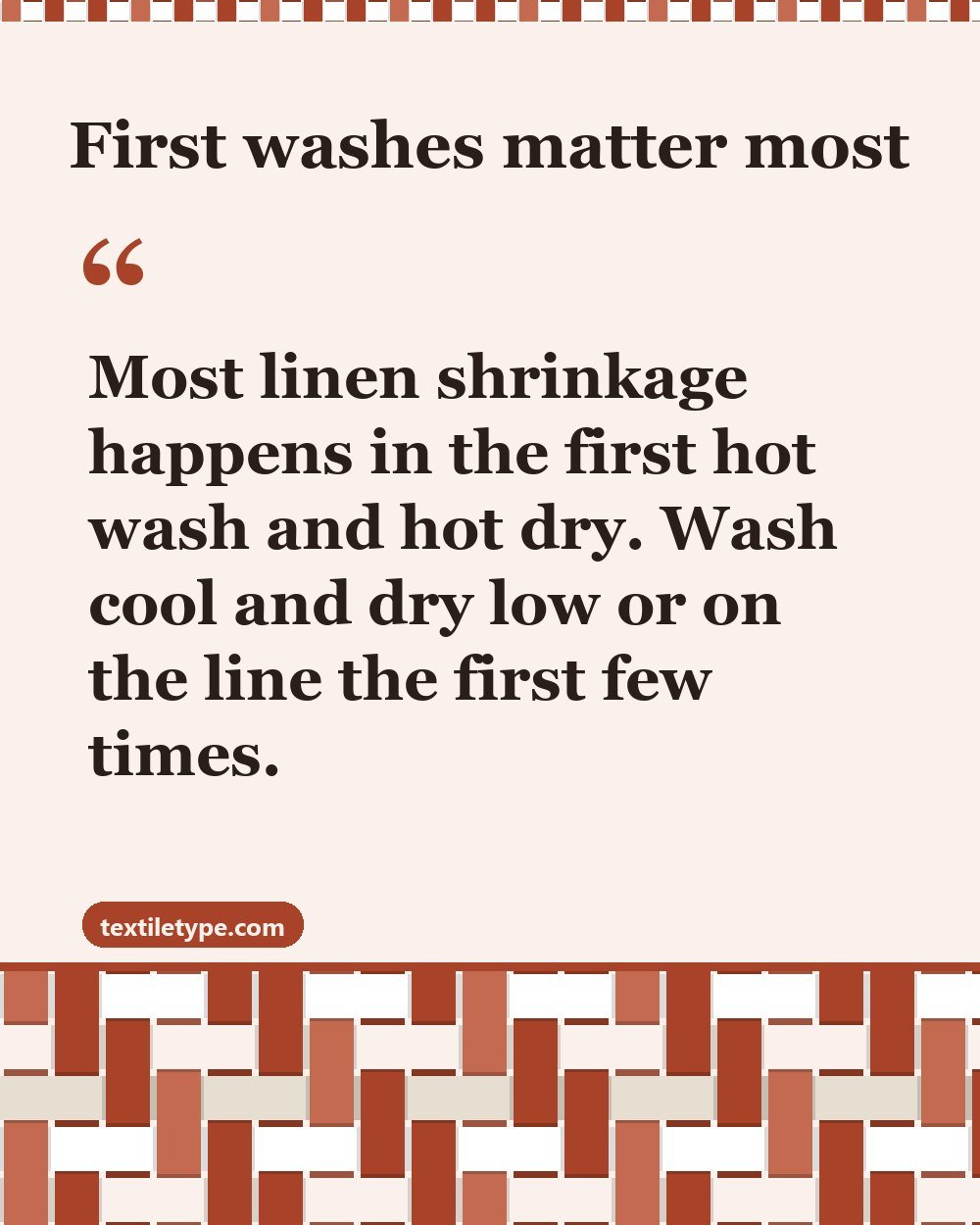
During weaving and finishing, yarns are held under tension, especially lengthwise along the warp (the threads that run the length of the cloth). Finishing can set the cloth in that stretched state. The first time it gets thoroughly wet, warm and agitated, that stored tension lets go: yarns crimp back up as they relax, and the fabric gets shorter and sometimes narrower. Textile people call this relaxation shrinkage, and it is mostly a one-time event concentrated in the first few washes.
Heat and tumbling
A hot dryer adds a second push. Tumbling a damp fabric packs its yarns closer together, and heat speeds things up. The European flax-linen industry’s own care guidance singles out excessive dryer heat as a cause of shrinkage and recommends a low, gentle program with linen removed while still slightly damp.
Linen also has very little stretch. Once yarns have pulled in, the cloth does not spring back on its own the way a knit or a stretch blend might, which is why prevention beats rescue.
How much shrinkage to expect
No single number fits every linen. Weight, weave, finish and how you wash it all change the result, and Canvas Etc., a linen fabric supplier, says plainly that no one shrinkage percentage applies to all linen. Estimates from linen sellers commonly run from around 3 percent up to about 10 percent for unwashed fabric. One large online linen retailer notes that most of its linen yardage is sold without pre-washing and treats about 10 percent as standard. On a 30-inch inseam, 10 percent is three inches, which is why this matters.
| What you have | Shrinkage risk | What to do |
|---|---|---|
| Unwashed linen yardage | Highest; can be several percent or more | Prewash the way you will wash the finished piece |
| New linen garment, crisp, not described as washed | Moderate to high on first wash | Cool gentle wash, air dry the first few times |
| Washed, stonewashed or garment-washed linen | Low, though rarely zero | Normal gentle care; avoid hot dryer |
| Linen/cotton blend | Similar to the dominant fiber | Treat like untreated cotton if unwashed |
| Linen/viscose blend | Can be higher; viscose dislikes heat and agitation | Cool wash, gentle spin, no hot dryer |
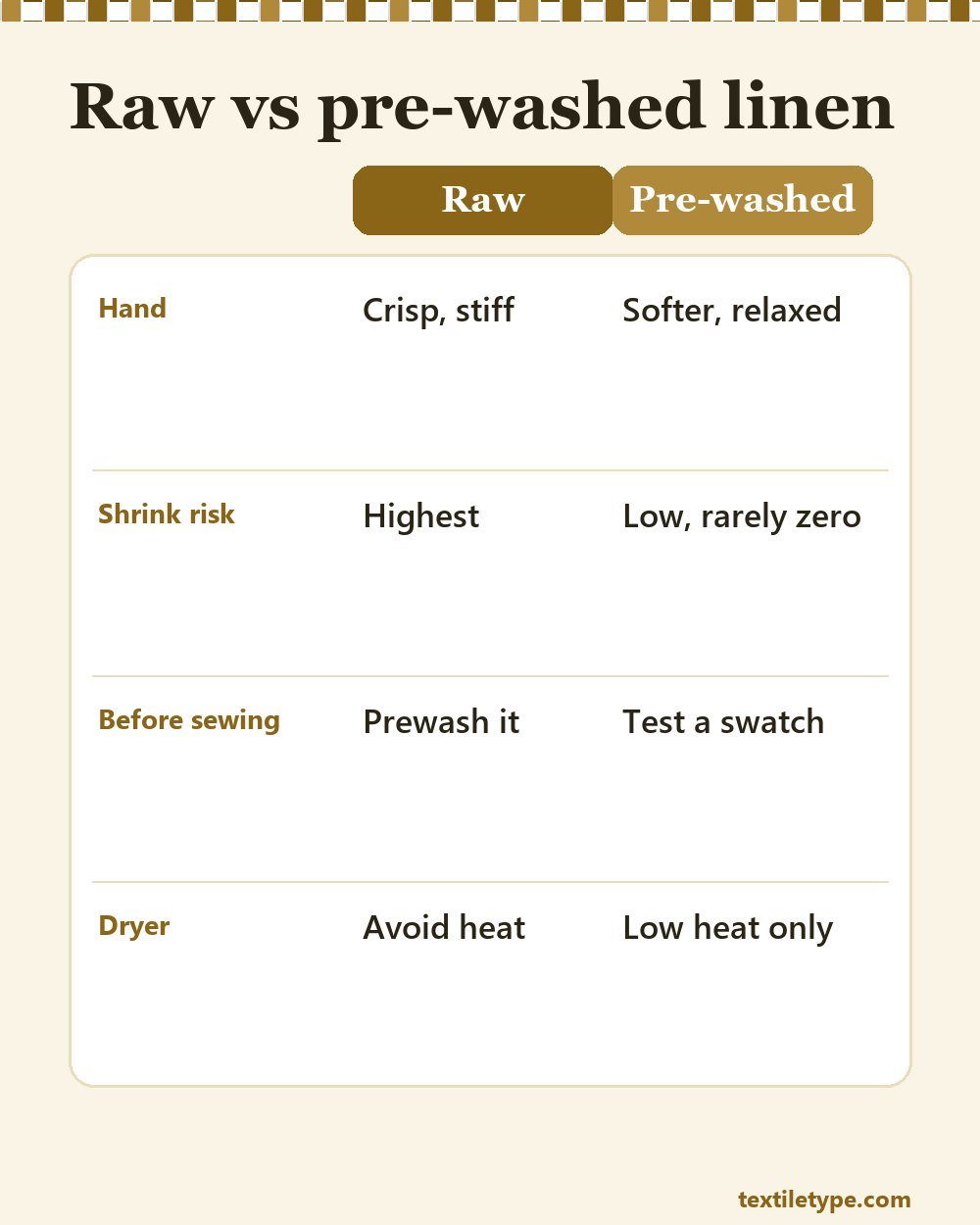
Blends follow their partner fiber. If viscose is in the mix, read up on what viscose fabric is, since that rayon tends to be the more delicate half. And if you are choosing between the two classic summer fibers, our linen vs cotton comparison covers how each one wears and washes.
How to keep linen from shrinking
This routine keeps shrinkage small on most linen. It follows the care advice published by the Alliance for European Flax-Linen and Hemp, and the garment’s own label always wins.
- Read the label first. If it says dry clean (common for lined linen jackets), believe it.
- Wash cool on a gentle cycle. Around 30C (cold to cool on most US machines) is the safe default.
- Use a mild detergent without bleaching agents, and do not overload the drum so the cloth can move freely.
- Keep the spin low. Hard spinning and wringing crush creases in and stress the fibers.
- Air dry when you can, out of direct sun. Shake the piece out and smooth seams and hems by hand.
- If you use the dryer, choose low heat and a gentle program, and pull linen out while it is still slightly damp.
- Iron while damp on a medium-high to high setting, which also lets you gently ease seams back to length.

Linen clothing brand Son de Flor covers washing, drying and storing linen, a handy visual run-through of the routine above.
Prewashing linen yardage before you sew
If you sew, prewash linen yardage before cutting. Otherwise the garment you fit so carefully will shrink after its first wash. The goal is to put the fabric through the harshest treatment the finished piece will ever see, so it does its shrinking now.
A 10-minute swatch test
For a big project, or when you are not sure how much yardage to buy, test a swatch first.
- Cut a square, for example 10 by 10 inches, and mark which edge runs lengthwise (the warp, parallel to the selvage).
- Wash and dry it exactly the way you plan to treat the finished item: same temperature, cycle and drying method.
- Press it flat without stretching and measure both directions again.
- Work out the percentage: (original minus new) divided by original, times 100. A 10-inch side that comes out at 9.5 inches has shrunk 5 percent.
- Add that percentage to your yardage, or simply prewash the whole length the same way before cutting.

Finish raw edges before prewashing a full length (a quick zigzag or serged edge), because linen frays readily in the machine. Heavier linens shrink and soften differently from light ones, so it is worth knowing the weight; our guide to GSM in fabric explains those numbers on fabric listings.
Little Seed Linen shows its pre-wash prep for linen yardage before sewing, which pairs well with the swatch test above.
Already shrunk? What you can try
Relaxed yarns rarely go all the way back, but you can sometimes win back a little length, especially at hems and sleeves.
- Re-wet the piece thoroughly in cool or lukewarm water so the yarns are pliable again.
- Press out excess water in a towel rather than wringing.
- Ease it to length by hand while damp, working along the shrunk direction, then lay it flat or hang it with light, even tension.
- Steam iron while damp, gently stretching seams and hems as you press.
Expect modest gains. Pulling hard on wet linen can distort the weave or pop stitching, and stiff flax yarns do not stretch much to begin with. If a garment came out a full size too small, a tailor letting out a hem or seam allowance may be the better fix.
Linen shrinkage myths
| Myth | Reality |
|---|---|
| Linen keeps shrinking every wash. | Most shrinkage comes in the first wash or two; after that, gentle care keeps it stable. |
| Washed linen cannot shrink. | Pre-washed linen shrinks less, but a hot dryer can still take a little more. |
| Cold water alone prevents shrinkage. | Water temperature helps, but dryer heat and hard spinning matter at least as much. |
| Linen should be dry cleaned only. | Most linen is machine washable; dry cleaning is mainly for lined or structured pieces. |
| Shrunk linen can always be stretched back. | You can often recover a little, rarely all of it. |
Wondering how other fibers compare? Our guide to whether polyester shrinks covers the synthetic side of the closet, and the full fiber library sits in our fabric guides.
Linen shrinkage FAQ
Does 100% linen shrink in the dryer?
It can, and the dryer is the most common culprit. Use low heat on a gentle program and take linen out while slightly damp, or line dry instead.
Does linen shrink in cold water?
Usually only a little. Cool water reduces shrinkage, but unwashed linen can still relax somewhat on its first soak, especially if it is then dried hot.
Should I size up when buying linen clothes?
Not usually for washed or stonewashed linen. For crisp, unwashed linen trousers or dresses, check length allowances or plan to wash cool and air dry.
Do I need to prewash linen fabric before sewing?
Yes, in almost every case. Prewash it the same way you will wash the finished item so the shrinkage happens before you cut.